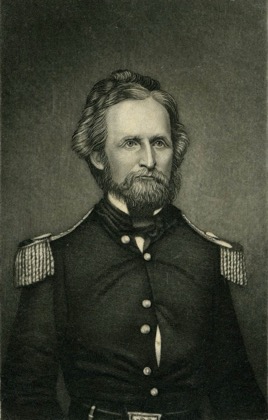
In the first summer of the Civil War, the fight that decided whether Missouri stayed in the United States was not fought by armies at all. It was fought in a St. Louis hotel, in the streets of that same city, and along the rivers and railroads that made Missouri worth fighting for in the first place. Missouri was a border state, a slaveholding state that had not joined the Confederacy and that Abraham Lincoln could not afford to let go. It sat on top of the Union like a keystone. Lose it, and the rebellion would push hundreds of miles north and put its hands on the Mississippi and Missouri rivers, the great water highways into the heart of the country. The man who refused to let that happen was a short, red-bearded, perpetually furious Regular Army officer named Brigadier General Nathaniel Lyon (North), and the way he refused was to start a war before anyone gave him permission to.
A keystone Lincoln could not lose
Missouri was a slave state that stayed in the Union, and it was the biggest prize of them all. It bordered the free states of Illinois and Iowa to the north, putting Confederate sympathizers within reach of the North's doorstep. More important than the borders were the rivers. The Missouri and the Mississippi ran through or past the state, and rivers in 1861 were how you moved armies and supplies in bulk; whoever held them held the ability to push troops deep into enemy country. Add the rail lines knitting the state together, and Missouri was a logistics jackpot. By the end of the war it would send roughly 40,000 men to the Confederacy and about 60,000 to the Union, a state split down the middle over whether to take Missouri into the Confederacy and keep slavery safe there, which is exactly why both sides fought so hard and so dirty to control it.
The Confederate States of America that the secessionists wanted to join was a government whose constitution explicitly protected slavery, and whose own vice president, Alexander Stephens, had declared just weeks earlier that slavery and the subordination of Black people were the literal "cornerstone" of the new nation. When Missouri's secessionist leaders fought to deliver the state to that confederacy, they were fighting to keep Missouri a slave state inside a slaveholders' republic.
The trouble was the man in the governor's chair. Claiborne Fox Jackson (South) had Confederate sympathies and a problem: in March 1861, a Missouri state convention (a special elected body called to decide the question) had voted against secession (secession being a state's formal break from the United States altogether). The people of Missouri, formally, wanted to stay. Jackson did not let that stop him. He set about reorganizing the state militia and using it to menace the one thing the Union most needed to protect, the St. Louis Arsenal, a federal weapons depot (an arsenal being a government storehouse stuffed with guns, powder, and cannon) holding enough arms to outfit an army. Whoever grabbed the arsenal could arm Missouri. Jackson wanted it for the South. The Army had sent Lyon to St. Louis back in January for the express purpose of keeping it out of his hands.
St. Louis
In early May 1861, Lyon, at that point still only a captain, learned that pro-secession state militia were drilling at a camp outside St. Louis, a place they had named Camp Jackson after the governor. Worse, the camp had taken delivery of four cannon that Confederates had seized from the federal arsenal at Baton Rouge, Louisiana. To Lyon this was the South arming itself on Union soil. He is said to have scouted the camp personally while disguised as an old blind woman riding through it in a carriage, veiled and in skirts, taking a slow careful count of captured Confederate guns while the militiamen never gave him a second look. The sources hand the disguise story down with the caveat that it may be too good to be true. On May 10, 1861, he surrounded Camp Jackson with 6,500 troops and forced its 700-man garrison to surrender without a shot fired.
The shooting came afterward, and it came in the streets. As Lyon's men marched the captured militiamen back through St. Louis, hostile crowds gathered along the route, jeering and pressing in. A drunk man fired into the Union ranks and mortally wounded a soldier, and Lyon's troops opened fire on the crowd. When it was over, at least 28 civilians were dead and close to a hundred wounded, with more violence and six more deaths spilling into the next day.
The violence did exactly what Jackson needed it to do. Up to that morning, most Missourians had wanted no part of the war; they had voted, through their convention, to stay neutral. Lyon's armed seizure of the camp and the dead in the St. Louis streets handed the secessionists a grievance, and thousands of previously neutral Missourians (men who had opposed leaving the Union so long as nobody coerced the South or touched slavery) now had a reason to hate the federal army instead. Camp Jackson gave the Confederate cause in Missouri more recruits than a dozen speeches would have. A rattled legislature handed Governor Jackson near-dictatorial powers, and Jackson handed the reorganized Missouri State Guard, the South's homegrown Missouri army raised expressly to override the convention's vote and force the state into the Confederacy, to a veteran of the 1846 war with Mexico and former governor named Major General Sterling Price (South).
A peace meeting in a hotel
A month later, on June 11, 1861, the two sides sat down to talk it out at the Planter's House Hotel in St. Louis. Governor Jackson and General Price came for the secessionist side; Lyon, now promoted to brigadier general, came with his political partner, the congressman Frank Blair Jr. (North). They talked for four or five hours. Jackson's offer was a kind of armed truce: both sides would disarm, and Missouri would stay neutral, taking no part in the war. Lyon would not have it. In Lyon's reading, accepting neutrality meant treating Missouri's government as an equal party negotiating with the United States over whether the two would be at war, and a state government that could bargain with the federal government as an equal had already won the very argument the South was making. That was the one thing Lyon would never grant.
So he ended the meeting by declaring war. The exact words he used have come down to us in two different versions, both written years later by men who took opposite sides, and no document from the day itself records what he actually said. One version, from a Confederate aide writing in 1886, has Lyon vowing he would rather see every man, woman, and child in Missouri "dead and buried" than concede the smallest point to the state, and finishing with the line history remembers: "This means war." A Union version from 1866 phrases it differently. The flourish is contested; the substance is not. Lyon stood up, told Jackson and Price they were now enemies, and sent them out the door.
And then he walked out of that hotel, a brigadier general not three weeks in the rank, having just declared, on no authority but his own, that his country was at war with the government of one of its own states. Washington had not decided it. Lincoln had not ordered it. Lyon had decided it, in a hotel parlor, and walked out into the street with the decision made. Jackson and Price took him at his word, and on their way out of the capital, Jackson's men burned the Osage River railroad bridge behind them.
"Rather than concede to the state of Missouri the right to dictate to my government in any matter however unimportant, I would see you, and you, and you, and you, and you, and every man, woman, and child in the state dead and buried. This means war." As remembered by a Confederate aide writing in 1886; the exact wording is disputed, but the ultimatum was real.
Run them into the corner
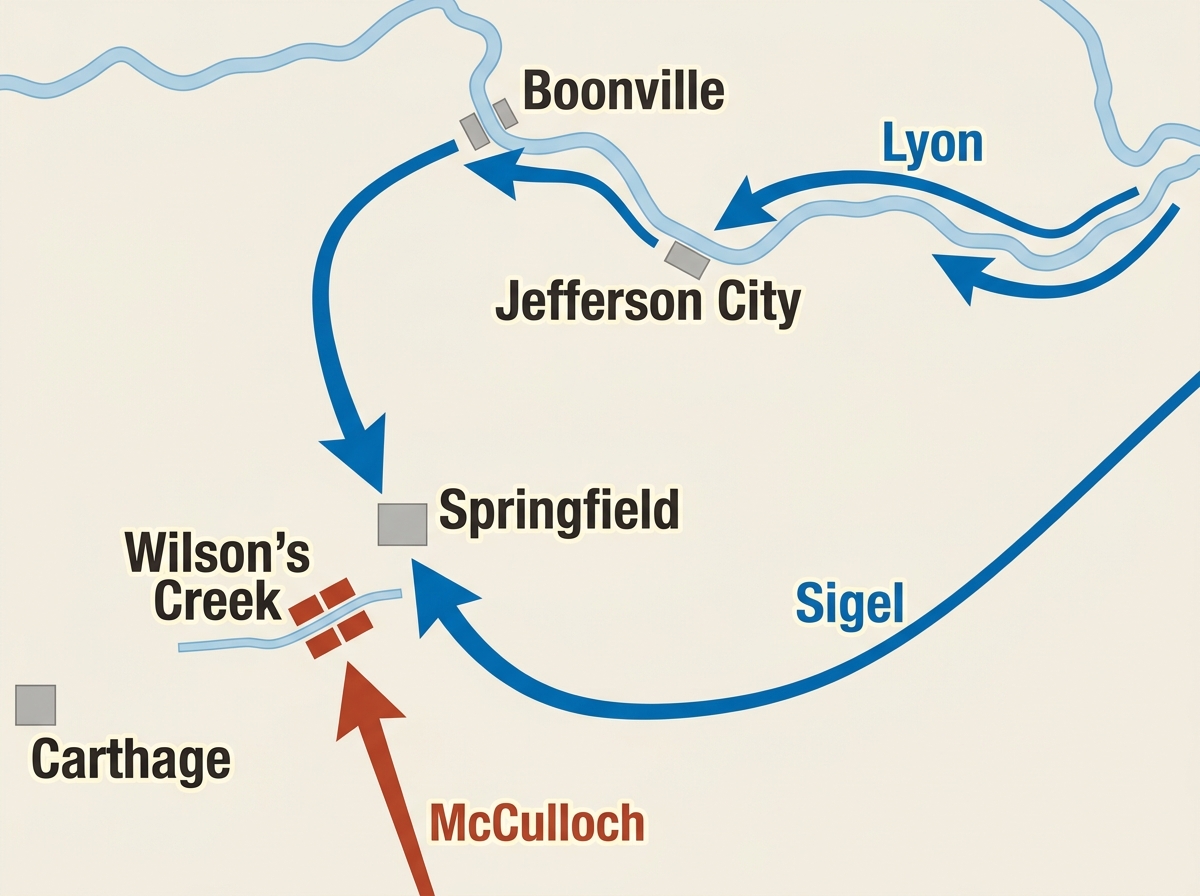
What followed was Lyon doing the thing he did best: moving fast and hitting hard. He loaded troops onto steamboats and ran them about 145 miles up the Missouri River to seize Jefferson City, the state capital, locking it down for the Union. Then he chased and scattered Jackson's forces at Boonville on June 17, running a sitting governor and his armed followers, the men who claimed to be the rightful government of Missouri, clean off the capital ground of the state they claimed to govern. He also sent a column under Colonel Franz Sigel (North) by rail to the railhead at Rolla to cut off the retreating secessionists, though Sigel ran into a larger force and got bloodied in a fighting retreat at Carthage on July 5, an early taste of what his impetuousness would cost him six weeks later. Through it all, Lyon kept pushing the secessionist government into the far southwestern corner of Missouri. By mid-July he had roughly 7,000 men gathered at Springfield, in the Ozark hill country, and he had effectively chased Missouri's rebel government out of Missouri proper.
Attack, or admit you've lost
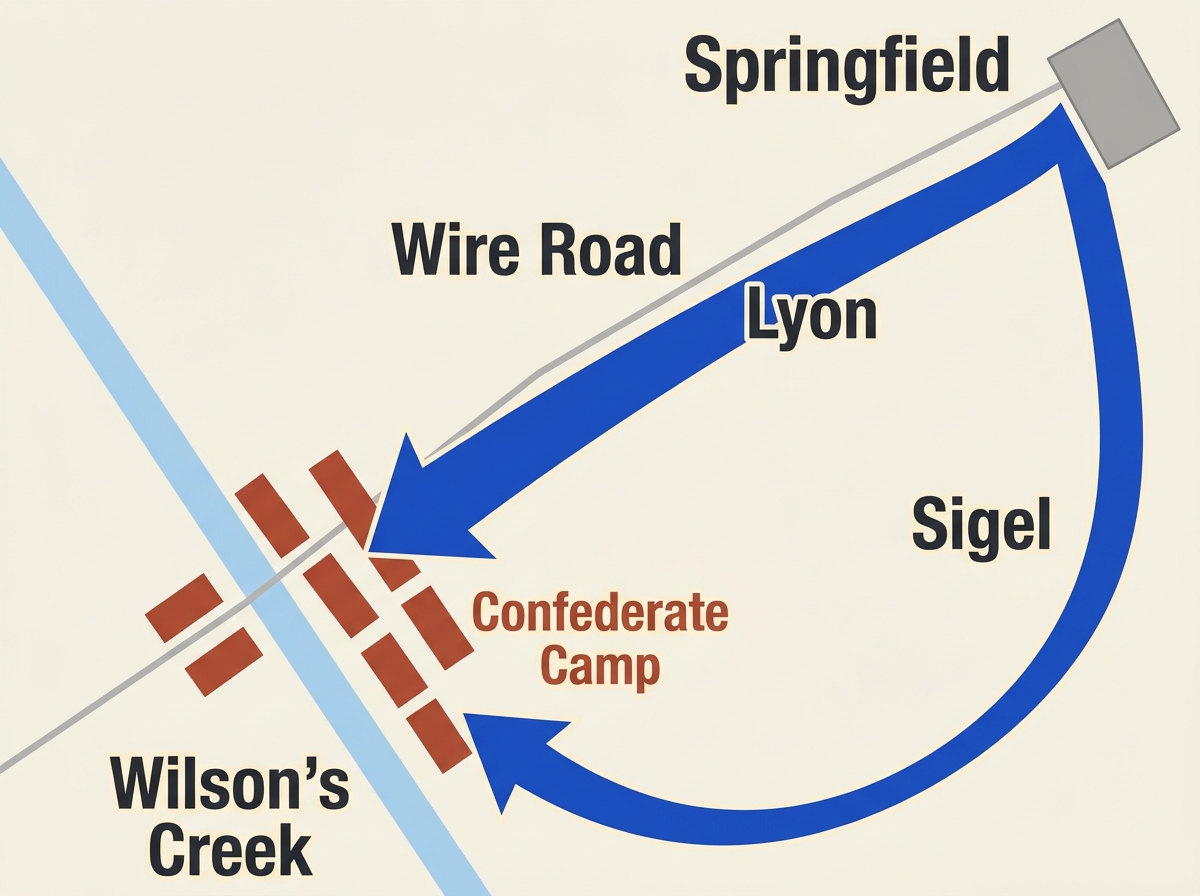
Then the math caught up with him. While Lyon chased, the South gathered. Price's Missouri State Guard joined with about 5,000 Confederate and Arkansas troops marching up from northwestern Arkansas under Brigadier General Benjamin McCulloch (South), the first Confederate move onto Union ground west of the Mississippi. Combined, they became the Western Army, somewhere around 12,000 strong, and they planted themselves about 10 miles (16 km) southwest of Springfield along a creek called Wilson's Creek. Lyon now faced a force roughly twice his size. His supplies had dwindled to half and quarter rations. His short-term volunteers (men who had signed on for ninety days) were weeks from the end of their enlistments and entitled to go home. And his own superior, the general commanding the whole western region, Major General John C. Frémont (North), refused to send him reinforcements and told him to retreat.
Retreat meant abandoning Springfield, and abandoning Springfield meant abandoning everything Lyon had spent the summer seizing, handing southwestern Missouri back to the men he'd just chased out of it. Lyon would not do it. He decided instead to do the most aggressive thing a heavily outnumbered general can do: he would attack the bigger army first, to hurt it badly enough that he could withdraw in safety, or, if it broke, break it for good.