On the morning of Sunday, March 19, 1865, Major General Henry W. Slocum’s (North) Left Wing came up the Goldsboro Road expecting to brush aside a little cavalry. Instead they ran into a dug-in line that would not move. Brigadier General William P. Carlin’s (North) division of the Fourteenth Corps deployed and pushed forward against what the men assumed were more of Wade Hampton’s (South) horsemen, and found infantry, artillery, and earthworks. For a few hours the two sides skirmished while Slocum slowly, reluctantly, came around to the truth: this was not a rear guard. This was Joseph E. Johnston’s (South) whole army, and it was waiting for him.
At about a quarter to three in the afternoon, Johnston sprang the trap. The assault was led on the field by Lieutenant General William J. Hardee (South), a respected old soldier who had literally written the army’s infantry tactics manual before the war. His men came out of the woods in a long sweeping line and fell on Carlin’s exposed division. A Union soldier remembered that the Confederates came down on them like an avalanche. Carlin’s line, poorly placed and caught in the open, broke almost at once. Men were shot down as they scrambled out of a ravine; a Union battery lost three of its four guns. The head of Slocum’s column was coming apart.
The Confederate attack had real weight behind it. The remnant of the Army of Tennessee, the men who had survived Franklin and Nashville, went in alongside Major General Robert F. Hoke’s (South) division, and for a stretch of the afternoon they rolled the Union left back through the woods and fields. Old soldiers on the Confederate side said afterward it was the last time the western army charged like the army it had once been. For an hour or two on that one road, the dying Confederacy looked, briefly, like it might win something.
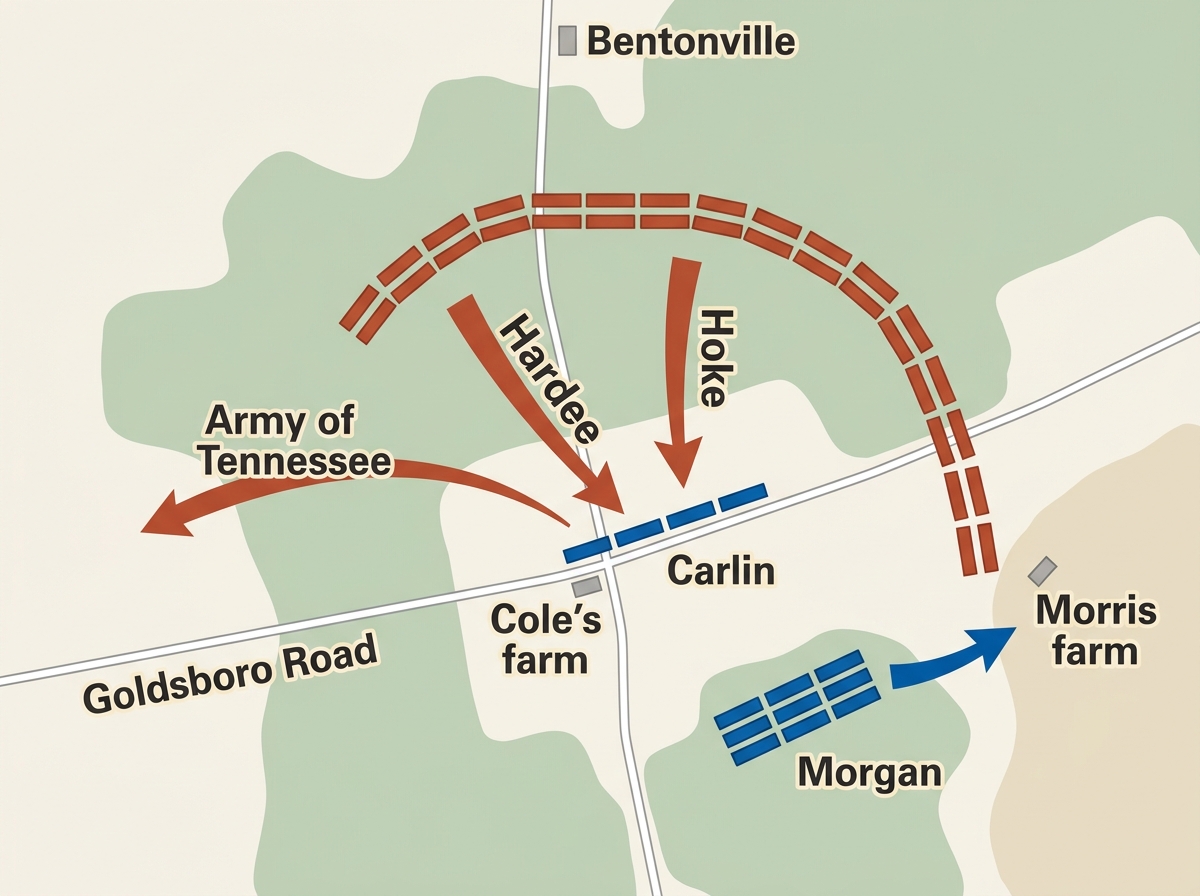
Morgan’s division will not break
What stopped it was a single Union division that refused to come apart. To the south of the broken line, the division of Brigadier General James D. Morgan (North) held a patch of woods and threw back charge after charge, even as Confederate troops worked around behind it and very nearly surrounded it. Morgan’s men fought in two directions at once, front and rear, and would not give way. Their stand bought the time the rest of the wing needed to pull itself together on higher ground around the Morris farm, where Union batteries massed and the fighting went hand to hand.
A Union private caught the feel of that late afternoon, when it seemed as though all was lost and the rebellious hosts came pressing on. But the line on the high ground held. Fresh brigades from the Twentieth Corps came up at the run, the massed artillery tore the front of each Confederate wave to pieces, and as the light failed the attacks faltered. A correspondent watching the guns wrote that the smoke settled down over them as it grew dark, and the flashes seen through it seemed like a steady, burning fire. By full night Johnston’s men had spent their strength and pulled back to where they had started. The hardest single afternoon of fighting in North Carolina’s history was over, and the Union line, though badly mauled, was unbroken.