March 20 belonged to arithmetic. Through the morning, Major General Oliver O. Howard’s (North) Right Wing swung north toward the fighting, marching to close the gap that had nearly cost Sherman a wing the day before. By midday Howard’s columns were filing onto the field on Slocum’s right, and the brief window in which the Confederacy had outnumbered anything slammed shut. Sherman now had close to sixty thousand men on the ground against Joseph E. Johnston’s (South) twenty thousand, a margin of nearly three to one.
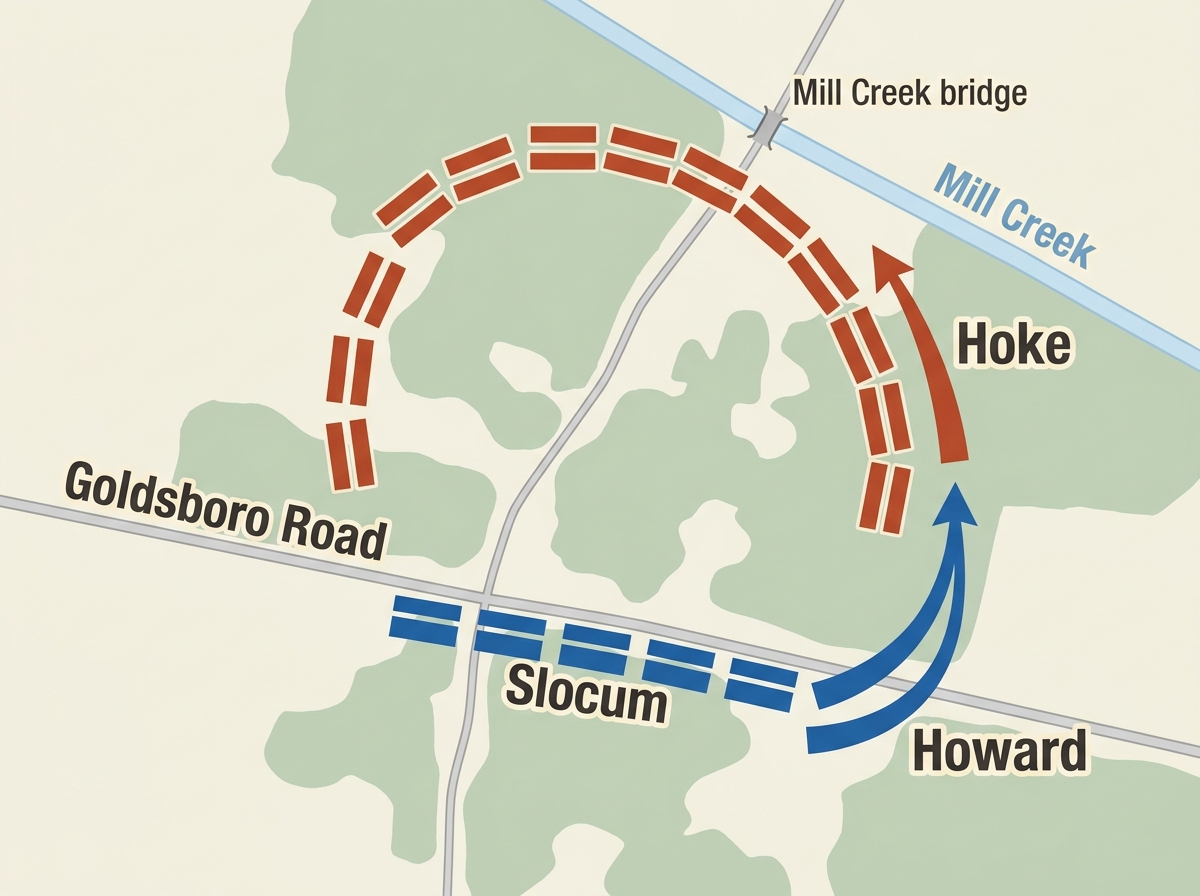
By every rule of war Johnston should have been gone already. He had made his attack, it had failed to break the wing, and now the rest of Sherman’s army was arriving to crush him against the only crossing at his back, the bridge over Mill Creek, the single road by which his whole army could escape. A defeated army does not linger a day’s march from a force three times its size with one bridge for a back door. Yet Johnston stayed. He stretched and bent his outnumbered line, pulling Major General Robert F. Hoke’s (South) division back to guard his flank, and held his ground through March 20 while heavy skirmishing rolled along the front.
His stated reason was that he could not yet get his wounded away, and there were many of them. But there was more to it. Johnston had spent the war being cautious, the general always accused of retreating, and Lee was counting on him to keep Sherman occupied. Lingering kept the threat alive a little longer. It was also a gambler holding his seat at a table he had already lost, unwilling to admit the hand was over. Sherman, for his part, did not want to throw his army headlong at entrenched men and pay in blood for a victory the calendar was about to hand him for free. So the two armies sat a few hundred yards apart in the rain, and the second day passed in skirmish fire while Johnston’s wounded were carried back across Mill Creek.
Eastern TheatrePetersburg: the siege that pinned Lee while Sherman ran loose