Bragg’s plan for September 20 was simple on paper and a disaster in execution. He would attack at dawn, rolling his assault from north to south, hitting one end of the Union line and letting the blow travel down it, unit folding into the next like a row of dominoes knocked sideways. His Right Wing under Lt. Gen. Leonidas Polk (South) would strike first against the Union left, then the blow would travel down the line. It did not happen at dawn. Polk’s attack went in hours late, around 9:30 in the morning, and when it finally hit, it struck Thomas’s fortified left at the Kelly Field log breastworks and made only limited headway. The Union left, the strong end, held.
Then came the mistake that decided the battle. Around mid-morning, Rosecrans was told, wrongly, that there was a hole in his line, a gap where one of his divisions ought to be. Acting on that bad information, he sent an order to Brig. Gen. Thomas J. Wood (North) to "close up on Reynolds as fast as possible, and support him," meaning shift your division north to plug the supposed hole. There was no hole. But the order was explicit, and Wood, who had been dressed down only that morning for not obeying an order quickly enough, obeyed this one to the letter. He pulled his entire division out of the line at the Brotherton field, in the center, and started it north.
In doing so he opened a real gap: a quarter-mile of the Union center, in the dense woods, now held by no one at all.
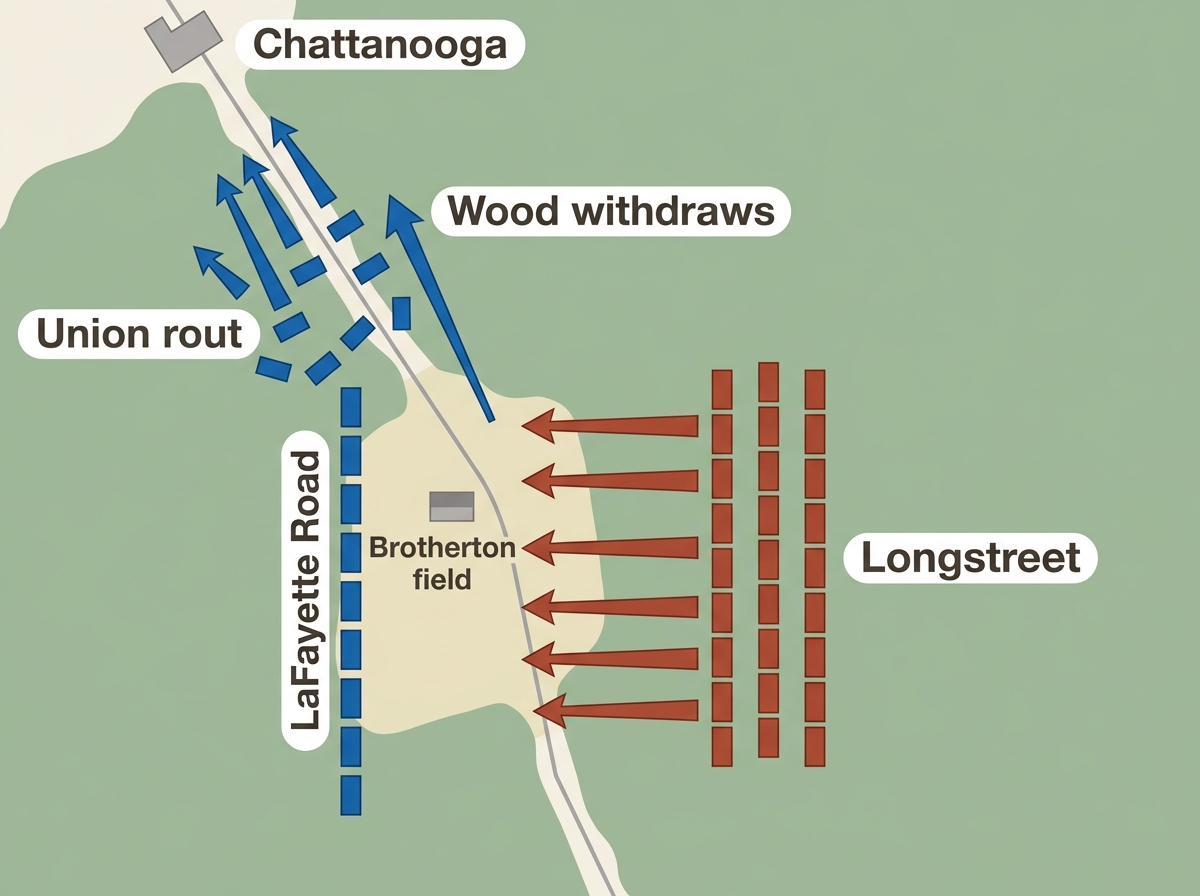
And at that exact moment, the hammer was already falling on that exact spot. Lt. Gen. James Longstreet (South), the wing commander who had brought his divisions all the way from Virginia, had massed an enormous assault column and aimed it at the Brotherton field: roughly eight brigades, thousands of men stacked several lines deep, a battering ram of infantry. At about 11:10 that morning the column surged forward, straight at the place Wood’s division had just vacated. There was no one there to stop it. The Confederates poured through the quarter-mile hole unopposed, and the dense timber that had blinded everyone all battle long meant the Union command did not even see the breakthrough until Longstreet’s men were already behind the line.
What followed was a rout. Longstreet’s column burst through the gap and rolled up the Union right and center, collapsing the line sideways, each unit folding into the one beside it as the attack swept along its length. Roughly half the Army of the Cumberland was swept clean off the field, and with it Rosecrans himself, along with his corps commanders Maj. Gen. Alexander McD. McCook (North) and Maj. Gen. Thomas L. Crittenden (North), and Rosecrans’s young chief of staff Brig. Gen. James A. Garfield (North), a future president of the United States. They went streaming north up the LaFayette Road toward Chattanooga in a single choking river of men, wagons, and dust, regiments dissolved into a crowd. Rosecrans, caught in the flood, rode all the way back to the city, convinced the battle was lost and his army with it.
A single mistaken order, obeyed exactly, opened a quarter-mile gap precisely where Longstreet’s column happened to strike. Half the army was routed off the field in minutes, and the commanding general rode away from his own battle believing it was already over. The Confederacy was a few hours from the most complete battlefield victory it would ever win in the West.