The second day opened in the dark with noise. Around 4:30 in the morning the Confederate artillery began a bombardment of the town, and out beyond the smoke the inner line of earthwork forts waited, short, close, packed with cannon, exactly the kind of fortified ground that eats an infantry charge. The hammer should have fallen at first light. It did not. Around seven o’clock Brigadier General Louis Hébert (South), slated to lead a key part of the assault, reported himself too ill to command, and Brigadier General Martin Green (South) had to take over his troops. The reshuffle cost the morning’s momentum, the second day in a row that Van Dorn’s timing slipped, and the infantry assault did not roll forward until around nine.
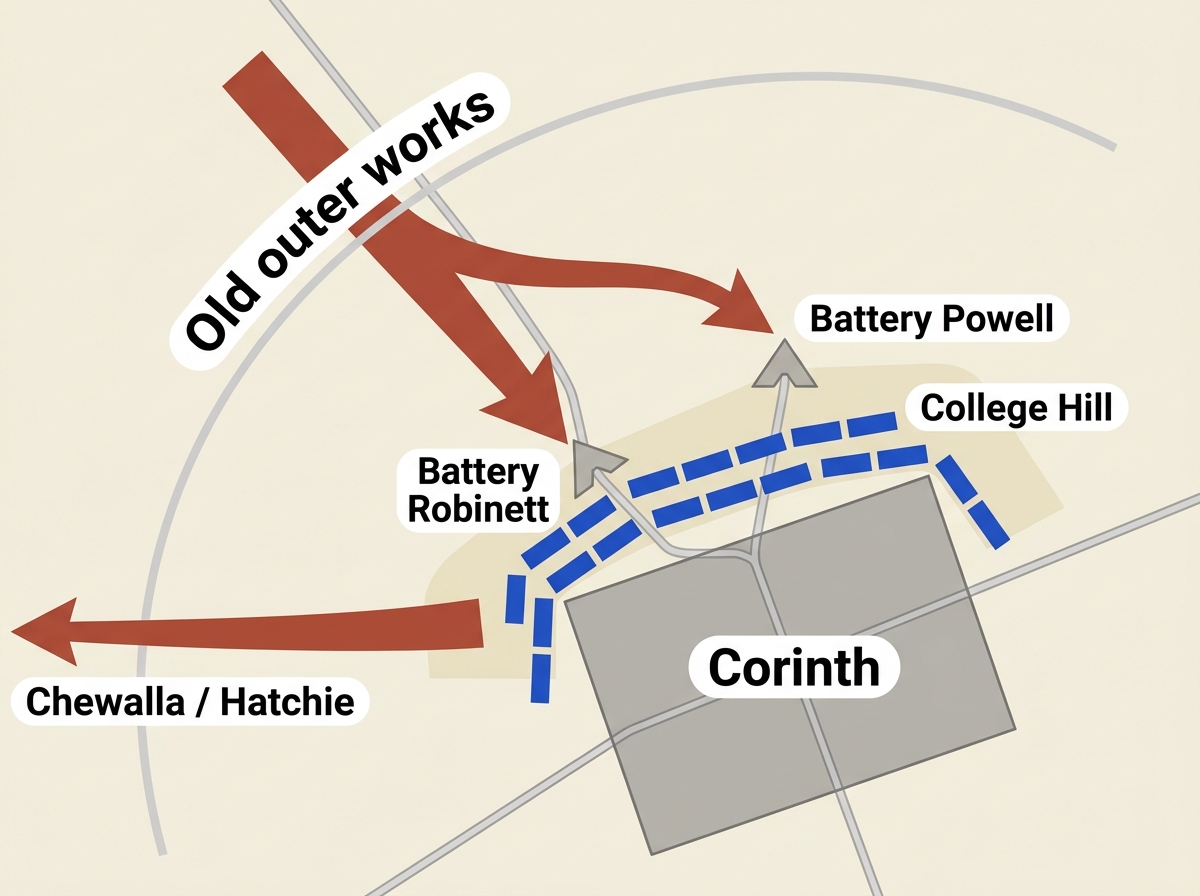
When it came, it came hardest at two places. To the north, Green’s (South) brigades drove in and took Battery Powell, the high-water mark of the whole Confederate effort, a captured Union fort and its guns in Confederate hands. It did not last. A Union counterattack drove the Confederates back out and recaptured the cannon. The deepest Confederate penetration of the inner line was retaken almost as fast as it was made.
The climax was a few hundred yards south, at Battery Robinett. Robinett was a redan (an arrowhead-shaped earthwork, its point aimed out at the enemy) sitting on the northwest face of the defenses, exactly astride the Chewalla Road the Confederates were coming down. It mounted three 20-pounder Parrott rifles (heavy rifled cannon, not the handheld kind), and a five-foot ditch ran across its front like a dry moat. Holding it was Colonel John W. Fuller’s Ohio Brigade (North), with the 11th Missouri close behind. Brigadier General Dabney Maury’s (South) division was sent straight at the redan, and at the head of the vanguard, on Maury’s order to lead the charge into the very front of the fort, rode Colonel William P. Rogers (South), commanding the 2nd Texas Infantry, a 42-year-old Texas lawyer brave to the edge of recklessness.
The Colors on the Parapet
The attackers came on into a terrific musket and artillery fire from the works, crossed the open killing ground, dropped into the five-foot ditch, and clawed up the parapet (the protective top wall of the earthwork), where the fight became hand-to-hand on the dirt rampart itself. Rogers got to the top. The regimental colors were in his hands, and for one moment the 2nd Texas’s flag stood on the crest of a Union fort. Then it ended. By the account in the Wikipedia entry on Rogers, “he had just climbed to the top of the parapet and planted the colors, when strong Federal forces were seen on the right, and then a volley of fire brought him down and nearly all the men with him.” That volley was the 11th Missouri coming up out of the fort with the bayonet, and their counter-charge is the act usually credited with breaking the assault at Robinett’s face. Colonel John Daly (South) of the 18th Arkansas was killed in the same rush. Just how Rogers was killed is genuinely disputed in the sources, whether by a volley of rifle fire or a charge of grapeshot or canister, and the popular tale of a specific number of bullets is not something the records support. Brigadier General Charles Phifer’s (South) brigade broke clean into the streets of Corinth itself, the Confederates in the town for a moment, before Union reserves under Brigadier General Jeremiah Sullivan (North) and the crossfire of the batteries drove them back out and routed them.
And then it was over, and what was left was the ditch. Maury pulled back what remained of his division, and the dry moat in front of Battery Robinett, the one the 2nd Texas had dropped into to make its rush, was left heaped with the men who had been alive and charging an hour before, piled where they fell along the foot of the dirt wall. A Northern photographer walked out to it the next morning and made one of the war’s most unflinching images: Confederate dead in front of Battery Robinett, layered in the ditch, the parapet rising empty behind them. The sources call Robinett “arguably the hottest action of the two-day battle.”
The Cost, and a Burial
By about one in the afternoon it was effectively finished. Around four o’clock, Brigadier General James B. McPherson’s (North) reinforcement column arrived from Jackson, too late to fight but in time to make Van Dorn’s position hopeless. Van Dorn ordered a general retreat. He had lost roughly twice what he inflicted. The Union loss came to about 2,520 men, killed, wounded, and missing, while the Confederate loss, genuinely contested in the records and somewhere in the range of 4,200 to 4,800, ran to about double that. It was the price of throwing infantry against fortified earthworks, paid in full at the ditch.
When the fighting was done, Major General William S. Rosecrans (North) ordered Rogers, an enemy colonel, buried where he fell, with full military honors, a tribute usually reserved for generals. An obelisk stands by Battery Robinett over his grave today.
“He was one of the bravest men that ever led a charge. Bury him with military honors and mark his grave so that his friends may claim him.”
William S. Rosecrans