A word on the term, since it runs through the next two days: “works” is the soldiers’ term for field fortifications, dug-in defensive lines, dirt thrown up into ramparts a charging man has to cross. Major General Earl Van Dorn (South) attacked the old works around ten in the morning on October 3, coming down out of the northwest along the Chewalla Road, the route that led toward town. Those old lines were the entrenchments Beauregard’s men had thrown up back in the spring, several miles north and northwest of the depot. They made a useful tripwire, but they ran too long a front for Major General William S. Rosecrans (North) to truly hold; the real defense lay closer in.
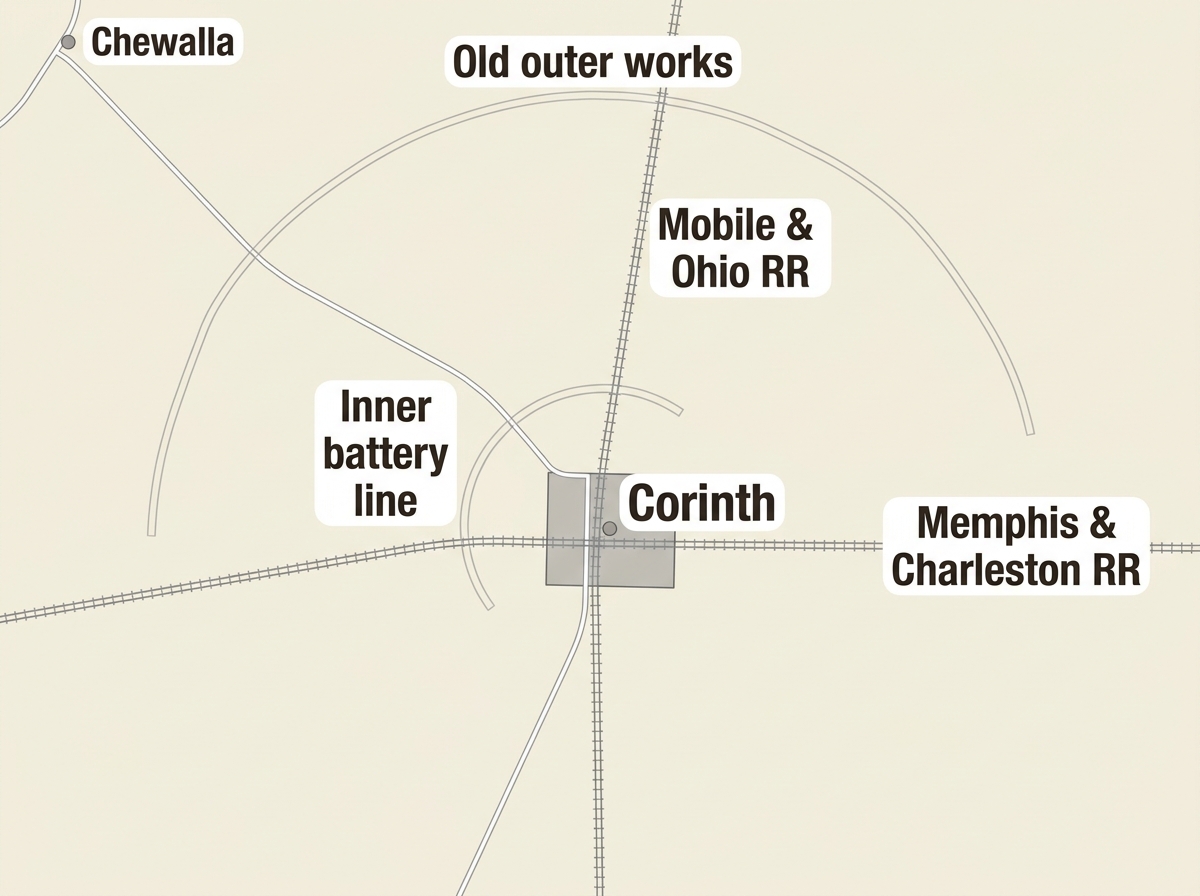
Rosecrans had his garrison sorted into the standard ladder of a Civil War army, regiments (a few hundred men each) grouped into brigades, brigades grouped into divisions. He pushed three of his divisions forward to meet the blow, each commander holding one stretch of the line, the left, the center, and the right, with a fourth division held back in reserve south of town. Van Dorn tried for a double envelopment, hitting both ends of the Union line at once to fold it inward. His own division under Major General Mansfield Lovell (South) came in against the Union left; Brigadier General Dabney Maury’s (South) division pressed the center, where Brigadier General Thomas Davies (North) held.
For most of the day it worked. Around 1:30 in the afternoon a gap tore open in the Union center, and a gap in a battle line is a doorway. The pressure on either side of it forced the whole Union line to peel back, falling away from the old outer works to within about half a mile of the inner defenses. The first day went to Van Dorn. He had pushed the Federals out of their forward line and driven them in on their last one.
It cost the Union army two of its generals in a single afternoon. Brigadier General Pleasant Hackleman (North) was killed, one of the relatively few Union generals to die in action in the entire war, and Brigadier General Richard Oglesby (North) was severely wounded, shot through the lungs (he survived). The Confederate momentum was real, and growing.
One Hour Short of Daylight
Then the daylight ran out. Late in the afternoon, around three o’clock, Brigadier General Charles Hamilton (North) was ordered to swing wide and flank the attacking Confederates. The order was garbled. As the account puts it, “through a misunderstanding of the order ... so much time was lost that it was sunset before the division was in position.” By the time anyone was ready to deliver the killing stroke, the daylight was gone. The Confederates had pushed the Federals to the edge of breaking and run out of day before they could finish it. Van Dorn later put his frustration into a single line, mourning the hour he did not have:
“One hour more of daylight and victory would have soothed our grief.”
Earl Van Dorn