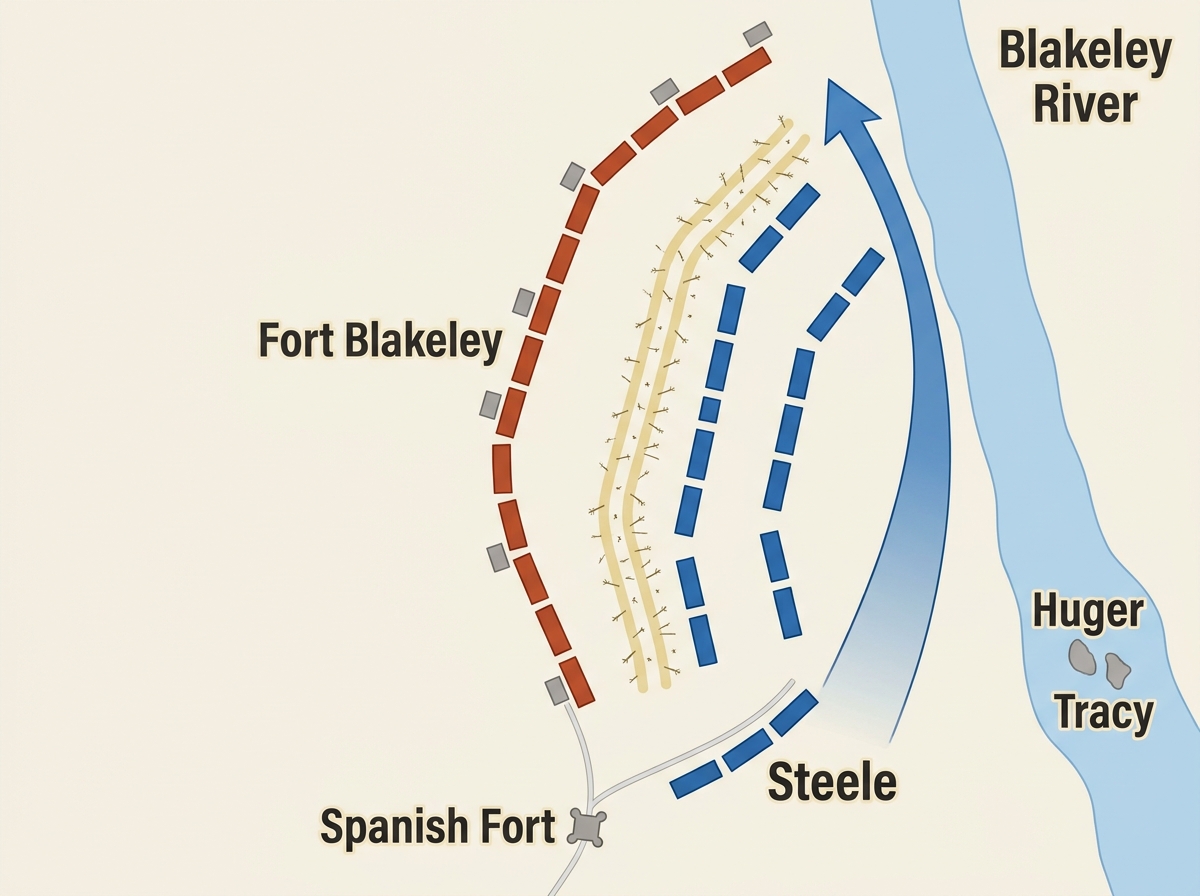
Fort Blakeley was not a fort in the sense of stone walls and a moat. It was a line of dug-in earthworks, a wall of piled earth almost three miles long, curving across the high ground above the rivers and anchored by nine strongpoints called redoubts, with about 40 cannon spaced along it. Behind it ran the rivers and marshes of the delta, and out on islands in the Blakeley River sat two more batteries, Huger and Tracy, that could throw shells into anyone attacking the line. Confederate gunboats lay in the rivers to the rear. It was a position built to make an attacker pay dearly for every step.
The defenders had done everything they could to thicken it. In front of the main wall they had cleared the trees and brush for hundreds of yards to open a field of fire, then filled that cleared ground with obstacles: rows of abatis (felled trees with their sharpened branches turned outward, an old and brutally effective way to tangle and slow attacking infantry), lines of sharpened stakes, and telegraph wire strung low between the stumps to trip men in the open. They had also buried something newer and crueler in the ground out front, what they called subterra shells: artillery shells rigged to explode when stepped on, an early form of the land mine. A man charging that line had to cross all of it under fire.
About four thousand against forty
The trouble was that the line was far too long for the men who held it. Command at Blakeley fell to Brigadier General St. John R. Liddell (South), with roughly 3,500 to 4,000 men to cover nearly three miles of works, fewer than two men for every yard of front. The overall defense of Mobile rested with Major General Dabney H. Maury (South), back across the bay in the city, but the men in the trenches at Blakeley were Liddell’s.
They were not all veterans. The toughest of them were two brigades under Brigadier General Francis M. Cockrell (South), hard-bitten Missouri and Mississippi soldiers who had fought through Pea Ridge, Vicksburg, the Atlanta campaign, and the slaughter at Franklin, and who held the center and left of the line. But a good part of the right was held by the Alabama reserves under Brigadier General Bryan M. Thomas (South), many of them teenage conscripts with little training, boys put behind a wall and told to hold it. They had skill at the center and numbers nowhere. Against them Canby concentrated about 16,000 men.
Western TheatreFranklin: the battle that had already gutted Cockrell’s MissouriansDigging closer
The siege of Blakeley followed the same patient method as Spanish Fort. The Union force in front of the works, with Major General Frederick Steele (North) directing the troops on the ground, dug forward in stages, throwing up three successive lines of earthworks, each closer than the last, until the foremost Union trenches sat under 1,000 yards from the Confederate wall. For more than a week the two sides skirmished by day and dug by night. The Confederates raided the forward trenches in the dark, lit the ground with shells filled with quicklime to spot targets, and their gunboats shelled the Union lines until artillery drove the boats off. It was grinding, sleepless, deadly work, and all the while the noose drew tighter. By the afternoon of April 9, with Spanish Fort just fallen and the whole Union army free to concentrate, Canby was ready to take Blakeley by storm.