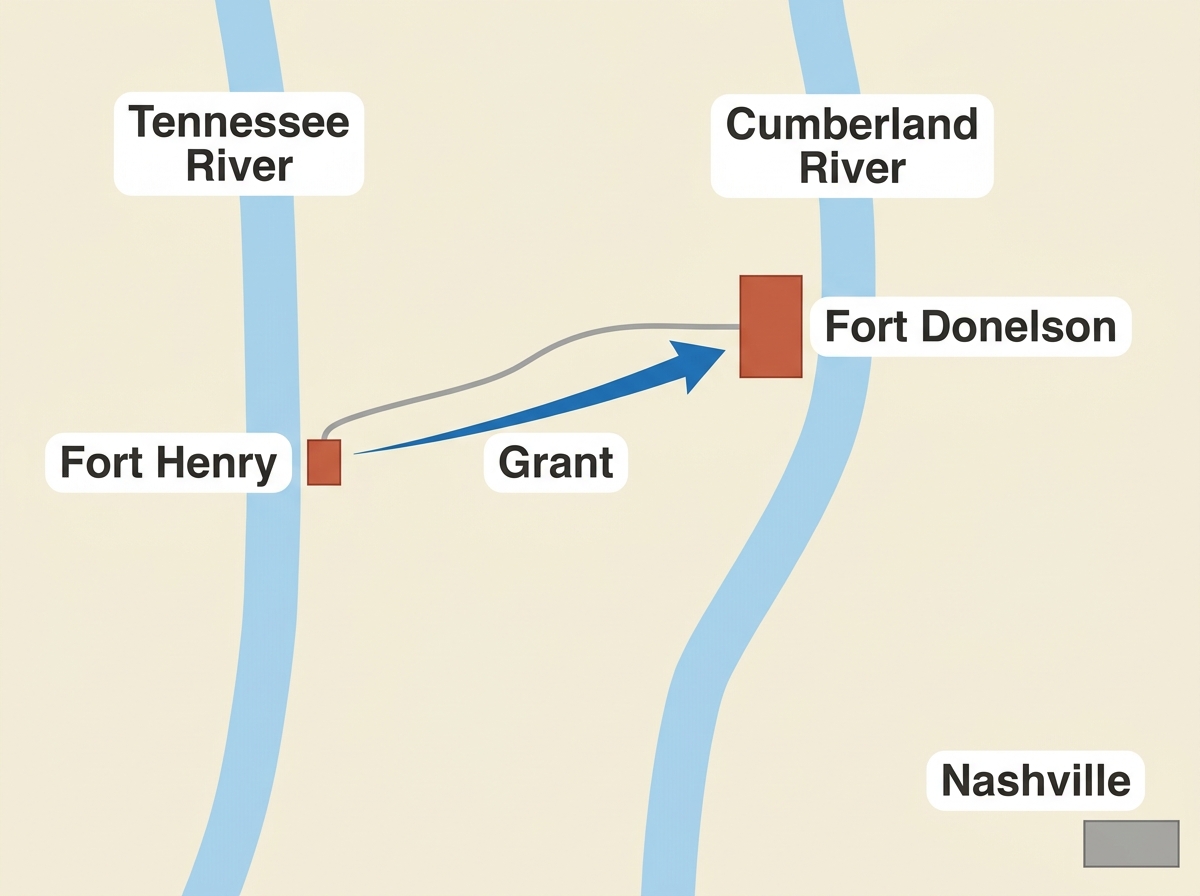
Two big rivers ran straight into the heart of the Confederacy, and the South had posted one smallish fort on each of them to keep the war out. In the first winter of the Civil War, the United States went looking for a back door into the South and found those two, the Tennessee and the Cumberland, lying in plain sight. They run roughly parallel through the Confederate heartland, only about 10 miles (16 km) apart where the South had planted its forts, and both of them point like arrows from the loyal North straight down into Tennessee and beyond. The war in the East was already a slogging, head-on affair, two armies grinding into each other across Virginia. Out West, the rivers offered a way around the grind. An army could float instead.
The man who would make the most of that was a then-obscure brigadier general (a rank one rung below major general) named Ulysses S. Grant. He had a partner in the work: Flag Officer Andrew H. Foote (North), the naval equivalent of a general and the senior commander of a brand-new fleet of river gunboats (warships built to fight on rivers, not the open sea). And he had a green light from his superior, Major General Henry W. Halleck (North), the cautious commander of the Department of Missouri (the Union’s military command zone for the western theater), who authorized a campaign against the twin river forts. The idea was simple and ruthless: drive gunboats and soldiers up those two rivers, smash the forts guarding them, and split the Confederacy and cut its supply lines in half. The thing that whole western line existed to defend was slavery. The Confederacy had broken away to keep human beings as property, and its generals had strung a defensive cordon (a ring of forts and troops) across Kentucky and Tennessee to protect that slaveholding heartland. The rivers strategy was a plan to crack that cordon open.
Off the fieldSlavery and cotton: the heartland the river forts were built to protectA fort that fell to boats alone
The first door came down fast. On February 6, 1862, ten days before Donelson, Foote's gunboats steamed up the Tennessee River and reduced Fort Henry more or less by themselves, his ironclads pounding the fort until it quit before Grant's foot soldiers could even close the ring around it. An ironclad is a gunboat plated in iron armor so cannonballs bounce off instead of punching through; in 1862 these were new machines, and at Fort Henry they looked unstoppable. The Confederate garrison (the body of troops assigned to hold a fort) was around 3,400 men, and most of them got out before the trap closed. About 2,500 of them simply marched the 10-odd miles overland to the next fort, Fort Donelson, on the Cumberland, and dug in there.
So Fort Henry's fall did two things at once. It threw open the Tennessee River to Union gunboats all the way down into Alabama, and it taught both sides the same lesson: out here, the boats won. Grant set out to do it again at the second door.
A twelve-mile march and a treacherous thaw
Grant moved his force the roughly 12 miles (19 km) overland from Fort Henry to Fort Donelson on February 11–13, and his men were so sure of the warm spell that had run ahead of the battle that they threw away their overcoats on the march to lighten the load. It was a costly bit of optimism. On the way Foote took the gunboats the long way around by water; on February 12 the army ran into Confederate cavalry under Col. Nathan Bedford Forrest (South) in sharp little skirmishes, and on the 13th there was some light probing (small test attacks) at the fort's defenses.
Then the warm spell broke. On the night of February 13 to 14 a severe snowstorm rolled in and dropped the temperature to 10 to 12°F (–12°C), with about 3 inches of snow on the ground and a lot of men no longer carrying the coats they had shed. Wounded soldiers left out on the field overnight froze where they lay. It was one of the documented horrors of Fort Donelson, and it had barely begun.