Why this charge was suicidal before the first shot
Why Franklin became a slaughter is plain on the ground itself.
The town of Franklin sits on the south bank of the Harpeth River, which loops around its north and east. That meant the river was behind the Union line. Major General John M. Schofield’s (North) army had its back to the water, with only the bridges and fords as a way out. That is why Schofield fortified instead of just running: he needed to hold a perimeter long enough to get his wagon trains across the Harpeth before he could safely withdraw the rest of the way to Nashville. His men dug a strong arc of works (the soldiers’ word for field fortifications, meaning a ditch fronting an earthen wall thrown up high enough that an attacker has to climb it under fire) curving south and southwest of the town, from the river on one side around to the river on the other. It was a bridgehead, a defended semicircle guarding the southern approaches and the crossings to its rear.
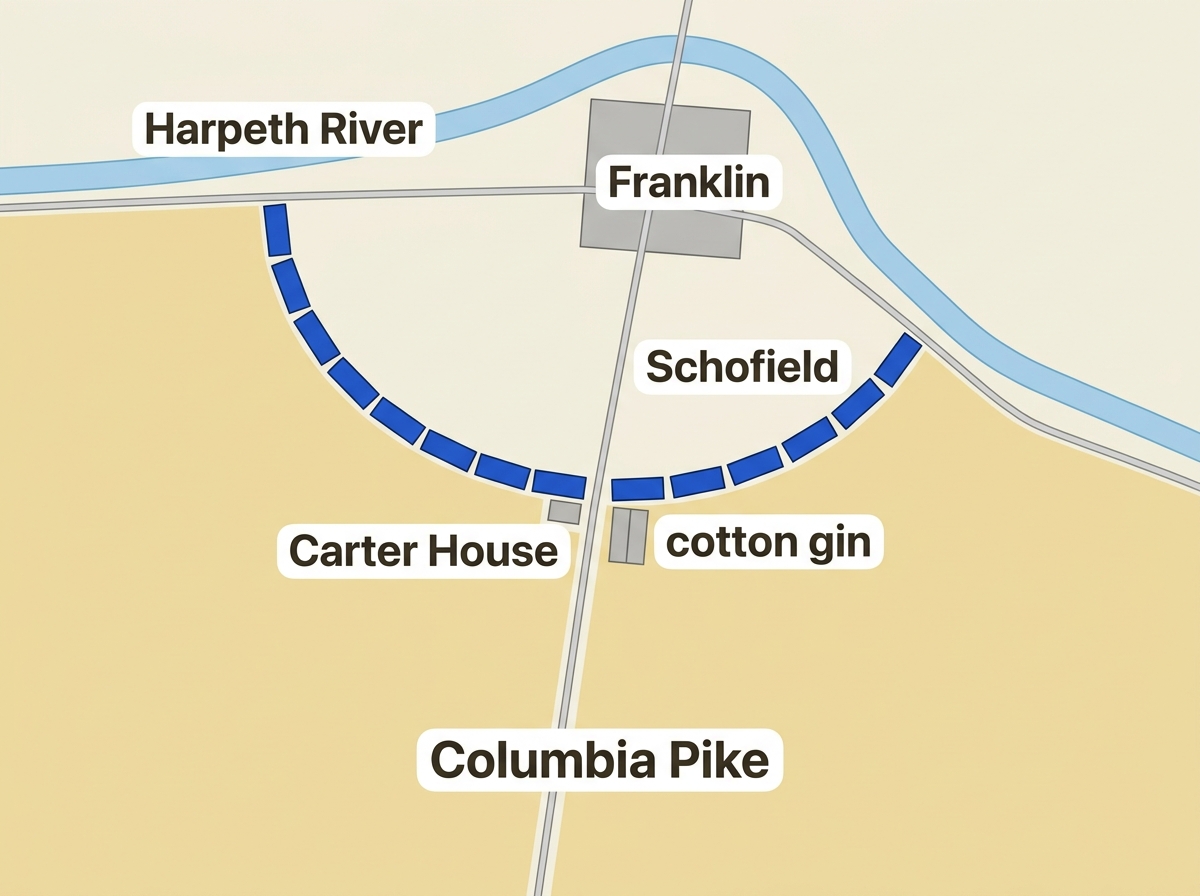
The Columbia Pike ran straight north into the town and punched through the Union line at its center. The defenders had deliberately left a gap in the works where the Pike passed, so wagons and troops could move through, and that gap would become the place everything broke open. Just inside the line, on the west side of the Pike, stood the Carter family’s house, the home that sat at the literal center of the Union position. A little to the east of the Pike, right at the line, stood the Carter cotton gin (a barn-like building for cleaning cotton), forming a small salient, a bulge in the line that juts toward the enemy and catches fire from three sides.
Then the Confederate problem. Lieutenant General John Bell Hood (South) formed his army on the open plain about two miles south of those works, and to reach them his men had to advance north across roughly two miles of open, gently rolling farmland: no woods, no walls, no cover, in full daylight view of the dug-in Federals the entire way. A frontal assault (marching infantry straight at a fortified position head-on, rather than slipping around its flank) is the costliest attack in the tactical book even in good conditions. These were not good conditions, and Hood ordered it anyway, over objections from his own subordinates. His cavalry commander, Major General Nathan Bedford Forrest (South), had found a crossing of the Harpeth and argued for a flanking move to turn Schofield out of his position instead of charging it. Major General Benjamin F. Cheatham (South), whose corps would lead the main assault, is reported to have warned that he did not like the look of the fight, that the enemy held an excellent, well-fortified position. Hood overruled them both.
Then came the detail that turned a long-shot attack into a near-certain massacre: there was essentially no artillery preparation. When the Confederates made their famous charge at Gettysburg the year before, roughly a hundred and fifty guns hammered the Union line for about two hours first, trying to soften it up before the infantry stepped off. At Franklin, Hood sent his men forward behind only a battery or two (a battery being a cluster of a few cannon). That is why the battle earned its nickname, “the Pickett’s Charge of the West,” but the honest comparison is that Franklin was worse: a larger assault, across roughly twice the open ground, into stronger works, with almost no guns to clear the way, timed to hit right at dusk.
Eastern TheatreGettysburg: Pickett’s Charge, the assault Franklin is measured againstAround four in the afternoon, with the sun setting about half an hour later, some twenty thousand Confederates stepped off and started walking north into the open.