By the end of August 1864, after four months of marching, digging, and bleeding across the hills of north Georgia, the city of Atlanta was very nearly surrounded and still would not fall. The reason was a railroad. An army the size of the one outside Atlanta does not live off the land it stands on; it eats what the trains bring. Every cartridge, every barrel of pork, every replacement rifle that kept the Confederate defenders fed and armed came in over the rails, and a city that loses its rail supply cannot be held no matter how thick its walls. The whole campaign came down to a simple, brutal arithmetic: cut the lines into Atlanta, and Atlanta has to be abandoned.
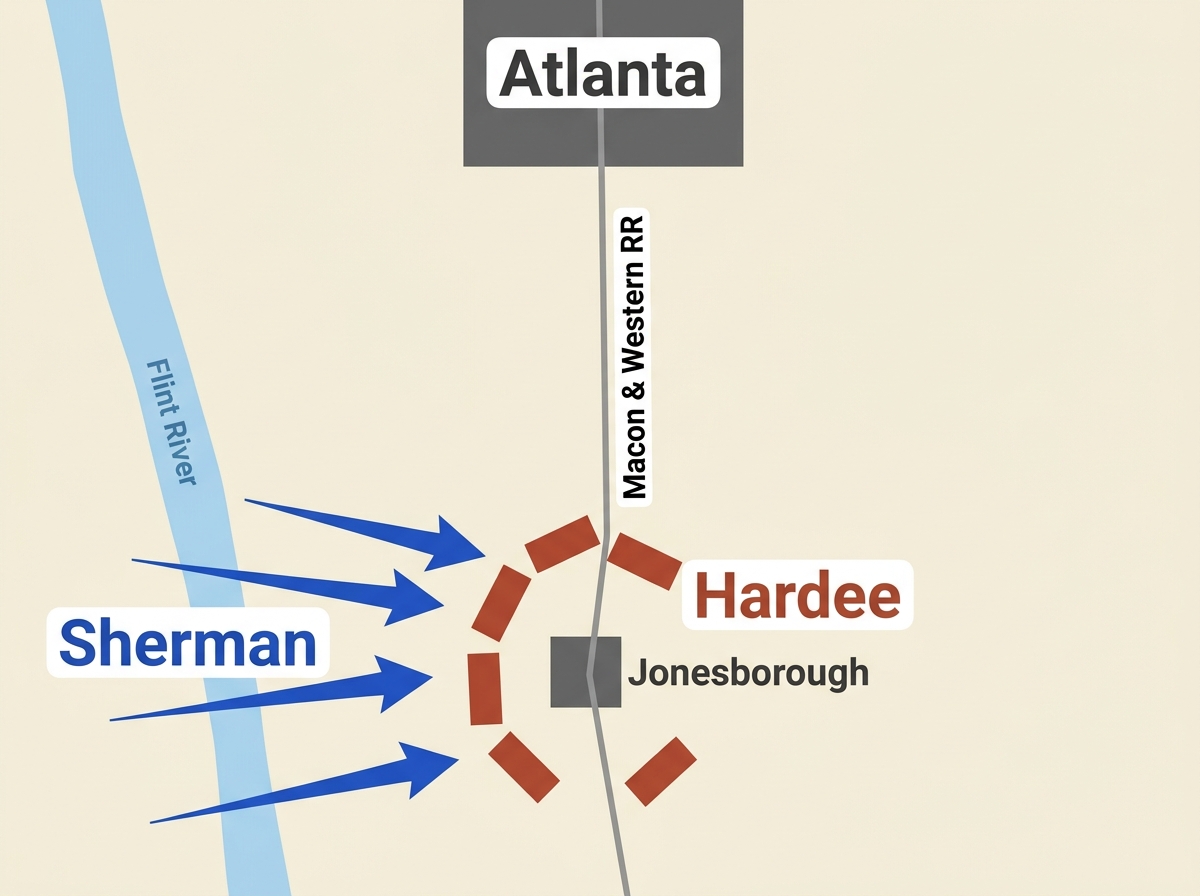
Major General William T. Sherman, commanding the three Union armies grouped under the grand title of the Military Division of the Mississippi, had spent the summer doing exactly that, severing the rail lines into the city one by one. By late August he had cut every line but one. The survivor was the Macon & Western Railroad, which ran south out of Atlanta down through a small town called Jonesborough, roughly 20 miles (32 km) below the city. (The town is spelled “Jonesborough” in the period and in every history of the battle; the modern Georgia town has shed an o and is now “Jonesboro.” The old spelling is used here for the fight.) That single line was Atlanta’s last open artery. As long as it ran, Atlanta could be fed. Sever it, and the city was finished.
Sherman could have battered himself bloody against Atlanta’s fortifications instead. He chose the railroad. Rather than assault the works head-on, he swung the bulk of his armies in a wide wheeling march to the south and west, a great curling sweep around the city’s flank (the side or end of an army’s line, as opposed to its front), aimed not at Atlanta at all but at the Macon & Western near Jonesborough. The plan was unglamorous and exactly right: get astride that last railroad, tear it up beyond quick repair, and the prize would fall on its own.
It is worth being plain about what these two armies were fighting over, because a rail junction is a thing you capture, not a thing you fight a war for. The Confederacy existed to preserve and extend slavery: eleven states had broken from the United States rather than accept any limit on the enslavement of Black people, and they built their armies to defend that. Atlanta was the Confederacy’s arsenal-and-railroad heart, where the war matériel of a slaveholding republic was forged and shipped, and Hood’s army stood in front of it to keep that war effort alive. The Union came to take the city as one more cut into the body of that republic. By the end of this story that purpose will be standing on the roads south of Atlanta in human form, thousands of people walking themselves out of bondage.
When Sherman’s army materialized down at Jonesborough, threatening the last line, General John Bell Hood (South), commanding the Confederate Army of Tennessee inside Atlanta, did the only thing he could: he sent a force to drive the Federals back off the railroad before they could break it. The man he sent was Lieutenant General William J. Hardee (South), with two corps, Hardee’s own and that of Lieutenant General Stephen D. Lee (South), no relation to the famous Lee in Virginia. (A corps is the largest building block of a Civil War army, several divisions and tens of thousands of men under one general.) Their orders were simple and desperate: clear the Federals off the Macon & Western, or watch Atlanta die.