Morning on September 1 found Lieutenant General William J. Hardee (South) in an impossible position. Lee’s corps was gone, marched back to Atlanta in the night, and Hardee was left to defend a front roughly two miles (3 km) long with about 12,000 men against a Union force far larger. He stretched his line as thin as it would go, and a line stretched that thin has a fatal feature. At one point the entrenchments bent outward into a salient, an angle that juts toward the enemy like the prow of a ship. A salient is the weak point of any defensive line, because the men holding its apex can be fired on from two directions at once and assaulted from two directions at once. Holding the apex of this one was the brigade of Brigadier General Daniel C. Govan (South).
Sometime after four in the afternoon, the blow fell on exactly that spot. The XIV Corps, a corps of Major General George H. Thomas’s (North) Army of the Cumberland, commanded by Brigadier General Jefferson C. Davis (North), went in against the salient. (This Jefferson C. Davis is the Union general of that unfortunate name; he is no relation whatever to Jefferson Davis the Confederate president, and his name comes up again before this story ends.) The attack was no clean parade-ground charge. Brigadier General William P. Carlin’s (North) division had to push forward through dense underbrush and thick woods that broke up the lines and slowed the advance, while Brigadier General James D. Morgan’s (North) division came on from the west.
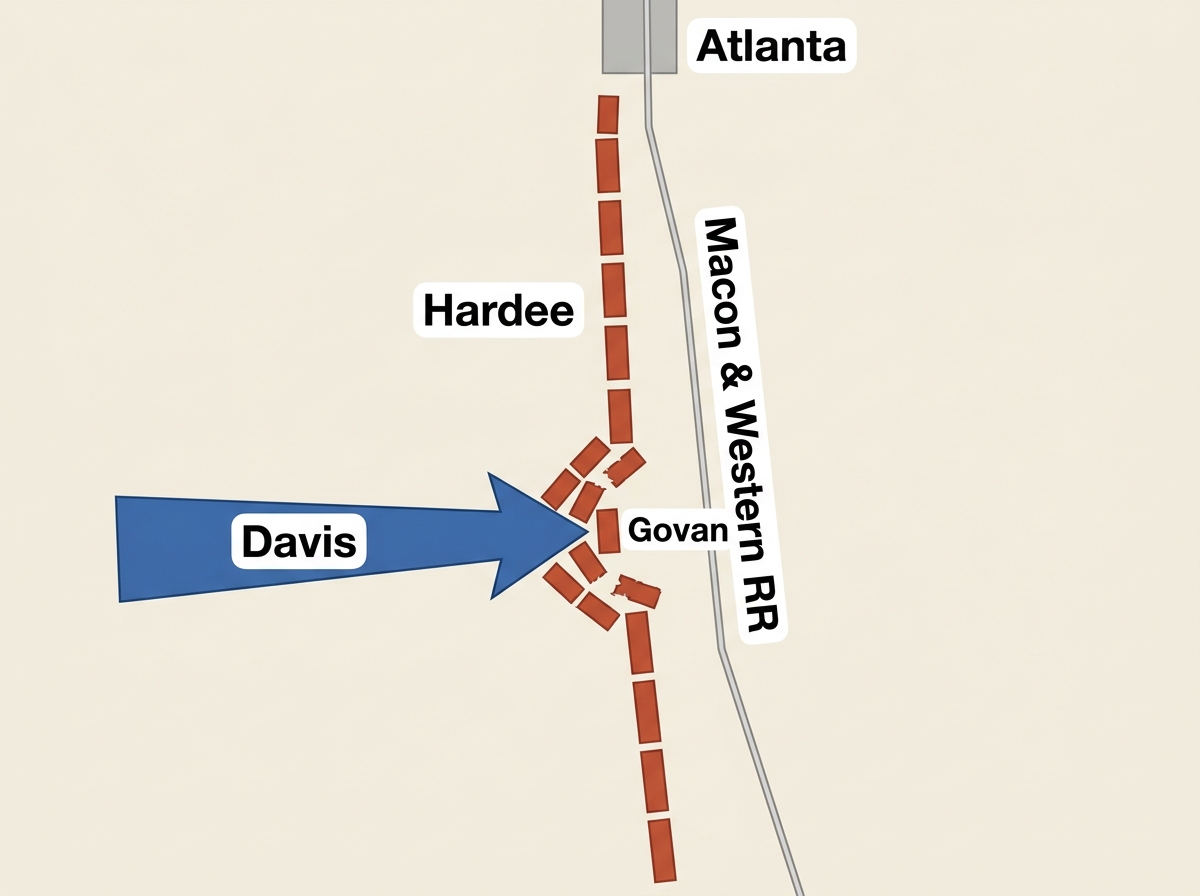
The breakthrough came from the north. A brigade under Colonel George P. Estey (North), roughly 1,139 men, assaulted the salient from above while Morgan’s division (North) struck it from the west, the two converging on Govan’s apex from two sides at once. Estey’s regiments overran the Confederates holding the point and punched clean through, and with Morgan’s men closing from the other face, the salient was suddenly not a defensive angle but a trap. Govan’s brigade (South), the whole apex of Hardee’s line, was surrounded inside it.
What followed was rare: not a position taken, but a brigade taken. Govan (South) himself and roughly 600 of his men were swept up as prisoners, along with about eight cannon, among them Key’s Arkansas Battery and Swett’s Mississippi Battery. A brigadier general captured with the bulk of his command, guns and colors and all, was an entire piece of the Confederate line scooped up off the field and marched to the rear.
The break did not run all the way through, though, and the reason was Major General Patrick Cleburne (South), “the Stonewall of the West,” the most respected fighting general in Hood’s army. Cleburne led the Tennessee brigade of Brigadier General Alfred J. Vaughan (South) into the gap and halted the Federal advance before it could roll up the rest of the line, while on the eastern sector another Confederate brigade rallied and threw back a Union brigade coming at it. The break was contained, but Hardee’s line was shattered, and the men who plugged the hole could not undo what the capture of Govan’s brigade meant. There is a private grief folded into Cleburne’s stand here: three months later, on November 30, at Franklin, Tennessee, Cleburne would be killed leading his men against another set of entrenchments. The Confederate cemetery at Jonesboro that holds this battle’s dead bears his name.
Western TheatreFranklin: where Cleburne fell, three months laterThe Union did not finish the job it might have. Major General David S. Stanley’s (North) IV Corps came up slowly through the thick woods on the east, and rather than driving in to cut off Hardee’s whole battered corps, the Federals dug in instead of exploiting the breakthrough. It was a missed chance to bag everything Hardee had left. Hardee’s line was broken; his army was not destroyed. That distinction would matter for the rest of the war.