Hooker’s men started up before most of the valley was awake. Around eight o’clock on the morning of November 24, his force began crossing Lookout Creek, the stream running along the western foot of the mountain between Lookout and neighboring Raccoon Mountain. Days of rain had swollen the creek, so it had to be bridged and forded under fire, no small thing with the enemy somewhere on the slope above. Geary’s (North) column swung wide to the south and got across near a place called Wauhatchie, putting his men on the steep western flank of the mountain where the defenders were thinnest. A low band of cloud already clung to the slope, and for once the weather worked for the attackers: it helped screen the crossing from the Confederate pickets (the forward lookouts posted ahead of the main line) watching from above.
Then came the climb, and the climb was the real enemy. Geary’s men hauled themselves up the steep western face toward the base of the palisade, the vertical rock cliff-line that crowns Lookout Mountain near its summit, a wall of stone no infantry could storm. The fight was never going to be for the top. The palisade saw to that. The fight would be for the slope and for the narrow shelf of ground below the cliffs. So when Geary’s column reached the base of that rock wall, it did not try to scale it. It wheeled, turning to its left, north and east, and began sweeping across the mountain’s north face, rolling along the slope toward Chattanooga and rolling up the thin Confederate picket line from the flank as it went. To hit a line from the flank is to come at it from the side or the end rather than head-on, where a few defenders cannot face the blow without their whole position unhinging. That is the difference that decided this battle: the mountain was being turned, levered off its position by a blow to its side, not stormed, charged straight up the front into the defenders’ rifles.
For Walthall’s (South) outnumbered Mississippians, strung along that mile of slope, it was an impossible morning. Hit from the flank by a force several times their size, they could do little but fight a delaying action, falling back from one rocky position to the next, trading boulders and ground for time, never able to plant themselves long enough to make a real stand. Somewhere on that same ground, climbing from the Union side, a sergeant major of the 96th Illinois (North) hauled himself hand-over-hand up wet rock he could barely see, men slipping and going down all around him in a fog that closed to a few dozen yards, and decided, then or later, that he was on “undoubtedly the roughest battle field of the war.” The cost that day was paid less in casualty lists than in exhaustion and falls.
The picture in the popular memory, a heroic charge up a sheer mountain into the teeth of the enemy, is not quite what happened. What happened was a hard, miserable climb and then a long flanking sweep across a slope, against defenders too few and too spread out to hold it. The bravery was real. The ground was genuinely brutal. But the mountain was being turned, not stormed.
The Stand at the Cravens House
The Confederates made their one real stand at the Cravens House, and everything that mattered that day happened there. The Cravens place was a farmhouse on a small flat shelf of ground, a bench, a level ledge cut into the mountainside about two-thirds of the way up the northern slope, below the palisade. It was the strongest position on the mountain, the place the Confederates had built their best works (dug-in trenches and log-and-earth defenses), and it was the natural choke point, the one stretch where the slope leveled enough for men to dig in and stand. As Geary’s sweep rolled toward it through the late morning, the fight tightened down to this one patch of cleared ground in the fog.
The bench broke open under a crossfire the defenders could not answer. While Colonel David Ireland’s (North) New Yorkers pressed the front of the Cravens line straight on, Colonel George A. Cobham Jr.’s (North) Pennsylvanians worked onto the higher ground above and poured fire down into the defenders from the flank. Caught between the frontal push and the plunging fire from above, the Confederates at the Cravens House had no good answer. Around one in the afternoon, Brigadier General John C. Moore (South) led an Alabama brigade in a counterattack to throw the Federals back off the bench, and ran straight into that same crossfire, which stopped him cold. The attempt to hold the Cravens House by hitting back had failed.
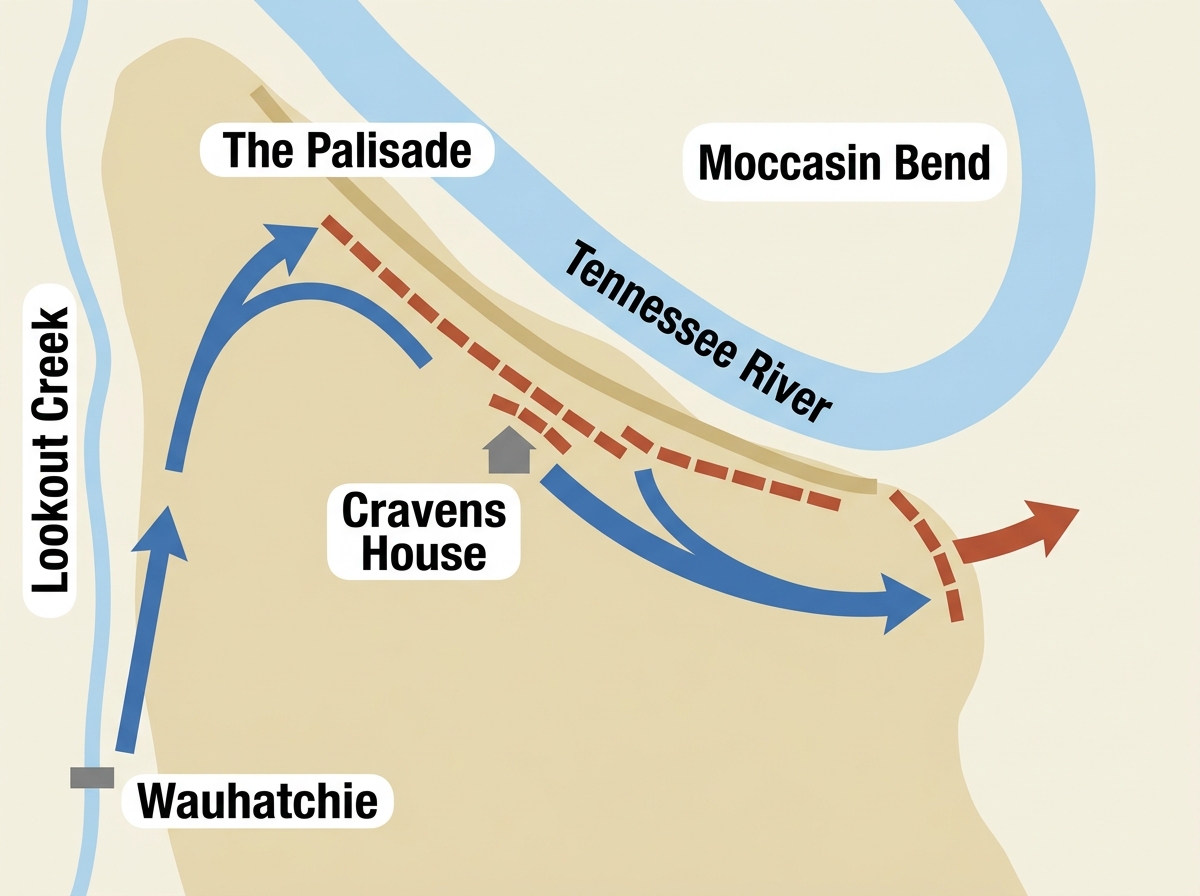
And then the fog, which had screened the climb, turned and wrecked the defense. Through the early afternoon the cloud-band thickened on the slope, and by about two o’clock it had closed in so densely that the Confederate command could no longer see to fight. Reinforcing brigades brought down from the summit, under officers named Brown and Pettus, could not be coordinated in the murk; men could not see who was where, or which way the enemy was, or where the line had broken. Outnumbered, out-positioned, and now blind, the defenders were driven off the Cravens bench and back eastward around the shoulder of the mountain. The fighting sputtered out in fog and the coming dark, ammunition running low on both sides, the line dissolving as much into surrender as into retreat. The mountain, for all practical purposes, had been taken, and it had cost remarkably little.