By November 1863, the Union Army of the Cumberland had spent the better part of two months living at the bottom of a trap. Two months earlier, at the Battle of Chickamauga, a Confederate army had beaten that Union force in the worst Federal defeat of the western war and driven it back into the city of Chattanooga, Tennessee, then followed it to the gates and sat down on the heights all around. To the east rose Missionary Ridge; to the southwest loomed Lookout Mountain, a long, steep wall of rock standing some 1,200 feet above the river. From those crests the Confederate Army of Tennessee, under General Braxton Bragg (South), looked straight down on the trapped Federals, on the river that fed them, and on the rail lines that were supposed to keep them alive. They had not so much defeated the Union army as caged it. That cage had a name. It was a siege: an army pinned inside its own lines by an enemy that rings it, cuts its supplies, and waits for it to starve or surrender.
Western TheatreChickamauga: the defeat that drove the army into the trapCaging it was the point, because of what Chattanooga was. Chattanooga was the great rail gateway to the Deep South, the junction through which an army could drive into Georgia, toward Atlanta and the plantation belt beyond. The Confederacy had broken away from the United States and gone to war for one overriding reason: to protect and extend the enslavement of four million Black people, the system its economy and its social order were built on. By the late autumn of 1863, with the Emancipation Proclamation in force since the first of that year, the Union’s war aim openly included slavery’s destruction. Bragg’s men held these mountains to keep the door to the slaveholding heartland shut. The Federals in the valley below were there to kick it open. The fight that was about to happen on the cliffs above them was, underneath the fog and the romance, a fight for the road into the slave South.
Off the fieldThe Emancipation Proclamation: what the war had become by 1863Through October the trapped army had nearly starved. With the Confederates commanding the river and the good roads, supplies had to come in over a long, broken mountain track, and the horses died by the thousands while the men went hungry. Then, in late October, the situation reversed. Major General Ulysses S. Grant, the Union’s rising star in the West, fresh from splitting the Confederacy at Vicksburg, arrived to take overall command on October 23 and almost at once forced open a new supply route, the “Cracker Line,” seizing a river crossing at Brown’s Ferry on October 27. Food and ammunition flowed again. The army that had been slowly strangled was fed, rested, and reinforced, and Grant began planning not to escape the trap but to smash it, to lift the siege by breaking the ring of heights that held it shut.
Western TheatreVicksburg: the victory that made Grant the West’s rising starThe plan was a three-day breakout, not a single battle. Grant meant to crack the ring of heights around the city one piece at a time: Orchard Knob, a low rise out in front of Missionary Ridge, on November 23; Lookout Mountain, the western wall, on November 24; and Missionary Ridge itself, the long eastern crest where Bragg’s main strength sat, on November 25. Lookout Mountain was the middle day. It was never meant to be the decisive blow. It was meant to clear the western peak and set the stage.
Hooker Gets the Mountain
The job of taking Lookout Mountain fell to Major General Joseph “Fighting Joe” Hooker (North). Hooker carried a dented reputation: it was he who had commanded the Union army to defeat at Chancellorsville in the spring, and he had been shipped west with two corps to get him out of the way as much as anything. A corps was the army’s largest building block, tens of thousands of men under one general; it broke down into divisions, each division into brigades, each brigade into regiments. The steep mountain was, in part, Hooker’s chance to redeem the year. Grant never meant it to be much of a fight. Grant, prodded by Major General George Thomas (North), ordered Hooker only to demonstrate against the mountain, to threaten it, and take its point only “if his demonstration should develop its practicability.” It was a hedge, not an attack order. Hooker ignored the subtlety. At three o’clock on the morning of November 24 he told Geary to cross Lookout Creek and assault the mountain outright. The fight got big because the man told to feint chose to swing. He commanded an ad-hoc force of roughly 10,000 men, about three divisions, scraped together from three different corps.
Eastern TheatreChancellorsville: the defeat that dented Hooker’s nameThe force was a patchwork. Brigadier General John W. Geary (North) led the column from the XII Corps that would make the main ascent. Brigadier General Peter J. Osterhaus (North), a German-born “Forty-Eighter,” one of the émigrés who fled the failed European revolutions of 1848, brought a division of the XV Corps that had been stranded on the wrong side of the river when the pontoon bridge tore apart, and was simply attached to Hooker for the day. Brigadier General Charles Cruft (North) brought the third piece, drawn from the IV Corps. Three corps, three commanders, one mountain.
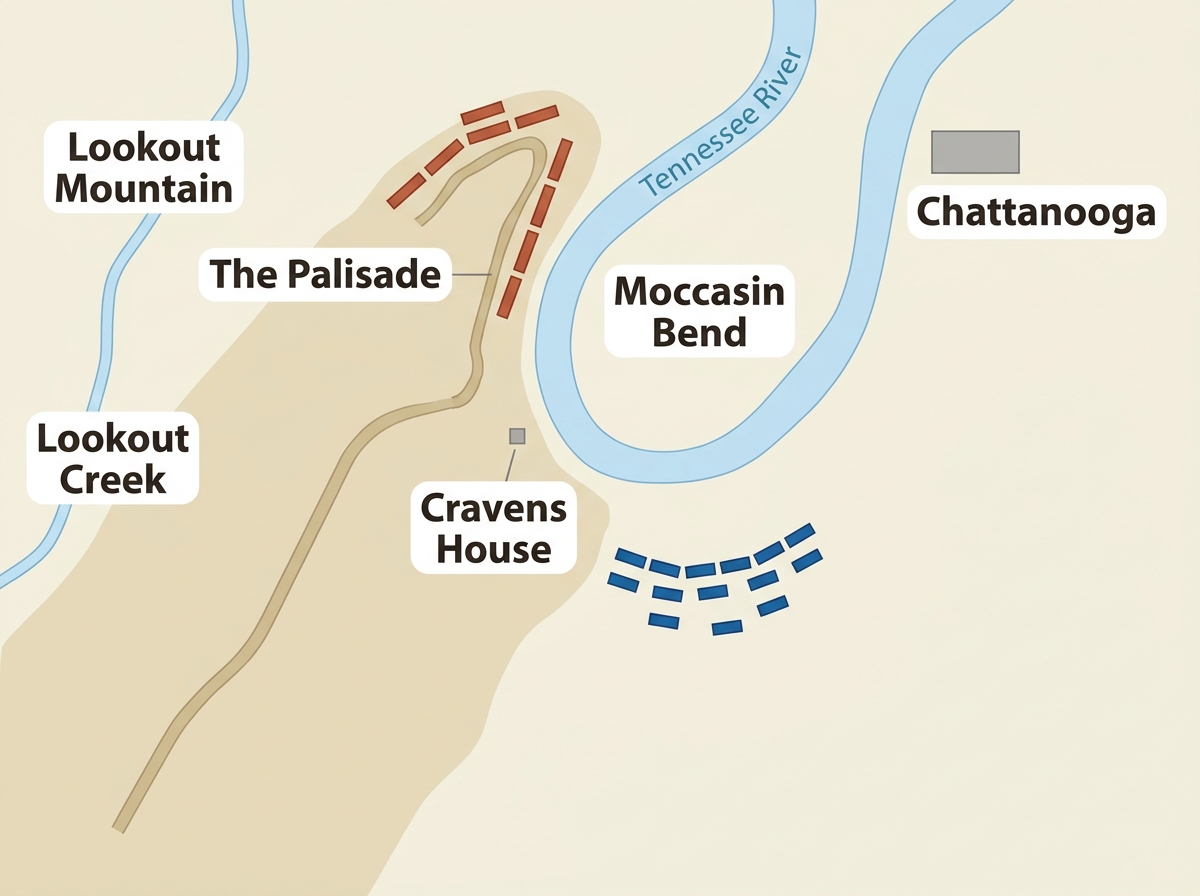
Against them, the mountain was held by far fewer men than its grim silhouette suggested, and fewer still than it should have been. The Confederate field commander on Lookout Mountain was Major General Carter L. Stevenson (South), responsible for the whole long northern face with too few troops to cover it. Worse for the defense, Bragg had recently thinned the garrison, pulling a division off the mountain in the days before the attack, on the apparent assumption that the cliffs themselves were defense enough. On paper there were perhaps 8,700 Confederates on Lookout Mountain. At the point where the blow would actually land, on the western and northern slope, there were only a few thousand, by one account around 3,000 men in three brigades, the rest scattered along the ridge and the summit where they could never be brought to bear.
The forward defenders, the men who would take the first blow, belonged to the Mississippi brigade of Brigadier General Edward C. Walthall (South). They were about to learn what it meant to hold a mile of cliff-face with too few rifles, sent there to keep shut the door into the country the Confederacy had gone to war to keep enslaved, and left too few to do it by their own commander’s miscalculation. The romance of “the Battle Above the Clouds,” a name not yet coined that morning, rested on a plain and brutal military fact: a steep, supposedly impregnable height, held by far too few men, climbed by a larger force that simply walked up it.