Grant’s plan for November 25 was simple on paper. A quick word on how an army of that day was built, because the whole battle turns on it: the basic blocks were the brigade (a couple thousand men), several of which made a division (several thousand), several divisions a corps (bigger still), and the corps together an army (the whole force). The generals’ ranks ran in the same order, biggest command to smallest: general at the top, then lieutenant general, then major general (Maj. Gen.), then brigadier general (Brig. Gen.).
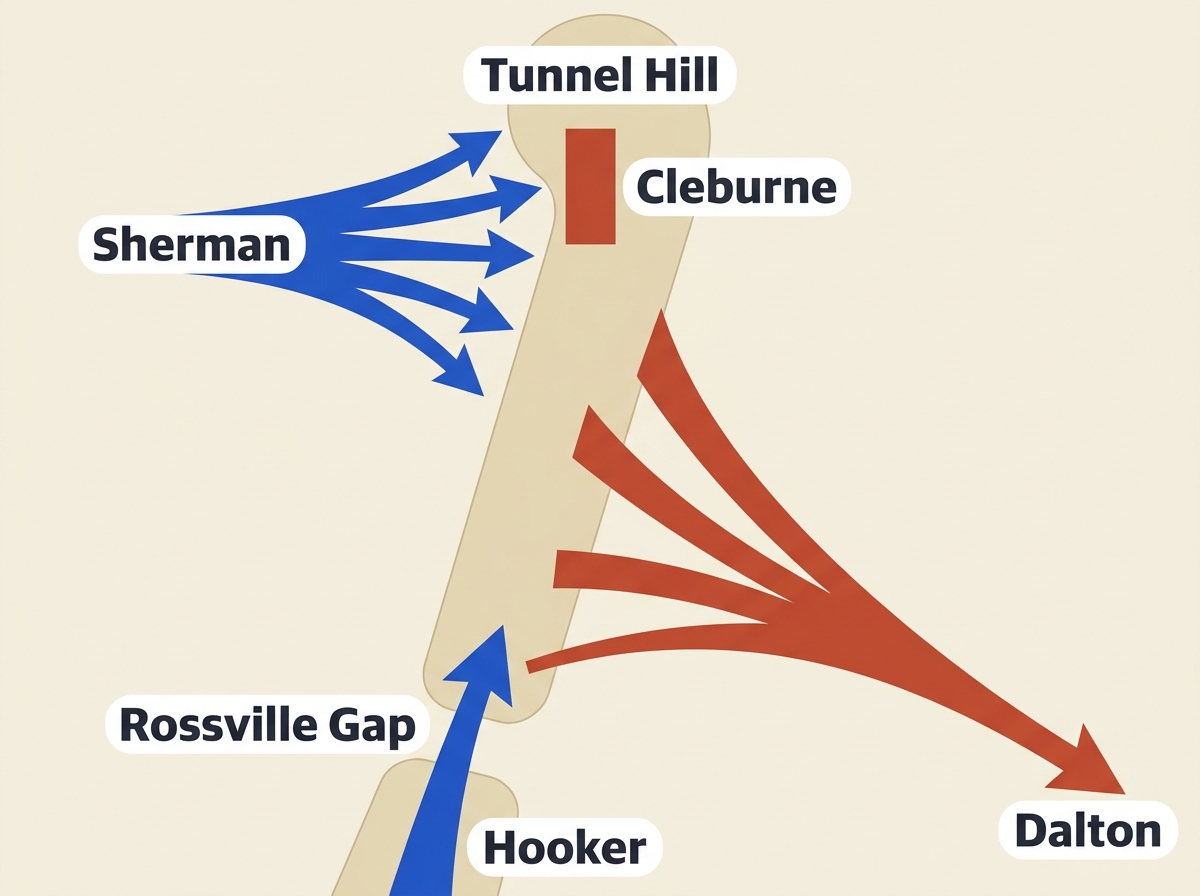
The blow would land on the north end of Missionary Ridge, where the ridge ran into a feature called Tunnel Hill (named for a railroad tunnel bored through it). There Grant put his hardest-hitting weapon: Maj. Gen. William T. Sherman (North) and the Army of the Tennessee, a second named Union field army, and almost the same name as the Confederate Army of Tennessee they were all there to destroy. One is the river, one is the state, and they are enemies. Sherman commanded the troops he and Grant had won with at Vicksburg. He was the hammer, sent to crush the Confederate right and roll the whole line up from the north.
At the south end, Grant gave a supporting role to Maj. Gen. Joseph Hooker (North), who commanded a detachment sent west from the Army of the Potomac (the main Union army back in Virginia). Hooker had just taken Lookout Mountain the day before in the fog-shrouded fight nicknamed “the Battle Above the Clouds.” Now he was to come down off the mountain, swing around to the southern tip of the ridge through a pass called Rossville Gap, and press up the Confederate left.
Western TheatreLookout Mountain: Hooker’s “Battle Above the Clouds,” the day beforeAnd in the center, facing the steep heart of the ridge, stood Thomas’s Army of the Cumberland, the army that had been beaten at Chickamauga and had been seething about it ever since. Their job, in Grant’s design, was the smallest of the three: a hold, a feint, a diversion to pin the Confederate center in place while Sherman did the real work on the flank (the flank being the end of the enemy’s line). Nobody expected the battle to be won in the center, and that was the one assumption everyone got wrong.
The Hammer Won’t Fall
By midday, the plan was failing at both ends. On the north, Sherman never even reached his target cleanly: misled by bad maps and a distant view that made the high ground look like one continuous ridge, he had crossed over and seized a separate, detached hill, only to find a deep ravine yawning between him and the real Tunnel Hill. So his roughly 16,600 men went in against the actual height piecemeal (a few brigades at a time rather than all at once, so each wave could be beaten on its own) and ran headlong into one of the finest division commanders in the Confederate army: Maj. Gen. Patrick Cleburne (South), holding the height with only about 4,000 men. Cleburne’s outnumbered division beat back assault after assault all day, counterattacking each time, and Sherman’s men were shredded against the slope, nearly 2,000 casualties for no breakthrough at all. Grant’s hammer would not fall.
On the south, Hooker was late. He had left Lookout Mountain around mid-morning, but when his column reached Chattanooga Creek, the bridge across it had been burned, and his advance stalled for some three hours while his engineers rebuilt it under the pressure of the clock. He didn’t reach Rossville Gap until mid-afternoon, around 3:30, and only then began working up the south end of the ridge.
So by late afternoon Grant was watching his battle stall from Orchard Knob. The hammer was stuck in the north. The flanking column was hours behind in the south. The day was burning down, and Bragg’s army was still sitting on the ridge, having lost almost nothing. Grant needed to pull pressure off Sherman, and the only fresh, idle force he had was the diversion in the center, Thomas’s revenge-hungry Army of the Cumberland.