Of all the things two armies kill each other over, water is one of the oldest, and at Perryville it was almost literally the trigger. West of the town ran a small creek called Doctor’s Creek, and in the drought its standing pools were a prize worth fighting for. On the evening of October 6, elements of the Union army’s center skirmished with Confederate pickets (soldiers posted out front to give warning) over those very pools. Men were shooting at each other for the right to drink.
Buell’s Trick
The Union army here was the Army of the Ohio, under Major General Don Carlos Buell (North). And Buell had just played the trick that would shape the whole battle. To keep Bragg and Kirby Smith from joining their two armies, Buell sent a strong column, some twenty thousand men, feinting eastward toward Frankfort, the capital, while the bulk of his army swung the other way toward Perryville. The feint worked far better than he could have hoped. Bragg, fed alarming reports by Kirby Smith’s cavalry, mistook that Frankfort column for Buell’s main thrust. He ordered part of his army north to meet it, which is why his men were the ones interrupting the Hawes inauguration with their own retreat, and so split his force in two, with a large chunk of it facing the wrong direction when the real Union army arrived. Buell had tricked Bragg into looking north while he came from the west.
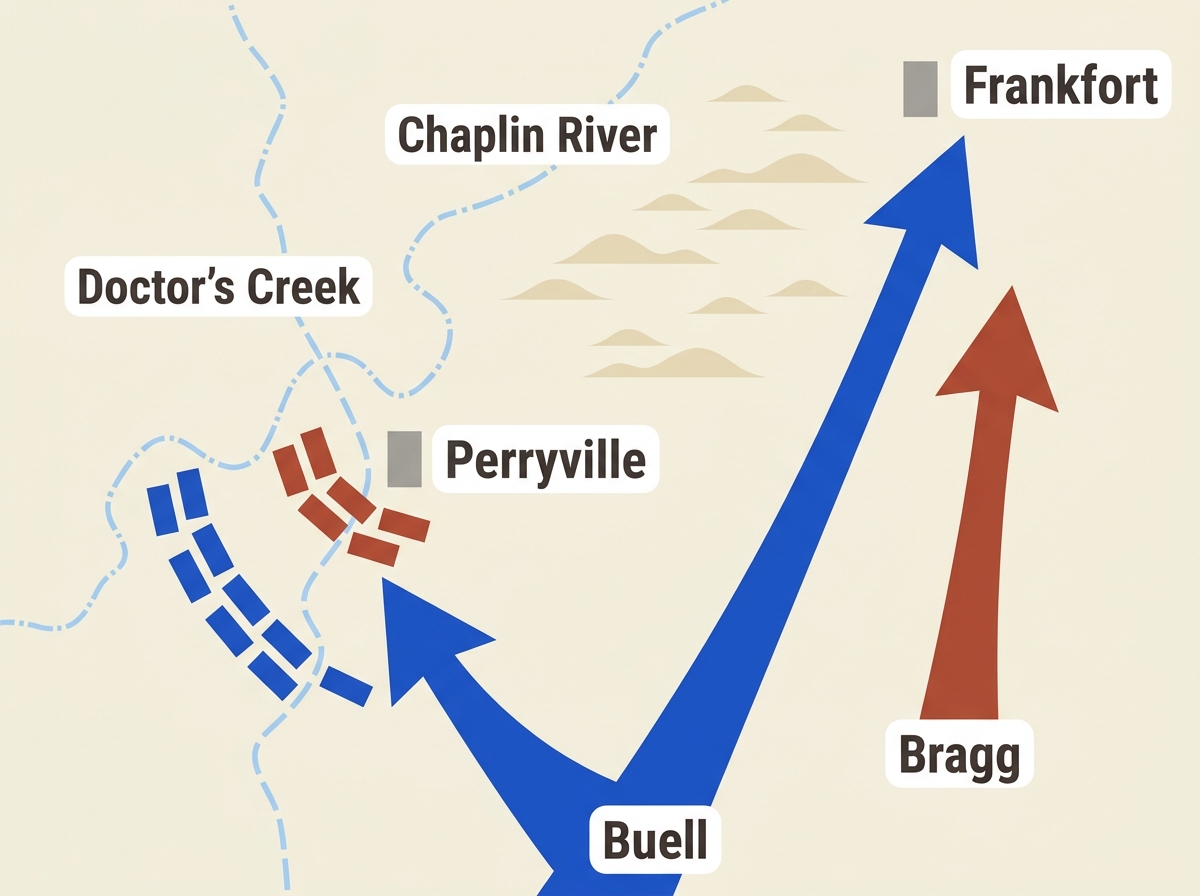
On October 7, three of Buell’s columns converged on Perryville, cavalry trading shots with the Confederate rearguard (the troops covering the back of a moving force), and Buell intended to attack the next morning. When the next morning came, the fighting flared right back at the water. Near a rise called Peters Hill, just west of town, a Union regiment, the 10th Indiana, went down to the creek for water and ran into Confederate troops. The skirmish grew, and into it rode one of the day’s most aggressive Union commanders, Brigadier General Philip H. Sheridan (North), who seized Peters Hill outright.
Told to Stop
And then, in a pattern that would define the whole Union side of this battle, he was told to stop. Sheridan’s corps commander, the general above him running one of the army’s three great wings, was the acting Major General Charles C. Gilbert (North), a man whose generalcy was never officially confirmed. Gilbert ordered Sheridan to pull back and avoid bringing on a general engagement (a full-scale battle rather than a passing skirmish). So Sheridan, who had the high ground and the appetite to use it, sat. It would not be the last time that day a Union commander held back a man who wanted to fight.
What none of this told either side was that a major battle was about to begin. Each commander was fighting half-blind, in opposite directions. Buell’s deception had Bragg facing Frankfort, and Bragg, misreading how much of the Union army was actually in front of him, was about to throw a hard punch at a single corner of a much larger enemy. The drought had drawn both armies to the same water; the water put their advance guards in contact; and the contact, that afternoon, would catch fire into one of the bloodiest few hours of the entire war.