By late morning the Union army had been shoved back from its camps, but it had not broken. As the divisions fell back toward the river, a section of the line firmed up in the center along an old farm lane, a worn country track running past the edge of an open field, with thick brush and timber crowding it. Here two Union divisions dug in their heels and refused to move. For most of the afternoon, the center of the battle would be decided on this one patch of ground, and the fighting there was so furious that the men gave it a name out of the sound the bullets made tearing through the thickets: the Hornet's Nest.
The two commanders holding it were Brigadier General Benjamin Prentiss (North), leading the 6th Division, and Brigadier General W.H.L. Wallace (North), no relation to Lew Wallace despite the matching surname, leading the 2nd Division. Behind and around them the rest of Ulysses S. Grant's army was bending back toward Pittsburg Landing, but here in the center, Prentiss and Wallace held.
Six Hours on the Sunken Road
A note on the lore before the fighting: this farm lane is famous as the "Sunken Road," remembered as a deep, trench-like cut that sheltered the defenders. But that picture is largely a creation of veterans embellishing the story over the decades. The word "sunken" does not even show up in descriptions until 1881, and contemporary reports and photographs show only a slight farm track, not a real entrenchment. Nearby Shiloh staples like the "Bloody Pond," a supposedly bloodstained watering hole, have no contemporary evidence at all and are probably pure legend. The stand was real and brutal; some of the scenery around it was added later.
For roughly six hours, the men in the Hornet's Nest beat back charge after charge. The Confederates came at the position again and again across the open ground of a farm field in front of it. Estimates of how many separate assaults they made range from eight to fourteen, and the true number cannot be pinned down, and each time the attack was shredded and thrown back. Major General Braxton Bragg (South), commanding one of the Confederate corps (a corps being a grouping of divisions, the layer just above a division and below a whole army), fed brigades into the meat grinder in piecemeal frontal attacks and watched them come apart against the line.
In front of and around the Hornet's Nest the fighting spread into a peach orchard held by the brigades of Brigadier General Stephen Hurlbut (North). It was open ground, good for artillery, and it became one of the bloodiest patches of the field, a ferocious contested zone in its own right, not just a backdrop. It was here, in the orchard sector, that the battle's single most important casualty fell.
The Death of Albert Sidney Johnston
Around 2:30 p.m., General Albert Sidney Johnston (South) rode forward to personally lead an attack near the Peach Orchard, out in front of his own lines. A bullet struck him behind the right knee and nicked the popliteal artery, the major blood vessel running behind the knee joint. It was a survivable wound: a tourniquet applied in time would almost certainly have saved his life. But Johnston, possibly because an old 1837 dueling injury had left the area numb, did not realize how badly he was hit. And he had, earlier that very day, sent his personal physician away to treat wounded Union prisoners. So there was no one to stanch the bleeding. His boot quietly filled with blood.
Governor Isham Harris of Tennessee, riding at his side, noticed Johnston sagging in the saddle and asked if he was wounded. Johnston's reported last words were that he feared he was, seriously.
"Yes... and I fear seriously."
He was eased to the ground and bled to death a short distance south of the Bell Farm. Albert Sidney Johnston was the highest-ranking officer on either side to be killed in combat in the entire Civil War.
There is a grim twist historians cannot fully settle: the bullet entered from behind his right knee, that is, from the direction of his own advancing lines, which has led some to conclude the fatal shot came from his own men. The National Park Service calls it "likely friendly fire," but it is not definitively established; it is possible a Union soldier fired it at an angle. We may never know for certain.
The Confederate president, Jefferson Davis, would later call the loss irreparable, saying that when Sidney Johnston fell, it was the turning point of their fate.
"When Sidney Johnston fell, it was the turning point of our fate; for we had no other hand to take up his work in the West."
Command passed to General P.G.T. Beauregard (South), who directed the rest of the battle from the rear.
Prentiss Surrounded
The Hornet's Nest finally broke not to a charge but to massed cannon. Around 4:00 p.m., a Confederate division commander, Brigadier General Daniel Ruggles (South), did something no one in North America had done before: he gathered roughly 62 cannons wheel to wheel, no gaps between them, into one enormous battery (a massed group of artillery) and turned them on the Hornet's Nest at once. It was the largest concentration of field artillery yet assembled on the continent, and it tore the position apart while Confederate infantry curled around both ends of the line to encircle it.
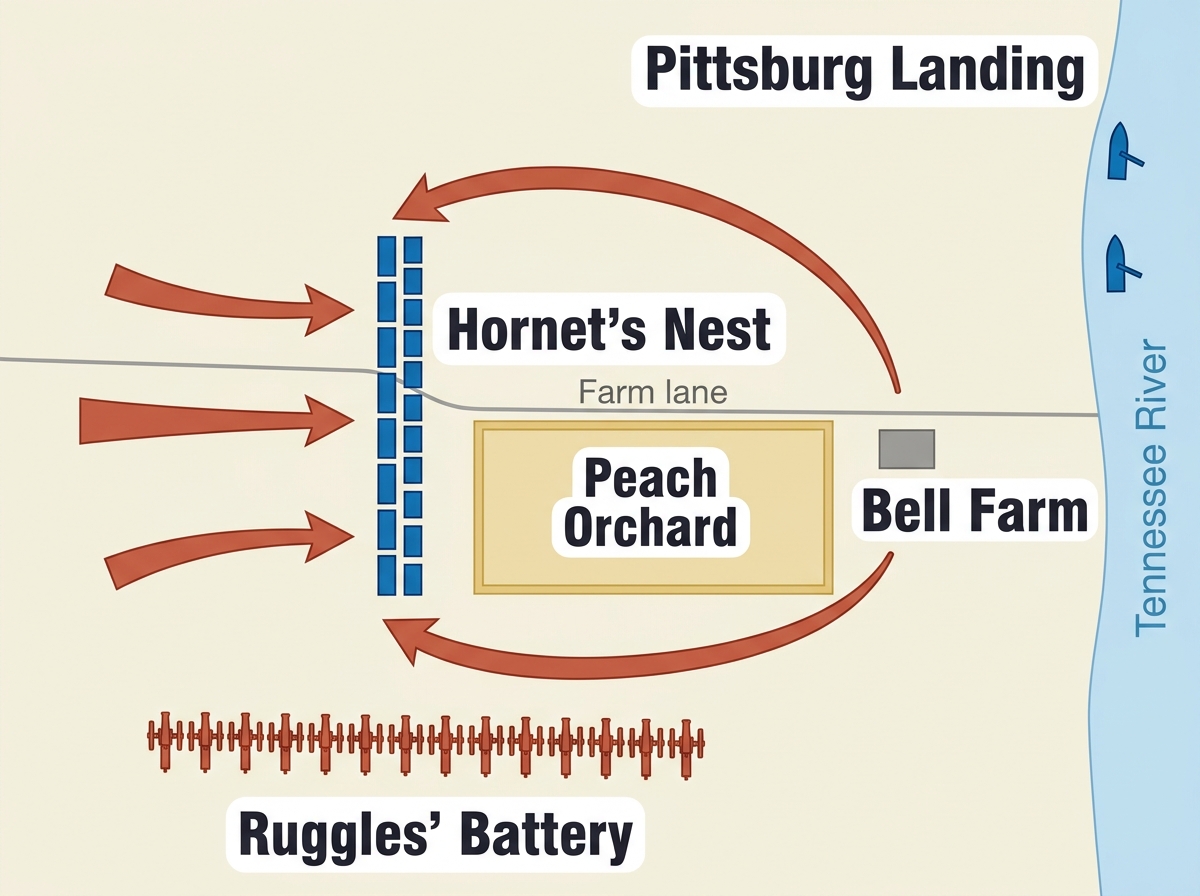
The defenders were being swallowed. Around 4:15 p.m., W.H.L. Wallace was mortally wounded while trying to lead his division out of the closing trap; most of his men escaped, but he was left for dead on the field and died four days later. Prentiss, with Confederate troops now closed in on every side, the pocket sealed around him, held on until about 5:30 p.m., when he and roughly 2,200 surrounded men finally surrendered, the largest Union capitulation of the day.
How much the stand actually mattered is debated. The traditional story credits Prentiss with buying Grant the hours he needed to save the army, but revisionist historians argue W.H.L. Wallace's men did more of the real holding, and that Prentiss got outsized credit mostly because he survived captivity to tell his own version. What is not in doubt: the center cost the Confederates dearly in time and blood, and the sun was getting low.
Grant's Last Line
With the Hornet's Nest gone, the Confederate tide rolled on toward Pittsburg Landing itself, toward the river, the supply base, and the only escape route. Down under the bluff at the landing huddled thousands of broken, demoralized Union soldiers who had run from the morning's collapse, packed against the riverbank and refusing to fight; Grant and Sherman could not get them moving. But on a ridge less than a quarter-mile above them, with the river at their backs, Grant's army made its final stand of the day. Grant's chief of staff, Colonel Joseph D. Webster (North), wheeled roughly 50 cannons into a solid wall of artillery on the high ground above two small creeks. As exhausted Confederate brigades came at this last line, they ran into a storm of close-range cannon fire.
And they ran into the navy. Anchored in the Tennessee River off the landing were two Union gunboats, the USS Tyler and the USS Lexington. (A gunboat, as in the first section, is a river steamer armored and armed with heavy naval cannon, able to float right up to a battle and shell the shore.) Starting around 4:00 and 4:30 p.m., the Tyler and Lexington opened up, firing heavy naval shells into the Confederate infantry massing for the final push. Between Webster's 50 guns and the gunboats, the last line held. As the light failed, Beauregard, his army disorganized, low on ammunition, badly bloodied, and fed a false report (from a mistaken Confederate scout) that Buell's fresh army was nowhere near, called off the attacks, certain he could finish Grant in the morning. He even wired Richmond claiming "a complete victory." He was wrong on every count, and the proof was already crossing the river behind Grant.