While General P.G.T. Beauregard's (South) army slept among the Union camps it had just captured, the river behind Major General Ulysses S. Grant was filling with boats. Through the night the whole balance of the battle quietly reversed itself in the dark, on the steamboats crossing the Tennessee in a thunderstorm and on the roads coming up out of the south. The Confederate soldiers had spent the evening certain the hardest part was over; many had broken ranks to loot the overrun Federal camps, eating the Yankees' food, pulling on their boots, and carrying off whatever they could, and the looting helped scatter the army's order just as it needed to be tightening. Beauregard halted at dusk believing Grant was beaten and the morning would only finish him. By dawn, the army he thought he had cornered was bigger, fresher, and ready to attack.
Reinforcements in the Night
Two things happened overnight that doomed the Confederate position. First, around 7:15 p.m., the division of Major General Lew Wallace (North), the reserve Grant had summoned that morning, finally reached Pittsburg Landing, some 5,800 men arriving after the day's fighting had ended. Wallace's march had been a fiasco of its own: ordered to come, he had taken a road Grant did not expect, found himself behind the shifting Confederate lines, and had to countermarch, arriving hours late. He was blamed for it for the rest of his life, though modern historians have largely vindicated his choice of road, since the original written orders were lost and the route he took made sense at the time. Late or not, his fresh division was now on the field.
Lew Wallace would carry the controversy for decades, but he had another life waiting. He went on to write the novel Ben-Hur in 1880, for a long time one of the best-selling American novels ever published.
Second, and far larger, Major General Don Carlos Buell's (North) Army of the Ohio began arriving. Through the evening and into the small hours, steamboats ferried Buell's divisions, those of Brigadier Generals William Nelson, Thomas Crittenden, and Alexander McCook (all North), roughly 18,000 fresh men, across the river to the Pittsburg Landing side. A violent thunderstorm broke over the field overnight, soaking the exhausted survivors of both armies and the wounded still lying out in the dark between the lines. The Confederate cavalryman Brigadier General Nathan Bedford Forrest (South) personally scouted the river that night and saw the boats unloading. He reported it to his superiors: Buell was here, thousands of fresh Union troops were crossing. The warning was ignored. Beauregard's army would wake up outnumbered and not know it.
And on the Union side, somewhere in that storm, came the exchange that has outlived almost everything else about the battle. Sherman, soaked and looking for Grant, found him standing under a tree in the rain, hat down against the weather, a cigar clenched in his teeth, and remarked that they had had the devil's own day. Grant's reply was that they would lick them tomorrow.
"Well, Grant, we've had the devil's own day, haven't we?" "Yes. Lick 'em tomorrow, though."
The two lines are recorded in Sherman's own memoirs and treated as authentic by mainstream historians. To his staff Grant put it less politely. Pressed on whether the army should pull back across the river, he refused even to consider it: he meant to attack at daylight and whip them.
Driving Back Over the Same Ground
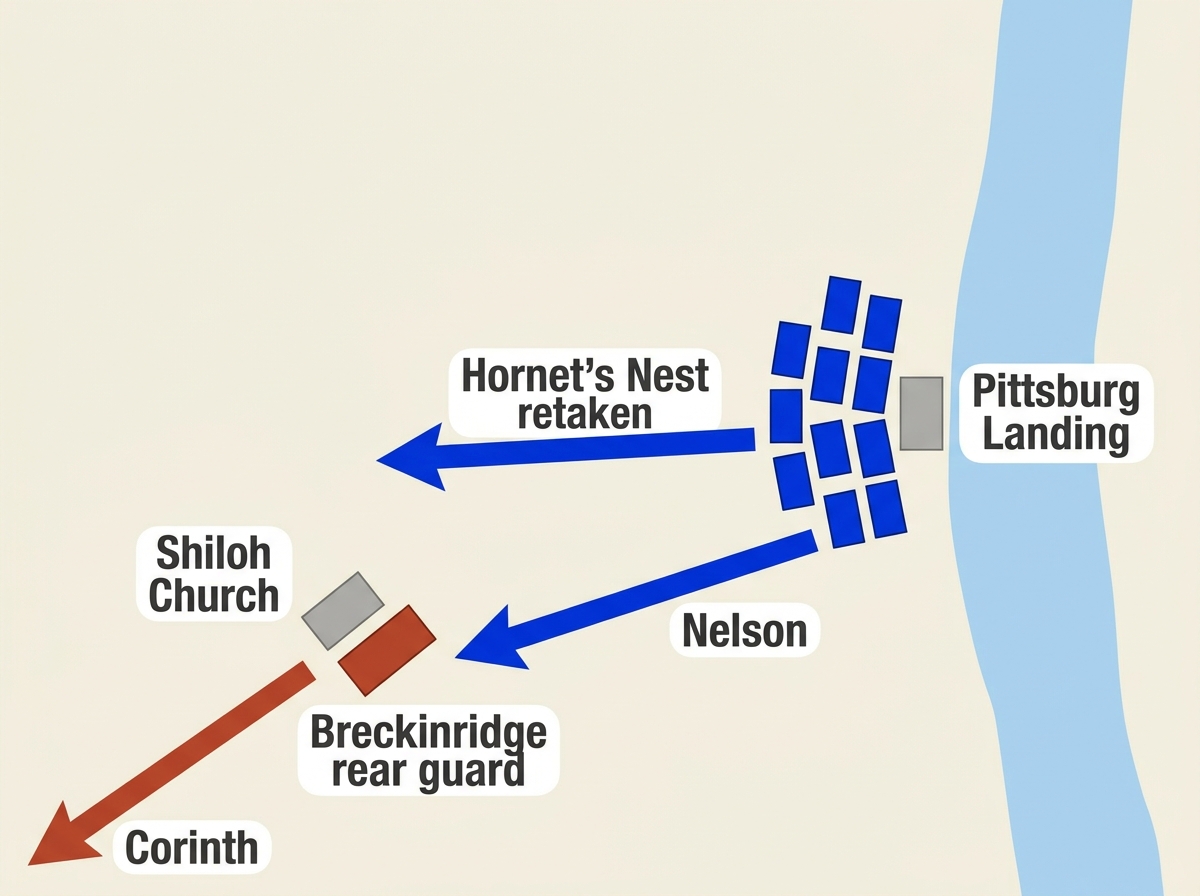
At first light on April 7, Grant did what Beauregard never imagined a beaten army would do: he attacked. Between roughly 5:00 and 6:00 a.m., Buell's fresh troops led off, Major General William Nelson's three brigades striking first against the Confederate left (the southern end of their line), while Grant's battered but reinforced Army of the Tennessee, with Lew Wallace's division now in line, advanced at the same time. The exchange from the day before simply ran in reverse. The Confederates, fewer in number and with no reinforcements of any consequence (a single Tennessee regiment of about 600 men was the only help they got all day), were pushed back over the very ground they had won at such cost on April 6.
But it was not a walkover. When Nelson's rested, well-fed brigades came on at dawn, the men who met them were the looters and survivors of the day before, hungry, short of cartridges, many of them strung out and exhausted, and yet the Confederate left did not simply give way. It fought back hard, ground forward in places, and made the Federals pay for every field and fence line. The famous landmarks changed hands again, slowly. By around noon, Buell's men had retaken the Hornet's Nest area. On the western side of the field, the advance of Sherman and Major General John McClernand (North) crawled forward against a stubborn Confederate division near Shiloh Church. It was hard, grinding fighting all morning. But the direction never changed: the Confederates were giving ground they could not get back.
Beauregard Pulls Out
By around 1:00 p.m. on April 7, Beauregard saw the truth of his situation, outnumbered, no help coming, his army fought out, and began preparing to withdraw. The corps of Major General John Breckinridge (South) formed a rear guard (a force left behind to slow any pursuit while the main army gets away) near Shiloh Church around 2:00 p.m. to cover the retreat, and by about 3:30 the last Confederate cannon rolled off down the road south. The Army of Mississippi retreated roughly 20 miles (32 km) back to Corinth, the rain turning to hail as evening came on, the men trudging through the mud past the wounded of two days.
Western TheatreCorinth: the rail crossroads the whole campaign was forThe Cavalry Bites Back
Grant ordered only a limited pursuit, and it ran straight into the war's most dangerous cavalryman. On April 8, a Union force probing south near a place called Fallen Timbers was ambushed by Forrest's cavalry (mounted soldiers fighting on horseback), about 350 horsemen who charged into the pursuing infantry, inflicting nearly a hundred casualties before pulling back. Forrest himself, riding too far into the Union line, was shot at point-blank range; he reportedly hauled a Union soldier up onto his horse as a human shield and galloped out, wounded but alive. After that, the chase fizzled. Grant did not mount a sustained pursuit, partly because Halleck soon arrived to take personal field command and sidelined him, and the Union let the broken Confederate army limp back to Corinth largely unmolested. Grant would be criticized for that for years.