In the spring of 1862, the war in the West was going badly for the South, and it was about to get worse before it got better. The whole region was laced with rivers (the Tennessee and the Cumberland), and rivers were highways. A Union army that controlled them could float supplies, men, and gunboats (river steamers armored and armed with heavy cannon) deep into the Confederate interior, the lower South, splitting the region in two and choking off the railroads that fed its armies. That was the strategy, and the man making it work was one of the Union's rising commanders, Major General Ulysses S. Grant. The Confederacy he was trying to split apart was a new country that had broken away from the United States barely a year earlier for one overriding reason: to protect and preserve the enslavement of four million Black people. The South had built its economy and its social order on slavery, seceded rather than see it limited, and now fielded armies to keep it. Grant's campaign down the rivers was, at bottom, a campaign to strangle a slaveholding republic.
He had already proved the rivers could be taken. In February 1862, Grant captured Fort Henry on the Tennessee River and then Fort Donelson on the Cumberland, scooping up something like 12,000 to 15,000 Confederate prisoners and a new nickname, "Unconditional Surrender Grant," after the terms he gave the garrison. The defeats forced General Albert Sidney Johnston (South), the Confederate commander in the West and the second-highest-ranking officer in the whole Confederacy, to abandon Kentucky and most of Tennessee. Now Grant pushed south by river toward the next prize: Corinth, Mississippi, a small town that happened to be the great rail crossroads of the western Confederacy, the one place where the South's main east-west railroad met a major north-south line. Take Corinth and you cut that east-west artery in two. The Confederacy would be sawn in half.
Western TheatreFort Donelson: the surrender that opened the riversOn April 3, 1862, three days before the battle, Grant wrote in a letter that he did not feel there was the slightest doubt about the result.
"I do not feel that there is the slightest doubt about the result."
Grant's Orders Were to Wait
Grant's orders were to wait. His superior, Major General Henry W. Halleck (North), had told him to take his army, roughly 45,000 men, to Pittsburg Landing (a steamboat dock, or "landing," on the west bank of the Tennessee River) and encamp there until a second Union army could join him.
A note on how a Civil War army was built, because the words come up constantly. The biggest field force was the army itself. An army was split into divisions (here, six of them, each ten to twelve thousand men). Each division was made of brigades of a few thousand, and each brigade of regiments of around a thousand. Keep that ladder in mind, army to division to brigade to regiment, and the rest of the battle reads cleanly.
That second army was Major General Don Carlos Buell's (North) Army of the Ohio (Civil War armies were usually named after rivers, not states), marching overland to link up. The plan was to combine the two before advancing, because Grant's force alone was not judged strong enough to take Corinth, about 20 miles (32 km) to the southwest, and hold it against a counterattack. Only once the armies were joined was Grant to move.
So through March and into April, Grant's men sat in their camps in the woods and fields around a little Methodist meetinghouse called Shiloh Church, drilling green recruits and waiting. Here Grant made the decision that would nearly destroy him: he did not entrench. To entrench is to dig in, to throw up earthen walls, trenches, and barriers so that attackers have to cross open killing ground to reach you. Grant refused to do it. His reasoning, which sounds reckless now and sounded fine then, was that he intended to attack, not defend, and that making the men dig defensive works would dampen their fighting spirit and make them timid. He simply did not expect to be attacked here. His division commander running the camps day-to-day, Major General William T. Sherman (North), agreed completely, and explained afterward why the camps were left undug.
"I always acted on the supposition that we were an invading army. We did not fortify our army against an attack, because we had no orders to do so, and because such a course would have made our men timid."
What Grant did not know was that Johnston was coming to him. Rather than wait at Corinth to be besieged, Johnston had gathered roughly 44,000 men, christened the Army of Mississippi, and resolved to march out, fall on Grant's army by surprise, and smash it before Buell could arrive. He set out from Corinth on April 3 intending a one-day march. It became a three-day ordeal: rain, tangled orders, bad roads, and inexperienced troops slowed the columns to a crawl, and they did not reach their jump-off positions (the start lines from which they would launch the attack) until the night of April 5. General P.G.T. Beauregard (South), Johnston's second-in-command, was sure the delay had cost them all surprise, that the noise and the days of marching must have alerted the Federals (the Union army), and he urged Johnston to call the whole thing off. Johnston refused, saying he would fight them if they were a million.
"I would fight them if they were a million."
That quote comes from after-the-fact recollections, not a contemporary record, so treat it as likely rather than gospel. The decision was real: Johnston attacked.
Breakfast Interrupted
At about 5:00 a.m. on April 6, a nervous Union colonel named Everett Peabody (North) sent a patrol probing south of the camps. In a farm clearing called Fraley Field, they ran straight into Confederate skirmishers (advance soldiers sent ahead of the main army to feel for the enemy), and the first shots cracked out. At 5:30, Johnston ordered the general assault to begin, and the Army of Mississippi came rolling out of the dawn woods in three great parallel lines, sweeping northeast from the direction of Shiloh Church toward the river. The thing Grant and Sherman had told themselves could not happen was happening: a full Confederate army, in their faces, at first light.
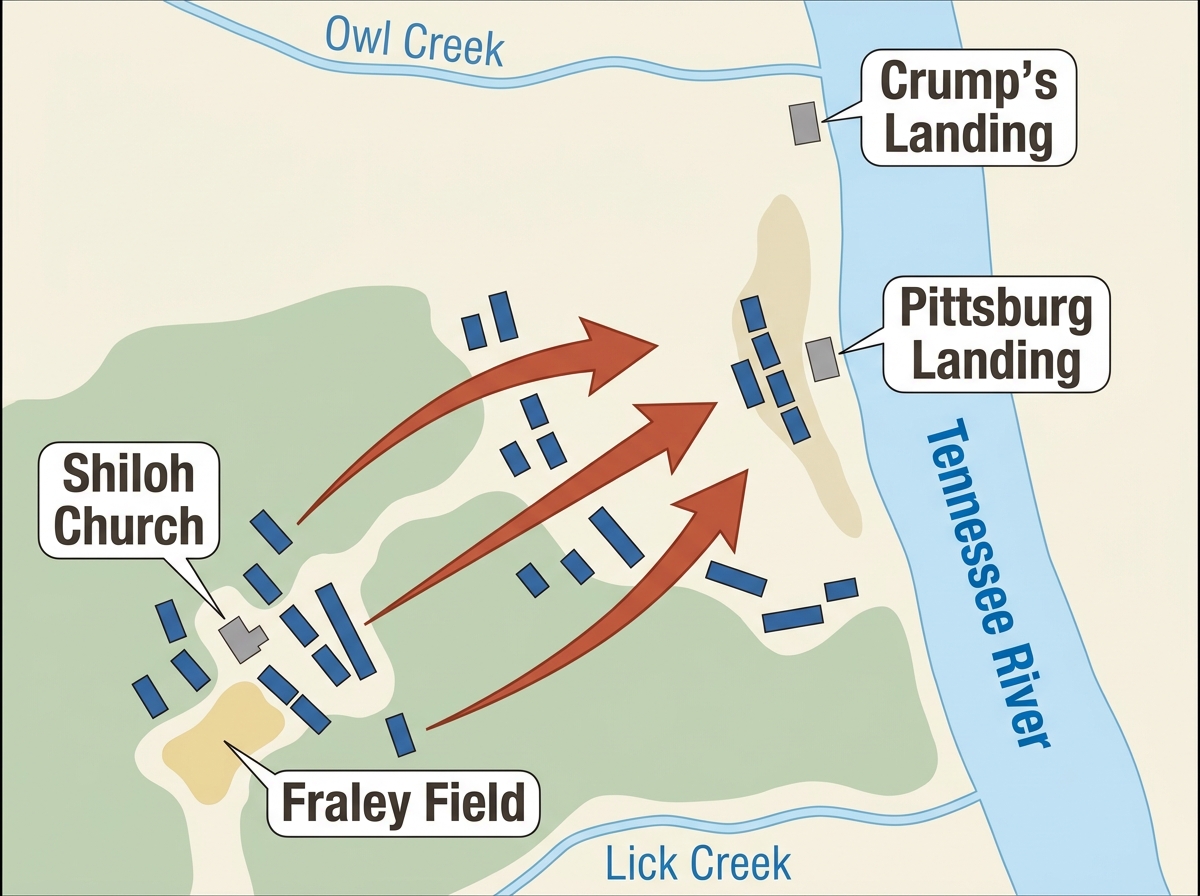
The Union camps were overrun one after another. Many soldiers were still cooking breakfast when the gray lines burst out of the trees; some were shot down among their cook fires, others ran. Whether Grant was truly "surprised" became a debate that has never fully died, but the honest answer, and the one most modern historians land on, is yes: he was operationally surprised. Nothing in his own correspondence suggests he expected a major attack, and the scattered skirmishing of the previous days had been dismissed.
Grant himself was nine miles (14 km) downriver at his separate field headquarters in Savannah, Tennessee, when the firing started, a commanding general often keeping a base apart from his forward camps to manage supplies, river traffic, and the wider campaign. He hurried upriver by steamboat and reached Pittsburg Landing around 9:00 a.m., into the middle of a battle already going wrong. He immediately sent word for his one division held in reserve, the men of Major General Lew Wallace (North), posted at Crump's Landing a few miles north, to march to the sound of the guns.
The Right Holds On
The hardest early blow fell on Sherman. His 5th Division held the Union right, the part of the line nearest Shiloh Church, and so it caught the leading edge of the Confederate onslaught. Sherman, a man who only months earlier had been pulled from command and whispered about as having lost his nerve, even his sanity, had the day of his life. He rode up and down his line under fire, rallying broken regiments, patching together one defensive position after another as each was overrun, trading ground for time. He was wounded twice, in the hand and the shoulder, and had three horses shot out from under him.
It was not a victory: the right was driven back, like the rest of the army. But Sherman's stubborn, fighting retreat slowed the Confederate advance on that flank (the flank being the end, the exposed side, of a battle line) and bought the precious commodity of the whole long day, which was time. Time for the rest of the army to form, to fall back to stronger ground, and to hang on until help could cross the river. Sherman walked out of Shiloh with his reputation not just restored but made.