In the second winter of America’s Civil War, the North against the slaveholding South and going on two years now, the fighting did not pause for Christmas. In the last week of 1862 the South had real reason for cheer: two weeks earlier, on December 13, a Union army had walked into a slaughter at Fredericksburg, Virginia, and the North was reeling. The Union badly needed a win, and it needed one in the West, the Civil War’s other great battleground, the long valleys of the Tennessee and the Cumberland rivers, where control of the rivers and the railroads meant control of the interior. So the day after Christmas, the Union’s Army of the Cumberland (Civil War armies were usually named after rivers, not states) marched out of Nashville, Tennessee, heading southeast down the Nashville Pike (a turnpike, a paved toll road) toward the town of Murfreesboro, about 30 miles (48 km) away, where a Confederate army was wintering.
Eastern TheatreFredericksburg: the slaughter that left the North desperate for a winThese two armies were marching toward each other to settle a question the Confederacy itself had never been shy about. It was a country barely two years old, founded for one overriding reason: to protect and preserve the enslavement of four million Black people. The South had built its economy and its social order on slavery and seceded rather than see it limited. And on the very morning these two armies would pause to bury their dead, that question would stop being abstract: the Emancipation Proclamation took legal effect on January 1, 1863, in the middle of this battle. Stones River would be the first major battle fought under it.
The Union commander was Major General William S. Rosecrans (North), a devout, fast-talking engineer of a man who had spent weeks stockpiling supplies in Nashville before he would budge. His Confederate counterpart was General Braxton Bragg (South), commander of the Army of Tennessee, a harsh disciplinarian whose own generals could barely stand him. Bragg had just come off a failed invasion of Kentucky that fall and had pulled back to Murfreesboro to recover. Now he turned to face Rosecrans on the open, rolling farmland west of the town, ground broken up by dense thickets of eastern red cedar growing over flat sheets of bare limestone, the "cedar brakes," gloomy tangles that would choke and hide whole brigades.
A brief word on how an army was built, since the rest of this story runs on it: an army split into a few corps, each corps into two or three divisions, each division into a handful of brigades, each brigade a few thousand men down to a thousand or so. The men running them ranked, top to bottom, full General, Lieutenant General, Major General, Brigadier General, then Colonel and Captain, each commanding roughly the unit his rank fit. Rosecrans had also split his army into three pieces by position: a right wing, a center, and a left wing, the three thirds of his battle line. Stones River, a shallow stream, ran roughly south-to-north through the field.
The Same Plan, Twice
Each general made the same plan. Both Rosecrans and Bragg decided to attack the other army’s right flank at dawn, mirror images of each other, each intending to swing wide around the enemy’s exposed end (the flank being the end, the unanchored side, of a battle line) and roll it up. Whoever struck first would have his blow land before the other’s was ready. It came down to the clock.
Wheeler Rides the Rear
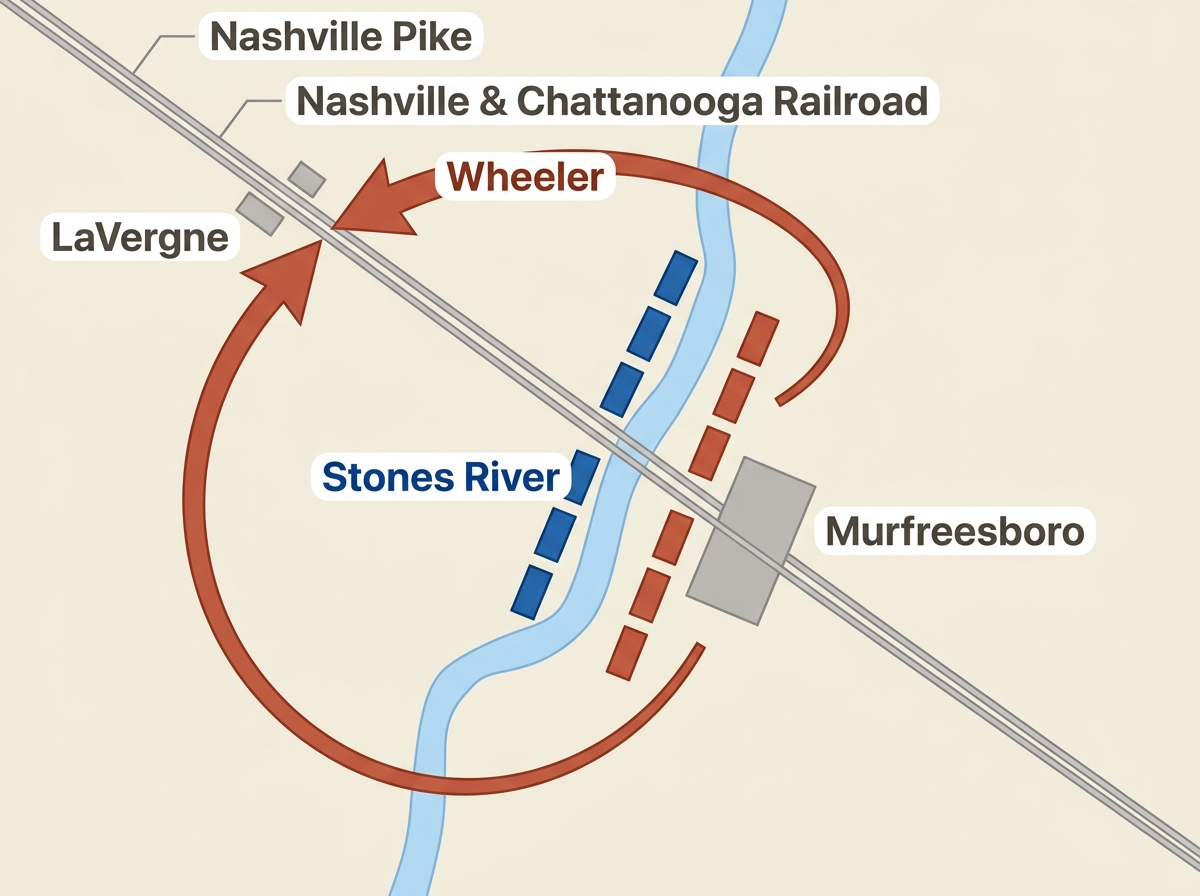
There was one Confederate piece already in motion before either plan could fire. In the days the Union army spent grinding the 30 miles down from Nashville, Bragg’s cavalry chief, Brigadier General Joseph Wheeler (South), took some two thousand horsemen and rode them completely around Rosecrans’s marching army, a full circuit, front to rear, in about forty-eight hours. At midday on December 30 his troopers fell on a lightly guarded supply train (a supply train being a convoy of wagons hauling food and ammunition, not a railroad train) near the village of LaVergne, behind the Union line. They carried off or burned close to a million dollars’ worth of supplies and captured and paroled some eight hundred men. By the early hours of December 31, Wheeler rode back in on Bragg’s flank having torn up the Union rear and left Bragg believing he could strangle Rosecrans’s supply line and force him to retreat without a real fight. That single road back to Nashville, the pike, was the Union army’s one open artery, and the Confederates had just shown how exposed it was. Hold the pike and you held the battle.
"Home! Sweet Home!"
The song that bands of both armies are said to have struck up together on the night of December 30; soldiers on both sides reportedly joined in.
The night before the battle, the two armies camped close enough to hear each other. Regimental bands began a kind of contest across the dark, one side’s "Yankee Doodle" answered by the other’s "Dixie." Then, by most accounts, one band started up Home! Sweet Home!, and bands and men on both sides joined in together: thousands of soldiers who would be trying to kill each other at first light, singing the same song about home across the cold ground between them.
Who Hits First
Two armies, two identical plans, one open question: who hits first.
By the night of December 30, 1862, roughly 76,000 men were bedded down within earshot of each other west of Murfreesboro, and both commanders intended to attack the enemy’s right wing at dawn. Bragg’s men had less ground to cover and woke earlier. That single fact, who landed the first punch, would shape the next three days.