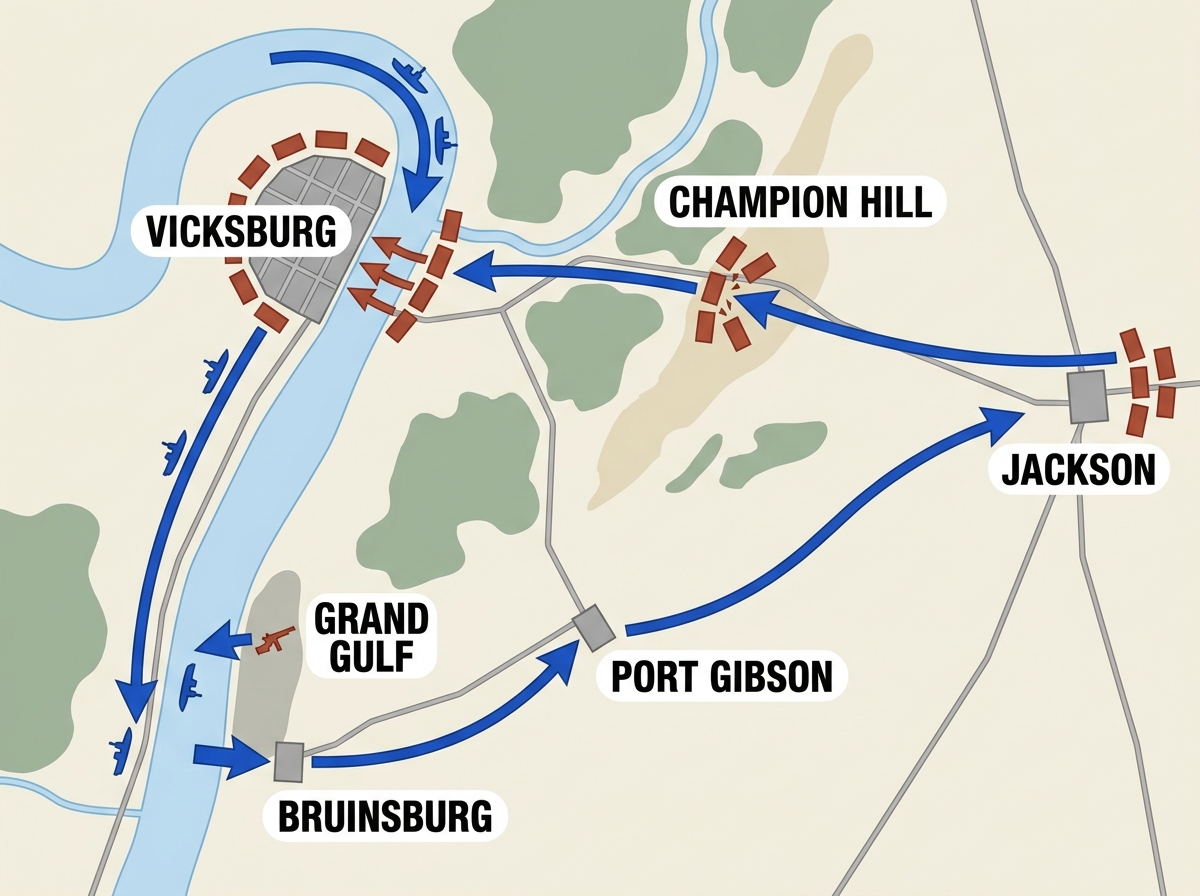
What Grant decided to do in April 1863 was the kind of plan that gets a general either remembered or relieved. If he couldn’t get above or around Vicksburg, he would get below it: march his army down the Louisiana side of the river, past the city out of range of its guns, then cross the Mississippi back to the eastern bank somewhere south of the fortress and come at it overland from the rear, the one direction the swamps didn’t protect. The trouble was the fleet. The army could walk down the west bank, but it needed Porter’s (North) gunboats and transports on the same side of the river to ferry it across, and the only way to get them downstream was to run them straight past the Vicksburg batteries.
Running the Batteries
On the night of April 16, 1863, Porter did exactly that. He took a fleet of gunboats and transports downriver in the dark, hugging the far bank, and for two and a half hours the Vicksburg guns lit up the night and hammered them as they passed. Most of the fleet got through; only a single transport was lost. A second run followed on April 22. It put Porter’s boats below the city, exactly where Grant needed them.
To keep Pemberton’s (South) eyes anywhere but the crossing point, Grant ran two deceptions. He sent Sherman to feint, or fake, an attack up at Haynes’ Bluff, north of the city, where the Confederates still expected the blow to fall. And he turned loose a cavalry raid under Colonel Benjamin Grierson (North) that slashed roughly 600 miles straight down the length of Mississippi, tearing up railroads and pulling Confederate forces into a frantic, fruitless chase across the whole state. While Pemberton looked north and east at phantom threats, Grant moved south.
The Largest Landing Before D-Day
The crossing itself nearly went wrong. Grant’s first choice was Grand Gulf, a Confederate strongpoint on the east bank, and on April 29 he sent Porter’s ironclads to pound its bluff batteries into silence so the army could land there. After five hours of bombardment the guns were still firing and the ironclads were battered, so Grant changed the plan on the spot: he marched the army a little farther downstream and crossed where nobody was waiting, at Bruinsburg, on April 30.
Ferrying the army across to Bruinsburg was, at the time, the largest amphibious operation, the largest ship-to-shore landing of troops, in American history, a record it would hold until the D-Day invasion of Normandy in 1944. Because Grand Gulf had pushed it to an undefended stretch of shore, the whole thing went across unopposed: by the next morning some 24,000 men had stepped onto dry Mississippi soil with the fortress behind them and the interior of the state open ahead.
Cut Loose from the Base
Then Grant did the thing the burning of Holly Springs had taught him. Rather than tie his army to a vulnerable supply line back to the river, the kind of line Van Dorn (South) had cut so easily that winter, he largely cut himself loose from his base and lived off the country, the army carrying what it could and stripping the rest from the Mississippi plantations as it marched: corn cribs, smokehouses, livestock, the stored wealth of the slaveholding valley feeding the army sent to break it. Freed from the supply tether, he drove inland fast, and over the next eighteen days he fought five battles.
He landed and won at Port Gibson on May 1, securing the beachhead. He beat back a Confederate brigade, several thousand men, at Raymond on May 12. Then, instead of turning straight for Vicksburg, he wheeled inland to the northeast and on May 14 stormed into Jackson, the Mississippi state capital, scattering a small relief force gathering there under General Joseph E. Johnston (South) and wrecking the city’s railroads and war factories so they could not be used against him. Only then did he turn back west toward Vicksburg, Jackson lying inland to the east and Vicksburg on the river to the west, deliberately keeping his own army planted between Johnston’s relief force to the east and Pemberton’s garrison to the west so the two could never join hands.
The Ridge That Decided It
On May 16 the campaign turned on a single ridge. About twenty miles east of Vicksburg, on a wooded hill called Champion Hill, Pemberton finally came out to fight, and the result decided everything. It was the hardest day of the campaign. Grant’s columns came at the high ground through ravines and cornfields; the crest changed hands as the lines surged up and back across it, and for a few hours in the middle of the day the issue was genuinely in doubt: Pemberton had the position and the moment to wreck a piece of Grant’s army if he moved fast. He didn’t. Grant’s men carried the hill, broke the Confederate line, and turned a battle into a rout. The cost to the Confederacy was permanent: Pemberton was thrown back toward the city, and an entire Confederate division of several thousand men under Major General William W. Loring (South) was cut off in the collapse and never made it back inside Vicksburg at all, wandering off east to join Johnston instead.
Western TheatreChampion Hill: the ridge that decided the campaignGrant later wrote that the day left him "assured of our position between Johnston and Pemberton, without a possibility of a junction of their forces."
Grant, Personal Memoirs
From Champion Hill the two Confederate armies could never combine, and Vicksburg’s garrison was on its own. The next day, May 17, Pemberton’s rearguard tried to hold the crossing of the Big Black River just east of the city and was routed, the survivors streaming back over the bridges and into the Vicksburg fortifications. The gamble had worked. In eighteen days Grant had crossed a major river, cut his own supply line, won five battles, taken a state capital, and driven the enemy’s whole field army inside its walls.