To understand what happened in the next two days, you have to start with what the warriors had come for, because it was not what Montcalm had come for. They had marched, some of them 1,500 miles, for concrete things their cultures valued and their losses demanded: plunder to carry home, scalps and trophies that proved a man’s prowess and standing, and above all captives. For many of these nations, captives were the point of war itself. In the mourning-war tradition, a people who had lost kin to disease or fighting could take prisoners from an enemy and adopt them in, replacing the dead, knitting up the wound a death left in a community. Captives could also be ransomed. Either way, to come home empty-handed was not merely disappointing. It was a failure, a humiliation, a war that had accomplished nothing.
Montcalm’s beautiful European terms handed them exactly that: nothing. A beaten enemy was going to march out the gate with his guns and his flags and his freedom, and the warriors who had won the battle were supposed to stand aside and watch him go. From the Native side, this was not honour. It was the French breaking faith. Their ally had promised, by coming to fight alongside them, a share in the fruits of victory, and now their ally was giving those fruits back to the enemy without so much as asking. The double betrayal that sits at the centre of this whole episode was already in motion: Montcalm would soon feel betrayed by allies who would not obey the terms he had set, and the allies already felt betrayed by a Frenchman who had denied them the spoils that victory owed.
It began with the men who could not march. The fort surrendered around one in the afternoon on August 9, and that same afternoon the killing started. The badly wounded had been left behind in the fort under French protection, as the terms promised. Warriors entered, found little plunder worth taking, and fell on roughly seventy sick and wounded men, about thirty sick and forty wounded, killing and scalping them. A planned night march-out of the rest of the column was then called off when warriors massed around it in the dark.
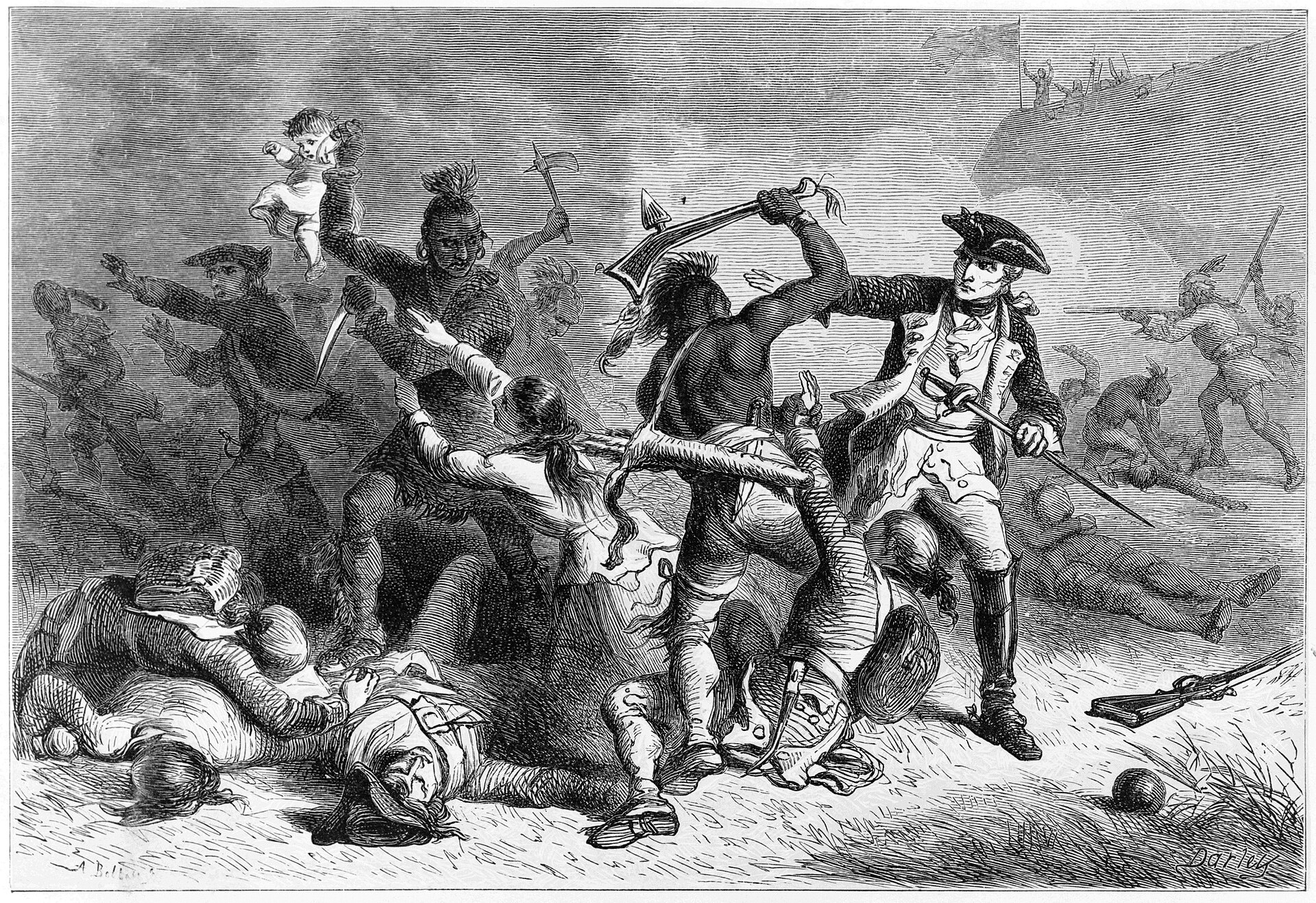
At dawn on August 10, around five in the morning, the column finally formed up and started south down the road toward Fort Edward, and as it moved, hundreds of warriors swarmed it. They stripped clothing off the marchers, snatched weapons and baggage, and seized people, dragging away women, children, servants, and enslaved people. Enslaved Black people in the column were singled out and seized whether or not they were legally free. The most exposed were tomahawked, especially at the rear of the column, where Abenaki warriors fell on the stragglers. The French escort was only partly able to protect the column, and in some cases unwilling. Colonel Joseph Frye of Massachusetts, who lived through it, put it flatly.
the savages fell upon our rear, killing and scalping.
And here the story has to part company with the number almost everyone has heard. The figure that rang through colonial newspapers and later through James Fenimore Cooper’s The Last of the Mohicans is that around 1,500 people were massacred at Fort William Henry. That figure is fiction. Cooper’s novel was fiction, and the toll itself was inflated by writers in the decades after. What the documents support is far smaller: the historian Ian K. Steele, whose reconstruction is the careful one, puts the dead and missing at fewer than 200, and modern scholarship lands somewhere around 70 to 185, out of the 2,308 who had surrendered. That is at most around eight percent of the garrison. None of it is softened by getting the number right. Sick men were murdered in their beds, and people on a road under a promise of safe passage were cut down. But it is roughly one-tenth of the myth, and the myth did damage of its own, which is part of this story too.
The gap between the myth and the count is explained largely by the captives, because most of the people the warriors took off that road were not killed. They were carried away as prisoners, and there were a great many of them, somewhere between 300 and 500 by Anderson’s estimate. This is where the mourning-war logic shows in the record: these were people taken to be adopted, ransomed, or kept, not slaughtered. Montcalm worked hard afterward to recover the roughly 500 taken, paying something like 130 livres and thirty bottles of brandy for each. About 200 were back by the end of August, and around 300 in all by late September. Some remained with the nations who had taken them, and at least around forty chose to stay, having been adopted in. Captivity in the mourning-war was often the doorway into a new life inside another people, not a death sentence, and most of those carried off this road lived.
That leaves the hardest question, and the honest answer is that it has never been settled: how much of this lies on Montcalm. By his own account and that of his officers, he waded into the chaos to pull captives back, with partial success, and felt personally dishonoured by what happened to people he had given his word to protect; Francis Parkman painted him this way, a man failing to control forces beyond him, while Francis Jennings argued he deliberately looked away. The sharpest reading is Steele’s, that the deeper cause was the French over-promising war trophies to draw the nations south, so that when the European terms denied those trophies the resentment exploded, and Montcalm’s own later excuse, that he could not restrain so many nations and that the British had given them rum, the record treats as dubious.
One last thing went home with the warriors, invisible and worse than any of it. The garrison had smallpox among its sick, the very men killed and scalped in the fort. Smallpox travels in blood and breath and on the things people carry, and the warriors who killed those men and took those trophies carried the disease north along the trails to their villages. It spread through the Great Lakes and Canadian communities, hitting the Potawatomi especially hard. The toll of that is real and was never counted, but it is entirely possible the deadliest casualties of Fort William Henry were not on the road at all. They were children in towns a thousand miles away who never saw a redcoat.