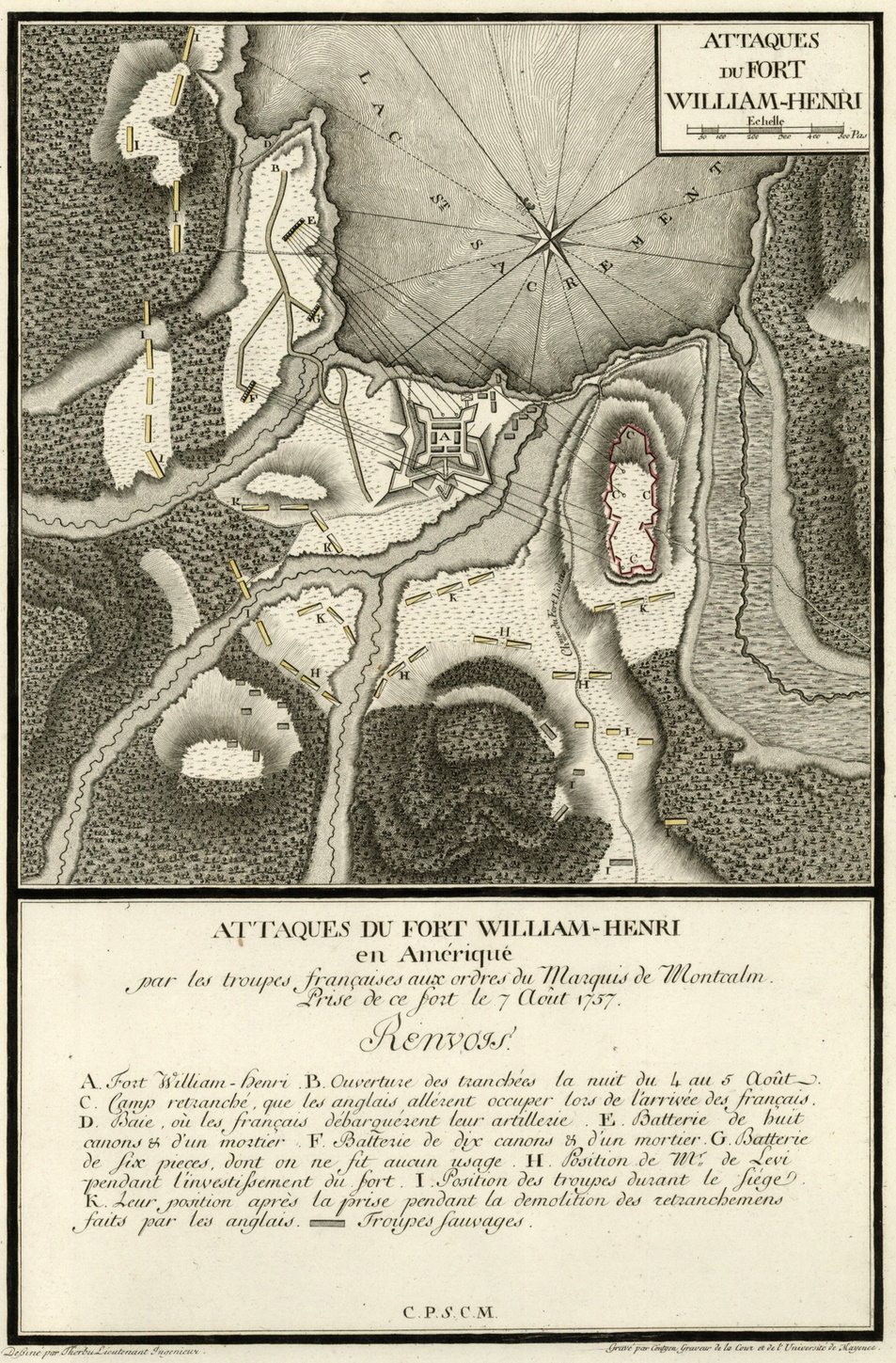
Montcalm had won. He had taken the fort, broken the British south anchor on the corridor, and proven that New France could mass an army and a coalition no British general could match. Then he threw most of the winnings away. With the road to Fort Edward and Albany lying open in front of him, he did not march on it, because his Native allies had gone home and he was short of the provisions and transport a deeper push would need. He burned Fort William Henry to the ground, levelled it, and withdrew north around August 18, 1757. The fort was never rebuilt by either empire; its ruins sat at the south end of the lake until a tourist reconstruction went up in the 1950s. The British had lost the position. But what the campaign did to everyone who touched it ran far past the loss of a fort.
For the British colonies, the massacre became a weapon, and the inflated number made it a far heavier one. "Remember Fort William Henry" became a rallying cry. The myth of 1,500 slaughtered under a flag of truce hardened British and colonial resolve to fight the war to the end, which from the British point of view was useful. But the same myth fed something uglier and longer-lived: an undiscriminating hatred of Native people as a whole, a conviction that they were treacherous and savage by nature, which the real and limited atrocity at Fort William Henry was made to prove. The lie did work that the truth could not have done, and a great deal of that work was poison.
The British also answered in kind, citing this very place. Where Montcalm had granted the honours of war, British commanders later refused them. Major General Jeffery Amherst denied the honours of war to the French garrison at Louisbourg in 1758 and again at Montreal in 1760, pointing back to Fort William Henry as his justification, and at Montreal he sent the surrendering French regiments home stripped even of their colours, the one possession the code had always let a beaten army keep. The courtesy Monro’s men had marched out under, and then died for the failure of, was now something the British would not extend to their enemies. The episode helped make the back half of this war harder and colder than its first years had been.
The deepest damage, though, fell on the alliance that had won the battle. The grand coalition of 1757, thirty-odd nations and the largest Native force of the war, never came together for France again. The far nations went home feeling cheated by an ally who had denied them their victory and, worse, sent many of them home carrying smallpox that then tore through their villages. They drew the obvious lesson: fighting for the French on the French understanding of war was a bad bargain. Never again would Native allies flock to the French colours as they had in 1757. That pushed Montcalm, who had always been more comfortable with European war than with frontier alliance, toward fighting conventionally, in lines and sieges against British regulars. For a New France that was outnumbered and could never win a straight contest of resources, losing the one advantage that had let it punch above its weight, the Native alliance, was a strategic wound it could not afford. The next year Montcalm would win another famous defensive victory in lines up the corridor at Carillon, but the war as a whole was turning against him, and the coalition that might have changed the odds was gone.
The BattlesCarillon (1758), Montcalm’s next stand up the same corridorAs for Webb, the general sixteen miles away who never marched, his failure to relieve Fort William Henry drew lasting criticism, and deserved it. His caution may have saved Fort Edward, but it abandoned a garrison that had every reason to expect help, and the men who died on the road died partly because the relief column never came. He was recalled to England not long after, his name attached to the corridor’s worst day, and never again held a field command that mattered.
Fort William Henry was not, in the end, a story of European honour betrayed by savagery, the version the myth told. It was two genuine systems of war meeting and finding they could not be reconciled. On one side stood the European honours of war, an elaborate code in which a beaten enemy was let go intact, his life and liberty untouched, his courage saluted. On the other stood a Native understanding in which victory meant captives to mend a grieving people, plunder to bring home, and trophies that gave a warrior’s life meaning, and in which an ally who promised those things and then gave them back to the enemy had simply broken his word. Montcalm set the terms by the first code without consulting the men who lived by the second, and the gap between the two filled with blood. Each side felt betrayed by the other, and from where each stood, each was right. That is the harder, truer story, and it does not need a number ten times too large to be a tragedy.
Off the fieldThe contest for Native alliances, the alliance this battle broke