The British colonists who fought this war named it after the people they were most afraid of. King George's War, a generation earlier, had already used the monarch's name, so when fighting broke out again in 1754 the colonists called the new one the French and Indian War. The label is a point of view. It names the enemy from a British porch looking west: the French Empire, and the many Indigenous nations fighting alongside it. What the name quietly admits is that Native nations were not a sideshow to this war. They were the thing the war turned on.
Look at a map of North America in 1754 and most of it is empty of colonial towns. The British colonies hugged the Atlantic coast. New France was a thin ribbon up the St. Lawrence River and a scatter of forts. Everything in between, the Great Lakes country and the Ohio Country (the upper Ohio River valley, roughly today's western Pennsylvania, eastern Ohio, and the panhandle of West Virginia), was Native homeland. No European army could march through that interior, let alone hold it, without Native nations who knew the ground, supplied the warriors, and decided whether a column of redcoats walked out of the forest or didn't. So both empires courted them. They courted them on very different terms, and that difference decided who won the opening battles, who lost the trust that won them, and what happened to the nations who had been doing the deciding all along.
What France had built
France's advantage was old. For a hundred years French traders had pushed deep into the interior to buy beaver pelts, and the men who did it (the voyageurs who paddled the canoe routes, and the coureurs de bois, the unlicensed "runners of the woods") did not stay behind fort walls. They lived in Native villages, learned the languages, married Native women, and raised children with a foot in both worlds. By the 1750s France's relationship with the interior nations was built out of kinship and need: France needed the fur, and the fur came through marriage and friendship, not conquest.
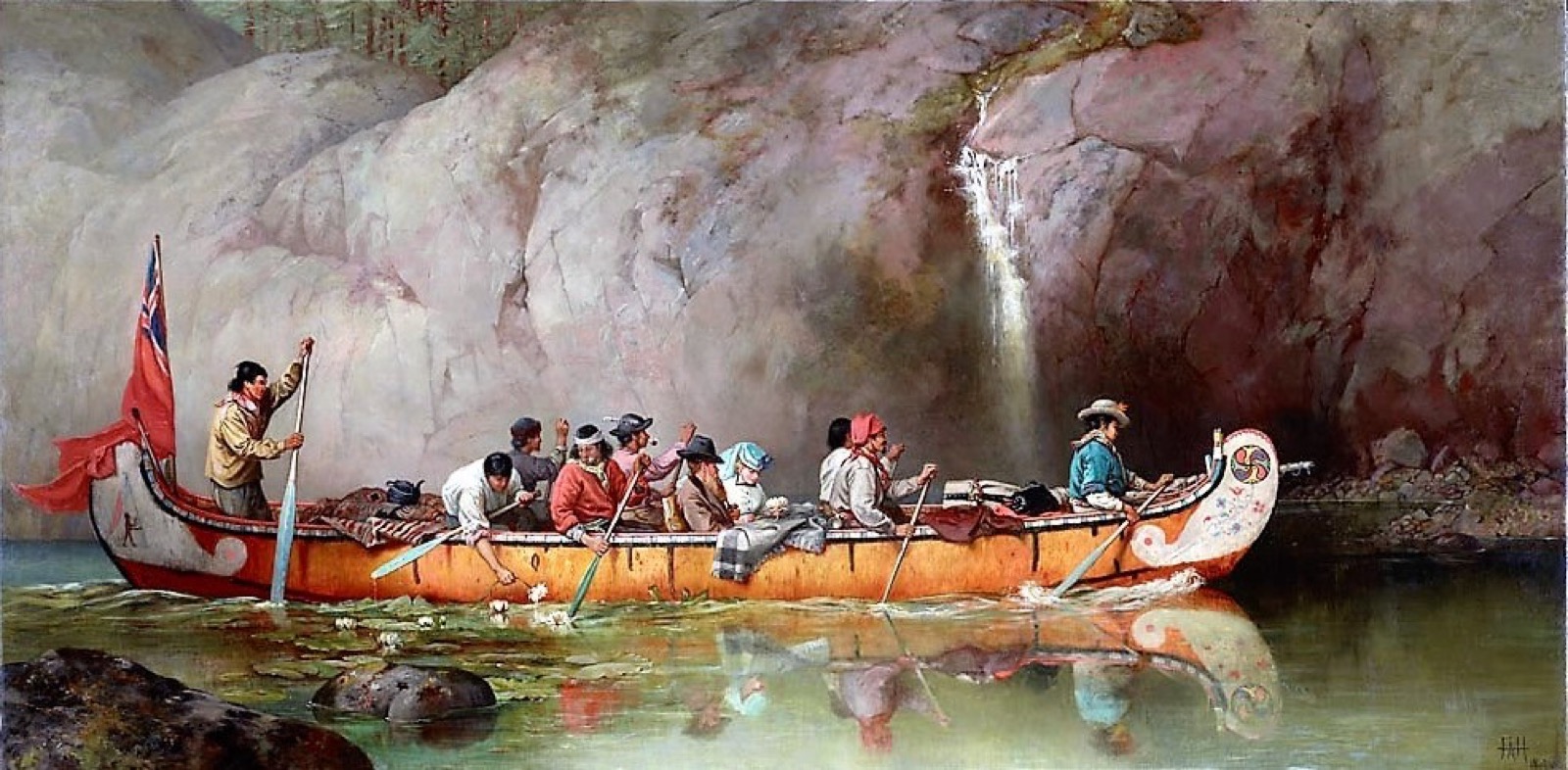
That relationship ran through a wide circle of nations. The French called the Great Lakes interior the pays d'en haut, the "upper country," and its peoples were France's deepest allies: the Ottawa (Odawa), the Ojibwe (also called Chippewa), the Potawatomi, the Huron-Wyandot, and others like the Mississauga and the Winnebago. Closer to the French heartland, strung along the St. Lawrence near Montreal, were the mission communities known as the Seven Nations of Canada: seven Catholic Native villages allied to New France. The most reliable of them was Kahnawake ("near the rapids"), a Mohawk town across the river from Montreal.
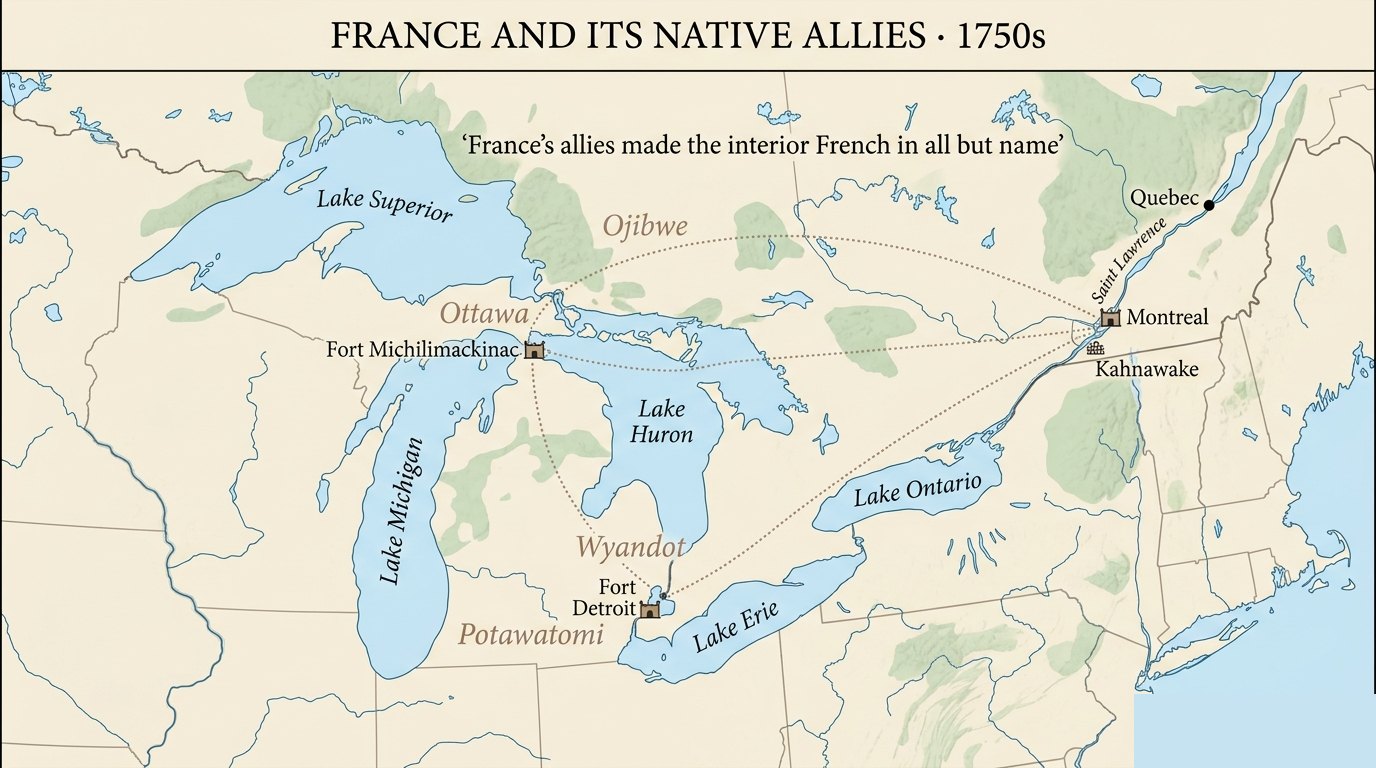
The Kahnawake Mohawk carry a sharp irony. Their ancestors were Mohawk who, after French raids on the Mohawk villages in New York in the 1660s, converted to Catholicism and resettled on the St. Lawrence. A century later their descendants were France's most dependable Native allies, which meant that when the war came, Mohawk would fight Mohawk: Kahnawake Mohawk for France, and the Mohawk of the New York valley for Britain. The nations were not blocs. They were communities making their own choices.
Two things made the French alliances durable, and both are easy to misread. The first is gift-giving. Every year France handed out powder, lead shot, cloth, and goods to its allied nations. To European eyes that looked like bribery. It wasn't. In Native diplomacy, accepting a gift created a real obligation between the giver and the receiver, and the steady flow of gifts was the substance of the alliance, the thing that proved the relationship was alive. Stop the gifts and you didn't just save money; you broke the bond. The second was the Catholic missions. Jesuit priests had converted many of the St. Lawrence nations while largely leaving their languages and clan systems intact, which tied those communities to New France by faith as well as trade.
Historians have a name for how this worked: the middle ground. The French governor played a role the Great Lakes nations called Onontio, a father figure, but a particular kind of father: one who gave gifts, settled quarrels between nations, and kept the peace that trade depended on, rather than one who gave orders. It was a relationship of mutual accommodation, a middle ground where neither side simply imposed its will. That is the model that made France's position in the interior so strong. Its collapse is where this story ends.
"We will not be like Father and Son, but like Brothers." — Iroquois leaders, 1692
What Britain had, and what it didn't
Britain's great alliance was the Covenant Chain, a partnership between the British colonies (New York above all) and the Iroquois Confederacy, also called the Six Nations or Haudenosaunee: the Mohawk, Oneida, Onondaga, Cayuga, Seneca, and Tuscarora. It had grown out of old Dutch trade ties and been formalized after England took over the Dutch colony in 1664, and it was renewed at councils in Albany, where the two sides spoke of a silver chain that had to be polished now and then to keep it bright. The Iroquois were precise about what the chain meant. It linked equals. As their leaders had put it back in 1692, they would be brothers to the English, not sons.
By the 1750s the chain was tarnishing fast, and the reason was land. British and especially Virginian land hunger pressed constantly westward, often through outright fraud, and the nations Britain most needed had the most reason to distrust it. The clearest example sat right in the Ohio Country, the very ground the war would be fought over.
Off the fieldThe Ohio Country & the Ohio CompanyIn 1749 a group of Virginia land speculators (investors who buy up land cheaply hoping to sell it later at a profit) called the Ohio Company of Virginia received a royal grant of 200,000 acres in the upper Ohio valley, with another 300,000 promised if they settled a hundred families within seven years. To the Ohio nations this was a paper claim on their homeland, and it was exactly the kind of thing that made the Ohio Delaware (also called the Lenape) and the Shawnee certain that the British wanted their country, not their friendship. France read the same threat and marched troops in to block it. The collision in the Ohio is where the war started, and the man who lit the fuse was neither French nor British.
The Half King starts a war
Tanaghrisson was a Mingo (Ohio Iroquois) leader the British called the Half King. The Iroquois Council had sent him to hold the Ohio Country for the Six Nations, to speak for the Ohio nations and keep them in line, but by the early 1750s that authority was slipping. The Ohio Delaware were going their own way; the Shawnee were drifting toward France. A leader without followers needed something to change the board, and Tanaghrisson decided what it would be. Historians such as Fred Anderson read his aim this way: he believed that a war between Britain and France would force the Ohio nations back under him, bound to a Britain that needed his warriors. So he set out to start one.
In the spring of 1754 a young Virginia officer gave him his chance. Lieutenant Colonel George Washington, then twenty-two, had pushed into the Ohio Country with about forty Virginians. On 28 May 1754, in the woods of Fayette County, Pennsylvania, Tanaghrisson and about a dozen of his Mingo warriors guided Washington's men to a hollow where a small French detachment was camped, under Ensign Joseph Coulon de Jumonville. They surrounded it and attacked at dawn. About ten of the French were killed and roughly twenty-one captured in a matter of minutes.
What happened next is the part the sources argue over. By the most-repeated account, the firing stopped with Jumonville wounded but alive, and Tanaghrisson walked up to him, said in French "Thou art not yet dead, my father," and killed him with a hatchet. The "father" was deliberate: Jumonville was standing in for all of French power in the Ohio, and Tanaghrisson was answering it. But the details are disputed. Sources disagree on whether Jumonville died from a musket ball or a hatchet, and by whose hand, and the killing is reported as widely as it is contested, never as settled fact.
The point that is not in dispute is whose plan this was. Washington did not stumble into the war and he did not engineer it alone; a Native leader put him in that hollow to serve a Native aim. It was the clearest case in the whole war of an Indigenous leader steering two empires toward a fight for reasons of his own. And it failed. The Ohio nations did not rally to him; the Shawnee had already turned to France, other Delaware bands with them, and Tanaghrisson had misjudged the ground he thought he commanded. He fell ill that summer and died of pneumonia on 4 October 1754, months before the war he had started spread across a continent.
Sir William Johnson and the Mohawk
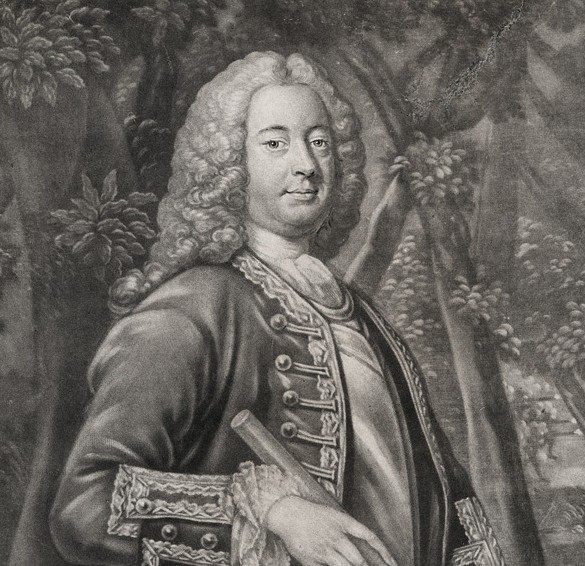
The man Britain trusted to hold the Iroquois was Sir William Johnson, an Irish-born trader who had settled in New York's Mohawk Valley, learned the Mohawk language, and steeped himself in Iroquois custom. The Mohawk adopted him around 1742 as an honorary sachem (a civil leader) and gave him the name Warraghiyagey, "a man who undertakes great things." In 1756 the Crown made him Superintendent of Indian Affairs for the Northern District, a post that reported straight to London over the heads of the colonial governments, with one job: revive the Covenant Chain and win the wary Iroquois to Britain. Johnson's closest link to the Six Nations was personal. His household partner was Molly Brant (Konwatsi'tsiaienni), a Mohawk clan mother whose standing among her people made her a power broker in her own right; she ran his household and her diplomacy and intelligence were central to his influence. Her younger brother Joseph Brant (Thayendanegea) was a boy in these years, about thirteen when he went with Johnson to his first battle in 1755; his fame would come later, in another war.
The Iroquois play their own game
It is tempting to file the Iroquois under "Britain's allies" and move on. They wouldn't have recognized the description. The Confederacy's strategy was its own: don't be conquered or dominated by either empire, and keep trade flowing from both. For most of the war that meant a careful neutrality, a refusal to commit fully to either side, because the leverage was in the not committing. A nation everyone needs and no one owns can play the empires against each other, and that is exactly what the Iroquois did.
It was never a single bloc, and the clearest proof runs along the length of the Confederacy itself. The Mohawk in the east, and especially Johnson's valley Mohawk, leaned British through his diplomacy and family ties. The Seneca in the west leaned the other way: Seneca warriors fought against Braddock's army at the Monongahela in 1755 and joined the raids on the Virginia frontier that followed, even as the Confederacy as a whole tilted British or neutral. So the Six Nations could have a man at the Monongahela firing on the redcoats and a man in the Mohawk Valley marching with them in the same year, and both were Iroquois. Even the British-leaning Mohawk were aggrieved rather than loyal, and the plainest proof of that came from their leading orator.
Hendrick at Albany
His name was Theyanoguin, known to the British as Hendrick, a Mohawk leader of the Bear Clan based at Canajoharie. (He is often confused with an older Mohawk of the same English name who had visited Queen Anne in London in 1710; they were two different men.) Hendrick was a Christian convert and the foremost Mohawk diplomat of his day, and he had run out of patience with the British.
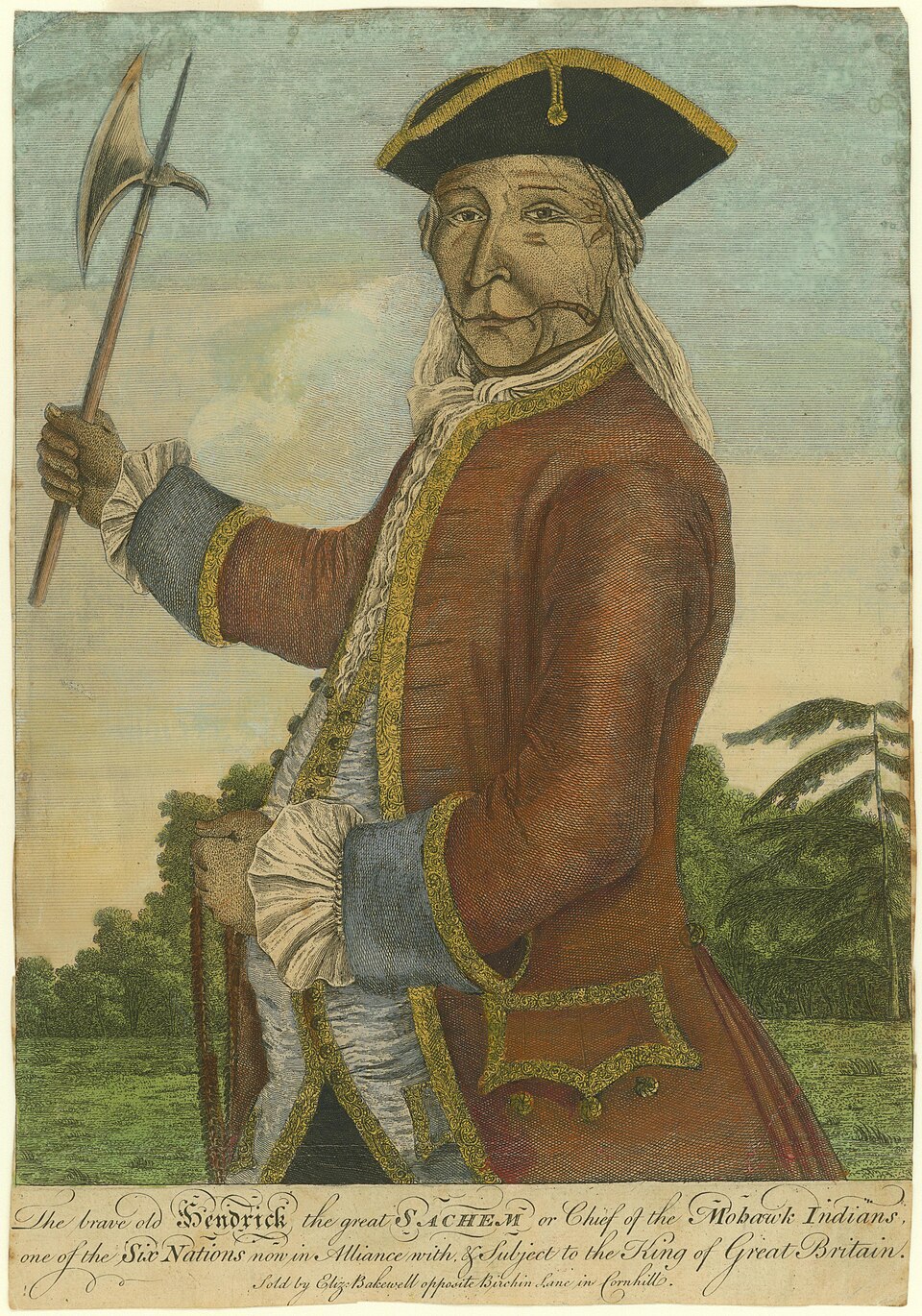
In 1753 he had stood before New York's governor and declared the Covenant Chain broken, citing roughly 800,000 acres of Mohawk land lost to fraudulent dealing. (That figure is the grievance Hendrick voiced rather than an audited survey, but the size of the anger is the point.) Then in June 1754, at a gathering of colonial delegates and Iroquois leaders in Albany called to shore up the alliance, he said it to their faces, in a speech that has outlived almost everything else said there.
"Brethren, you were desirous we should open our minds and our hearts to you; look at the French, they are men; they are fortifying everywhere; but, we are ashamed to say it, you are all like women, bare and open, without any fortifications." — Theyanoguin (Hendrick), Albany Congress, 1754
The contradiction in Hendrick is the contradiction in the whole British alliance. He thought Britain was negligent, grasping, and weak. He fought for it anyway, because the French expansion he watched fortifying "everywhere" threatened the Mohawk more. In 1755 he helped recruit Mohawk warriors for an expedition Johnson led toward the French at Crown Point, and rode out at the head of a Mohawk force himself, well into his sixties.
It went badly. On the morning of September 8, 1755, near Lake George, Johnson sent a detachment south, around a thousand colonial troops and two hundred or so Mohawk under Hendrick, and a French force under Baron Dieskau ambushed it in a ravine. Hendrick had objected to splitting the men in the first place. The saying remembered from him, passed down rather than written at the time, was that a small force was too few to fight and too many to die for nothing.
"If they are to fight, they are too few; if they are to die, they are too many." — Hendrick (Theyanoguin), on the eve of the Battle of Lake George, 1755
He was right. His horse was shot from under him in the ambush, and being old he could not get clear; he was killed there. And the warriors who killed Hendrick's Mohawk were themselves Mohawk, the Kahnawake fighting for France alongside Abenaki and Nipissing allies. Mohawk killed Mohawk in that ravine. There is no cleaner picture of what it meant to say these nations chose their own sides.
How Native allies won France its early war
A few weeks before Lake George, France's alliances had already delivered the war's most lopsided victory, and they had done nearly all of it themselves. In the summer of 1755 General Edward Braddock marched a British army toward Fort Duquesne, the French post at the forks of the Ohio (where Pittsburgh now stands). On July 9, about ten miles short of the fort near the Monongahela River, his column met a force that had come out to meet it.
The war storyThe MonongahelaThat force was overwhelmingly Native. Of roughly nine hundred fighters, only around 250 were French troops and Canadian militia; the rest, somewhere near 640, were warriors from the Great Lakes nations (Ottawa, Ojibwe, Potawatomi, Huron) and the Ohio nations (Delaware, Shawnee, Mingo), with Abenaki as well. The French field commander was killed almost at once. After that the warriors carried the fight, firing from the cover of the trees into Braddock's tight European formations standing exposed in the open.
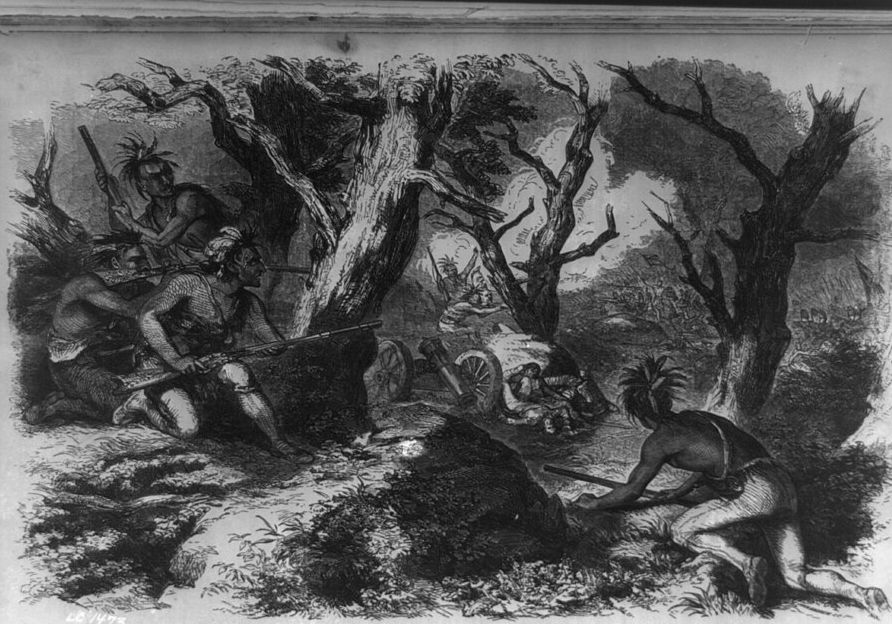
It was a slaughter. Of Braddock's roughly 1,300 to 1,460 engaged, more than 900 were killed or wounded; the French and their allies lost only a few dozen. Braddock himself was mortally wounded and died four days later, on July 13. A young Virginia officer named George Washington helped organize the survivors' retreat. The lesson of the Monongahela is the lesson of the whole war in miniature: the empire that held the Native alliances held the interior, and in 1755 that empire was France.
The Ohio nations' own war
What the Monongahela opened, the Ohio Delaware and Shawnee carried on for years, and they carried it on for themselves. Beginning about October 1755, war parties of Ohio Delaware (Lenape) under leaders such as Shingas and Captain Jacobs, and Shawnee alongside them, fell on the Pennsylvania, Maryland, and Virginia backcountry. From late 1755 into 1758 they killed, captured, or drove off thousands of settlers, in a frontier war that emptied whole valleys. They cooperated with France and were France's most important allies in those years, but they were not fighting France's war. They were fighting the colonists who had taken their land, for the land itself.
The colonies struck back where they could. On 8 September 1756 Lieutenant Colonel John Armstrong led about three hundred Pennsylvania provincials in a dawn raid that destroyed the Delaware town of Kittanning, the staging point for the raids, and killed Captain Jacobs in the burning. It was a mixed result at best. Armstrong took heavy losses, most of the townspeople escaped with their captives, and the raids only intensified that autumn. What the strike did was embolden a Pennsylvania peace faction, and that faction's road led to a council fire.
The man who drove it there was Teedyuscung (Delaware), the Delaware spokesman who turned the grievance into talks. At Easton in 1756 he laid the land fraud out in the open and accused the Pennsylvania proprietors of forging the deed behind it. His complaints pulled in British negotiators, ran through a second Easton conference in 1757, and built toward the treaty in 1758 that became the way out of the war in the Ohio. The fighting did not end on a battlefield. It ended at the table Teedyuscung had insisted on.
Easton: the Ohio nations change the war
The decisive blow to France in the interior was not struck by a British army. It was negotiated at a council. By 1758 the Ohio Delaware and Shawnee, the nations whose distrust of British land hunger had pushed them toward France in the first place, had reasons to reconsider. They had always fought for their own land, not for France, and Britain was now offering to talk about exactly that.
In October 1758, at Easton, Pennsylvania, more than five hundred Native people gathered with the colonial governors of Pennsylvania and New Jersey. Representatives of around thirteen nations attended, the Ohio Delaware and Shawnee and three of the Iroquois nations among them, with Teedyuscung prominent in the talks. On October 26 they reached terms. Britain pledged to recognize the nations' rights to their Ohio hunting grounds and, crucially, to keep British settlers out of the lands west of the Appalachian Mountains after the war. Pennsylvania agreed to return lands it had taken in the Walking Purchase of 1737, the swindle in which the colony used a rigged day-and-a-half "walk" (the Lenape expected a man to cover perhaps forty miles of forest in that time, but Pennsylvania cleared a straight path in advance and hired runners who turned it into a seventy-mile sprint) to seize a tract about the size of Rhode Island from the Lenape. The Lenape were paid about 1,000 Spanish dollars, money that bought their remaining land claims in New Jersey specifically rather than undoing the older fraud. And Pennsylvania's governor agreed to deal with the Delaware directly, restoring their standing rather than treating them as junior partners of the Iroquois.
The military effect was immediate. With the Ohio Delaware and Shawnee pulling away from France and pledging neutrality, the French garrison at Fort Duquesne lost the Native shield that had made it dangerous. As a British expedition under Brigadier General John Forbes closed in that November, the French, now outnumbered and abandoned by their allies, blew up Fort Duquesne and left. The British took the site and built Fort Pitt, the seed of Pittsburgh.
The Ohio nations were not given peace at Easton. They chose it, because it served their interest better than the French alliance now did: it promised their land back and got the Iroquois off their backs. In doing so they decided the war in the Ohio more surely than any battle had. The same promise to halt settlement at the mountains would echo five years later in the Crown's Royal Proclamation of 1763, and like most such promises to Native nations, it would not hold.
The victory that cost France its allies
Between Braddock's defeat and Easton, France won again, and the winning is where it began to lose. In August 1757 the Marquis de Montcalm laid siege to Fort William Henry, a British fort at the south end of Lake George held by Lieutenant Colonel George Monro with a garrison of around 2,300, many of them sick with smallpox. Montcalm's army of about 8,000 included some 3,000 French regulars (full-time professional soldiers), about 3,000 Canadian militia, and nearly 2,000 Native warriors drawn from both of France's alliance circles at once: the Great Lakes nations of the pays d'en haut and the St. Lawrence mission nations, the Abenaki among them.
The war storyFort William HenryMonro surrendered on August 8 on generous terms. His garrison would march out under French escort with the honors of war, keeping their muskets (though no ammunition) and a single symbolic cannon, on the promise not to fight again for eighteen months. It was an honorable European arrangement between two European armies, and that was precisely the problem.
The warriors who made up a quarter of Montcalm's army had not come for honor. They had been promised the trophies of war: plunder, scalps, and captives, the recognized returns of a successful campaign, the thing that justified travelling hundreds of miles from the Great Lakes to fight someone else's siege. The surrender terms handed the war stores to the French army and let the British keep their personal effects, which left the warriors with nothing at all. From where they stood it looked like the French had made a private deal with the enemy at their allies' expense. As the historian Ian K. Steele put it, the terms bred "resentment, as it appeared that the French were conspiring with their enemies, the British, against their friends, the Indians."
So on the morning of August 9, as the British column marched for Fort Edward, warriors fell on it. They struck first at the sick and wounded left behind in the camp, then at the marching column, killing some, stripping others, and seizing women, children, servants, and enslaved people as the captives they had been denied. A Massachusetts officer in the column, Colonel Joseph Frye, watched it happen.
"...the savages still carrying away officers, privates, women and children, some of which later they kill'd & scalpt in the road." — Col. Joseph Frye, eyewitness, 1757
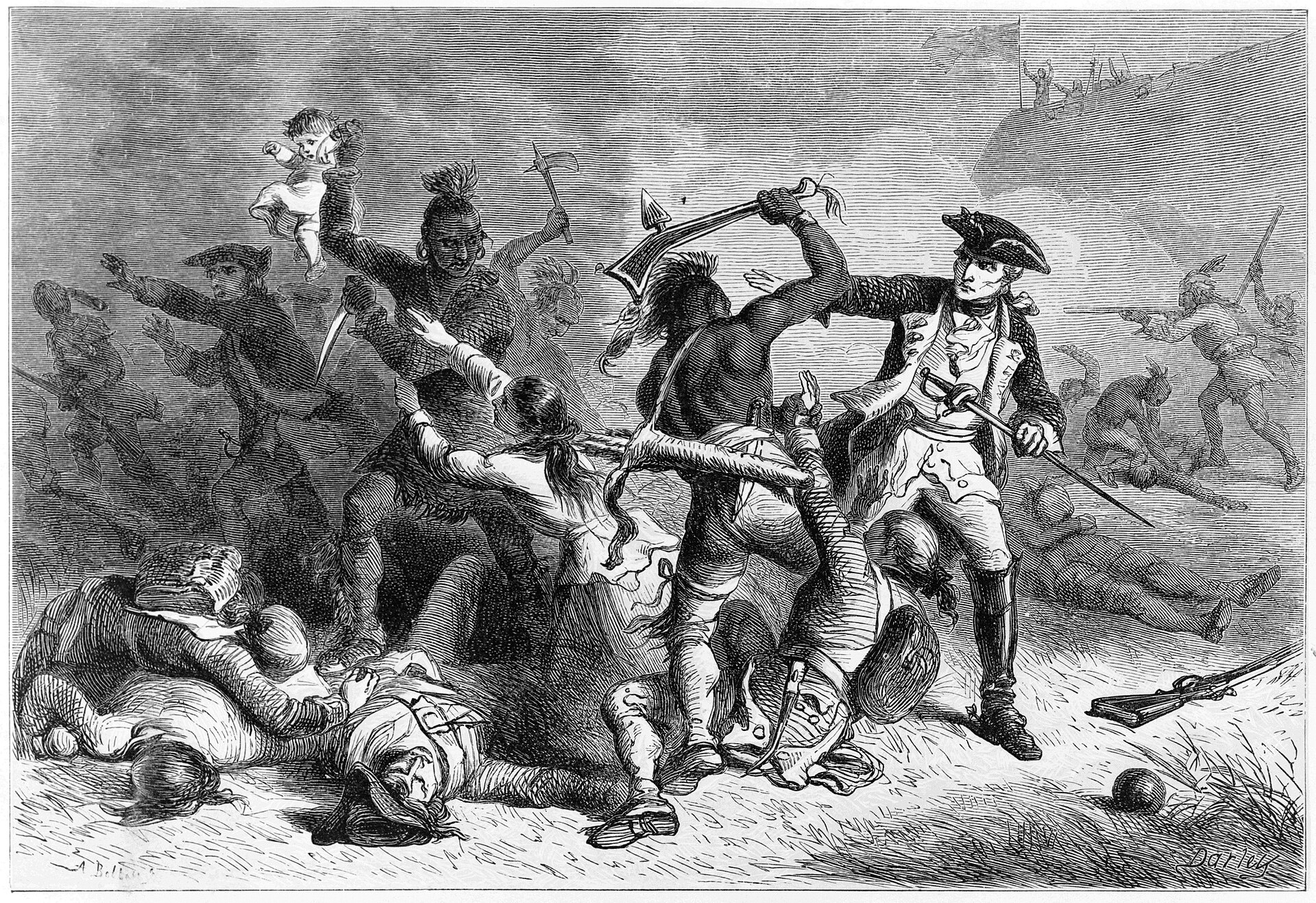
The episode became a legend, and the legend inflated it. Jonathan Carver's 1778 account claimed as many as 1,500 dead, a figure later echoed by the historian Benson Lossing, and James Fenimore Cooper's 1826 novel The Last of the Mohicans cemented the legend in the popular imagination. Modern scholarship puts the toll far lower, somewhere between about 69 and 184 British killed or missing, under eight percent of those who had surrendered, and forensic work on the dead has found that disease killed more of them than weapons did. Whether Montcalm could have stopped it is still argued: one tradition holds that his officers did what they could and were simply overwhelmed, another that he saw it coming and acted only once the worst was underway.
What is not in doubt is the cost, and it ran in two directions. The garrison had been riddled with smallpox, and the Great Lakes warriors who carried captives and plunder back to their distant villages carried the disease home with them, sparking epidemics that devastated their own communities. They had been denied their due, then sickened for their trouble. France had won the battle and broken faith with the allies who won it. The western nations remembered. Many of them would not march for France again.
Allies, not pawns
Step back from the battles and a pattern is plain. At every turn the Native nations were acting on their own strategy, not anyone else's. The Ohio Delaware and Shawnee distrusted Britain over land, then made peace with Britain when peace protected that land. The Great Lakes nations fought brilliantly for France, then turned away when France cheated them. The Iroquois balanced between the empires to keep from being swallowed by either. Tanaghrisson, the Mingo headman the British called the Half King; Hendrick at Albany; Teedyuscung at Easton; each pursued a Native aim, not a French or British one.
The protocols said as much, if anyone was listening. Gift-giving, the polished chain, brother and not son, Onontio the father who persuades rather than commands: every one of these assumed that Native nations were independent powers to be courted, not subjects to be owned. They were never "Britain's Indians" or "France's Indians." They were nations deciding which empire's offer served them, and reserving the right to change their minds.
The cost of being courted was nonetheless ruinous. Smallpox tore through the garrisons and then through the villages, carried home from Fort William Henry into the Great Lakes country. War and captivity emptied communities. And underneath all of it ran the slow catastrophe the whole war sat on top of: the steady loss of Native land. The Walking Purchase that defrauded the Delaware, the 800,000 acres of Mohawk country Hendrick said had been swindled away, the Ohio Company's 200,000-acre paper grant over Delaware and Shawnee homeland. The contest for Native alliances was, at bottom, a contest over Native land, and the people whose land it was would pay for the outcome no matter who won.
Winning the war, losing the peace
France lost. Quebec fell in 1759, Montreal in 1760, and the Treaty of Paris in 1763 handed New France to Britain. For the Native nations of the interior that defeat removed the one thing their whole strategy had depended on: a second empire to play against the first. With France gone, there was no one left to balance Britain with, and the leverage that had made these nations courted powers simply evaporated.
Britain's commander in North America, Jeffery Amherst, drew the obvious conclusion and acted on it. To him the Native nations were no longer allies to be cultivated; they were conquered subjects, and subjects did not need to be paid for their loyalty. Beginning in early 1761 he ended the customary gift-giving, the very practice that, in Native eyes, was the alliance itself. He restricted the sale of gunpowder and ammunition to Native traders, which was not an inconvenience but a threat to hunting and the entire fur economy. And he made little secret of his contempt; Native people complained that the British treated them no better than slaves or dogs. Amherst thought he was cutting waste. He was severing every cord that had held the interior together.
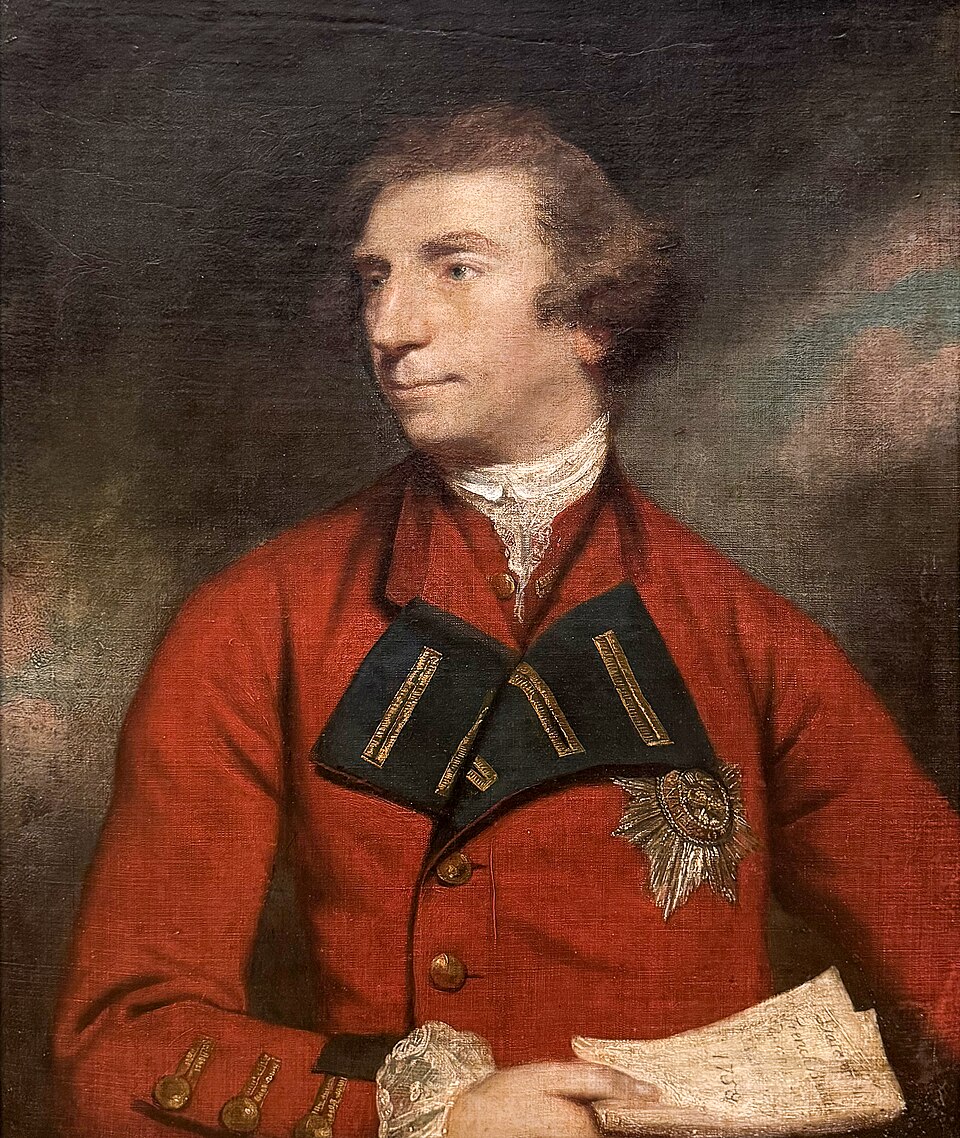
"Could it not be contrived to send the Small Pox among those disaffected tribes of Indians? We must on this occasion use every stratagem in our power to reduce them." — Jeffery Amherst to Henry Bouquet, 1763
The explosion came within months. In May 1763 a broad coalition of nations, led by the Odawa war leader Pontiac (Obwandiyag) among others, rose against the British posts strung across the Great Lakes and the Ohio. The trigger was Amherst's policy and the news that France had signed their homeland over to Britain without so much as a word to them. During the siege of Fort Pitt that summer, British officers gave besieging Delaware two blankets and a handkerchief taken from the fort's smallpox hospital; one of the traders inside recorded it plainly in his journal. Amherst, separately, wrote to his subordinate Colonel Henry Bouquet endorsing exactly that idea, that the smallpox should be spread among the nations by means of blankets.
"You will do well to try to inoculate the Indians by means of blankets, as well as to try every other method that can serve to extirpate this execrable race." — Jeffery Amherst to Henry Bouquet, 1763
To "extirpate" a people is to wipe them out, and Amherst meant it as he wrote it. Whether the blankets caused an outbreak is debated; the intent in his own hand is not.
The thing that had made France's alliances work for a century was reciprocity: gifts, mediation, the treatment of nations as nations. Amherst threw all of it away as so much foolish expense, and the war that followed was the bill. The contest for Native alliances did not end when France surrendered in 1760. Britain won the war and then lost the peace, because it forgot why the alliances had ever mattered.
Off the fieldPontiac's War & the Aftermath for Native Nations