Montcalm did this by the book, and the book was European. On August 3, 1757, his army came ashore at the south end of Lake George, and he sent a formal summons to the fort demanding its surrender. Monro refused. That refusal opened a classic eighteenth-century siege, the most mathematical kind of warfare there was: not a wild assault on the walls but a slow, geometric strangling. The French dug zigzag trenches called parallels, working them steadily closer to the fort, and at the end of the trenches they built batteries, emplacements for their heavy guns, sited so the fire would do the most damage.
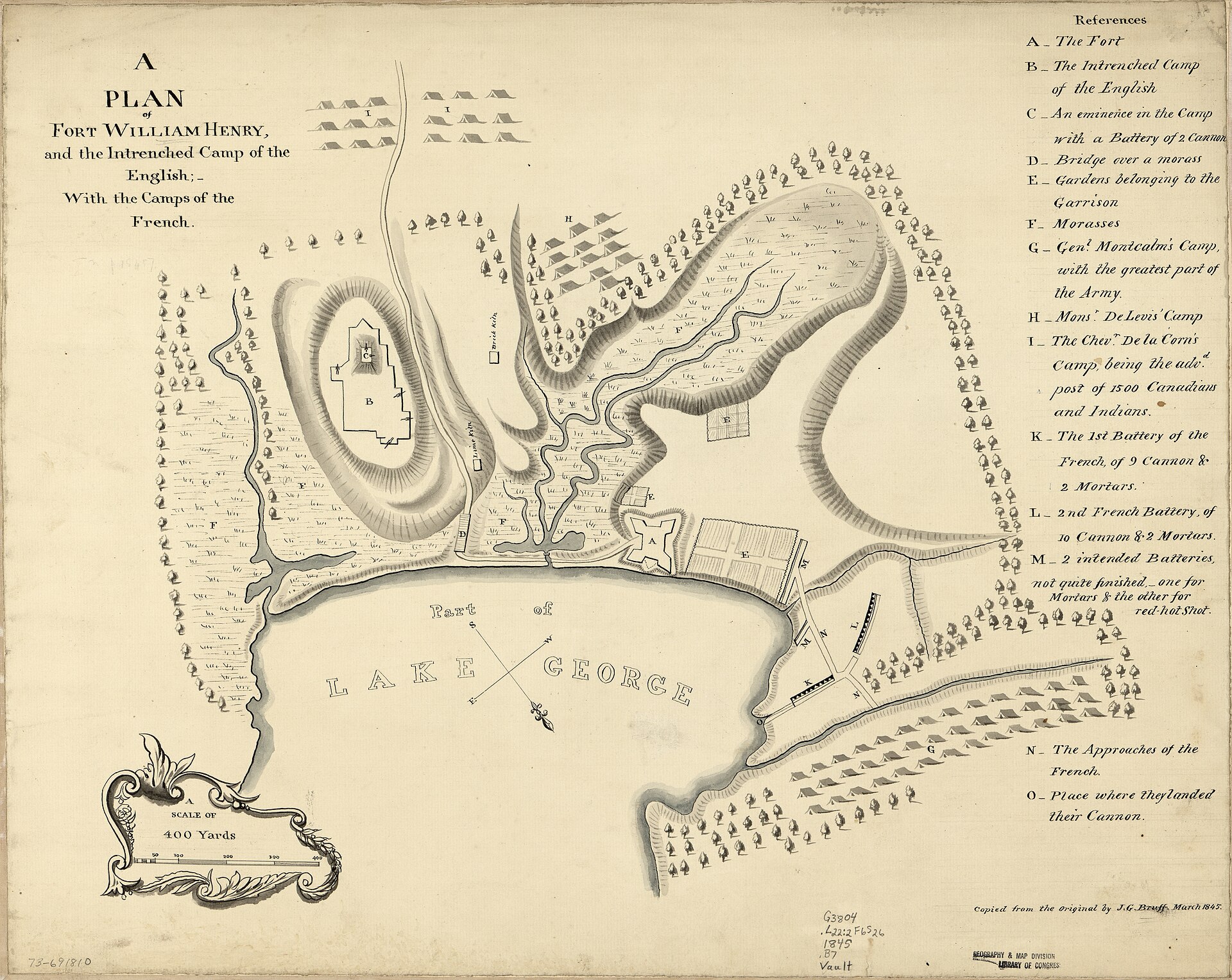
On August 5 the first French battery opened fire. On August 6 a second battery began firing, set at an angle so the two could catch the fort in a crossfire, hammering the walls from two directions at once. Day after day the heavy iron came in. Inside Fort William Henry the defenders fired back, but they were losing the gun duel in a way that no amount of courage could fix: their own cannon, worked too hard and too long, began to burst. A cannon that bursts kills the men serving it and takes itself out of the fight. Every gun the British lost that way was a gun Montcalm did not have to silence. The arithmetic of the siege was grinding the right way for the French and the wrong way for Monro, and it would not stop on its own.
Monro’s one hope was Webb, and on August 7 Montcalm took that hope away with a single sheet of paper. French scouts had intercepted a letter Webb had written on August 4. In it Webb told Monro the plain truth as he saw it: no relief was coming, and Monro had better negotiate the best terms he could. Montcalm could have buried the letter. Instead he sent it into the fort under a flag of truce, handing his enemy the proof that he was abandoned. It was a precise act of psychological war. Now Monro knew, in Webb’s own hand, that the sixteen miles to Fort Edward might as well have been a thousand.
Even then Monro did not fold at once. He held on, guns bursting, walls crumbling, sick men piling up, no relief on the road, until holding on stopped meaning anything. On August 8 the white flag went up, and on August 9 the fort surrendered. Monro had fought a hard, honourable defence against impossible odds, and Montcalm, who respected exactly that, gave him generous terms.
The terms were the honours of war, the highest courtesy one European army could pay another. Under them, the entire British garrison and the camp followers with it, the women, children, servants, and others who travelled with any army of the day, would not be made prisoners at all. They would be allowed to march out of the fort and away to Fort Edward under French escort. They could keep their muskets and one symbolic cannon, and they could keep their colours, their regimental flags, the proudest possession a unit owned. They could not keep ammunition. They agreed not to fight against France for eighteen months, and to release French prisoners within three months. The men too badly wounded to march would stay behind in the fort under French protection. In the European code, this was honour done correctly: a brave enemy beaten fair and let go with his dignity.
And here is the hinge on which the entire tragedy turns. Montcalm negotiated all of this with Monro alone. He did not consult his Native allies. He did not, because he must have known what they would say. The chiefs understood perfectly well that their warriors would never accept terms that let a beaten enemy walk away whole, carrying off everything the warriors had crossed a continent to win. Montcalm had just promised the British a bloodless departure with their weapons, their flags, and their freedom. He had promised it over the heads of the nearly 2,000 men whose entire reason for being there it cancelled. The honours of war, done correctly by the European book, were about to collide with a wholly different understanding of what a victory was for.
I have it yet in my power to restrain the savages, and oblige them to observe a capitulation.