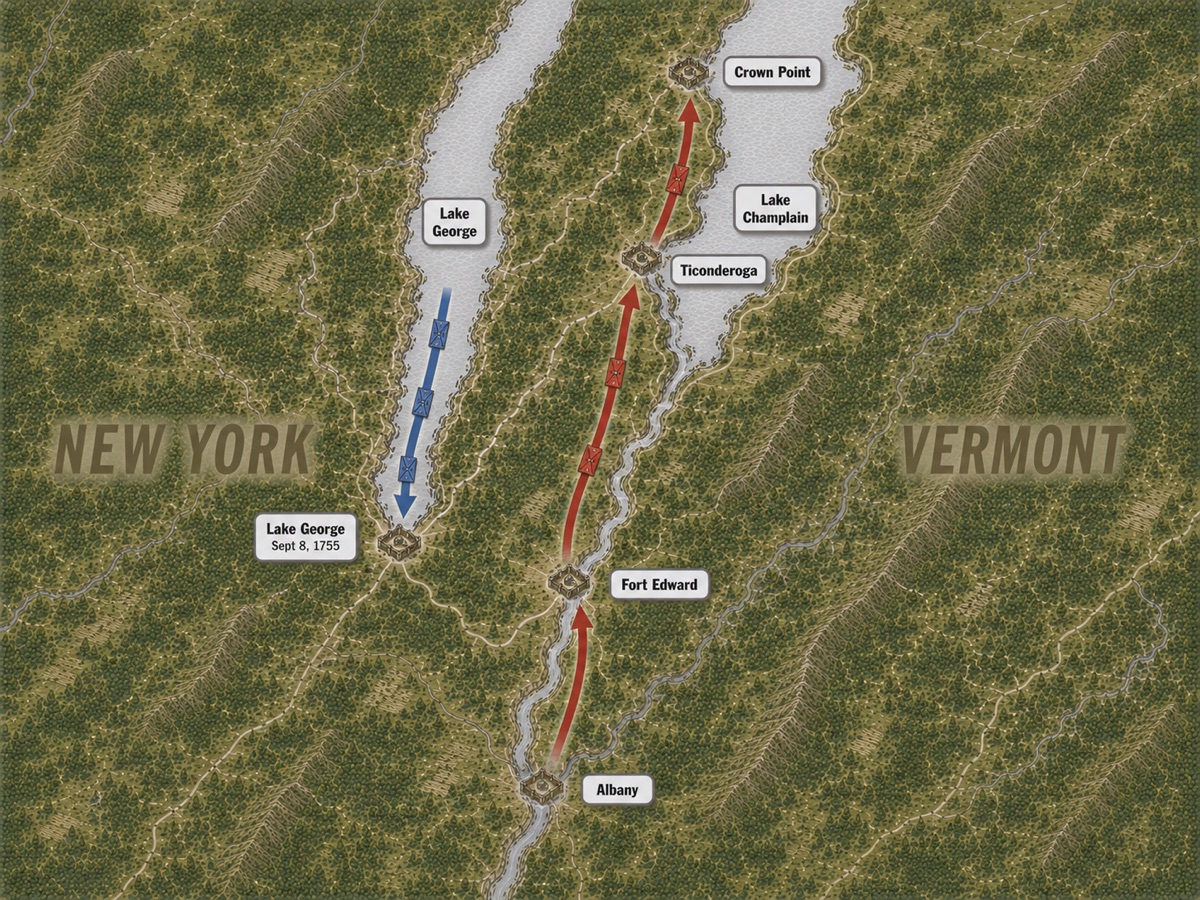
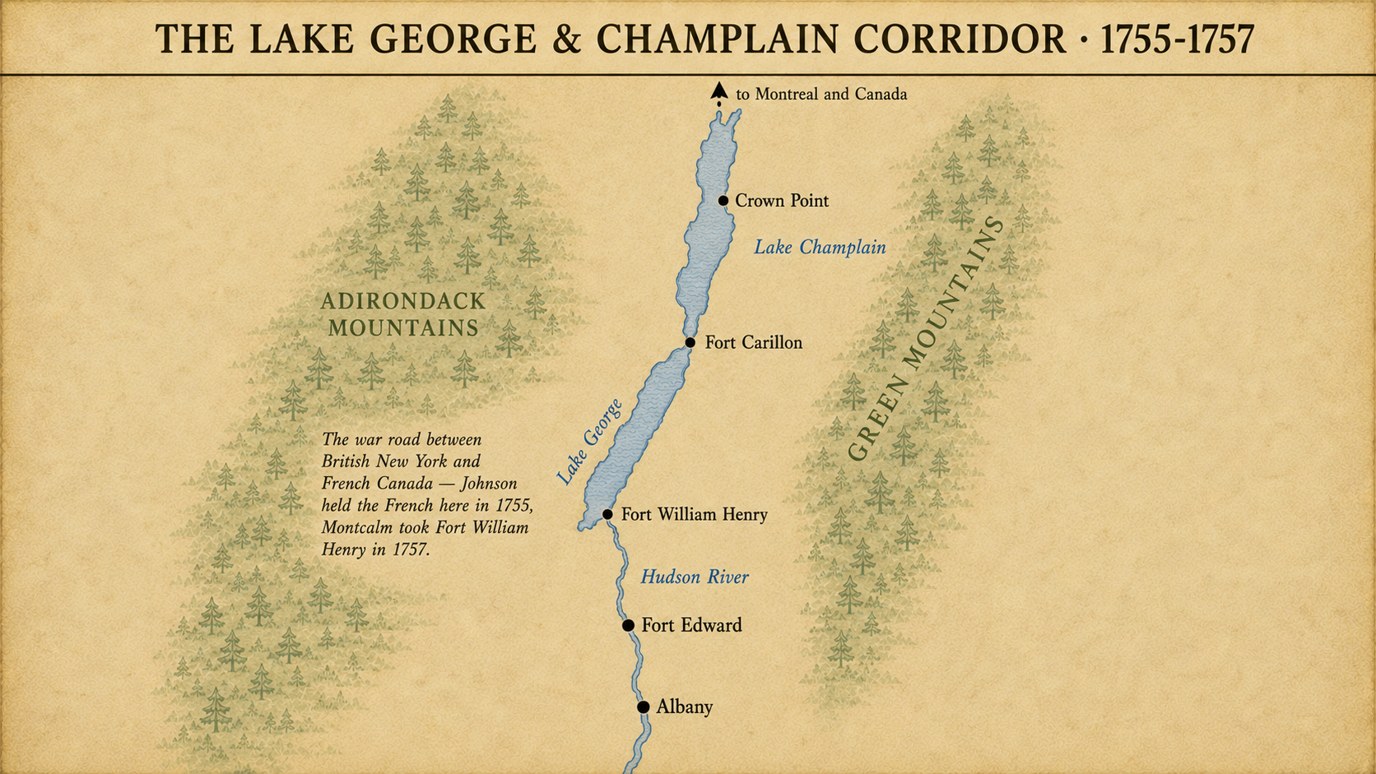
The summer of 1755 was a bad one for British arms in North America. London had launched four attacks on New France at once, and the flagship of them, Major General Edward Braddock’s drive on the Forks of the Ohio, had ended in slaughter on the Monongahela in July, two of every three men dead or wounded in the forest. Britain badly needed a victory, and a hero to hang it on. The next prong of that same offensive was still moving. Its target was Fort St. Frédéric at Crown Point, a French stone fort on Lake Champlain that guarded the great invasion highway of the northeast: the chain of water running from the St. Lawrence down Lake Champlain to Lake George and on to the Hudson and Albany, the corridor down which armies could pass between New France and the British colonies. Whoever held it held the door. And the door ran straight through the homeland of the Haudenosaunee, the six-nation Iroquois confederacy, whose land this was, whose fur trade ran along these waters, and whose alliance both empires were desperate to win.
Off the fieldBoth empires courting the HaudenosauneeThe man London chose to lead the Crown Point expedition was not a soldier at all. William Johnson (British) was an Irish-born trader and landowner, born around 1715 in County Meath, who had settled in the Mohawk Valley of New York and made himself the colony's agent to the Iroquois. He spoke their languages, lived among them, married into them, and had been adopted as an honorary Mohawk sachem (a respected civil leader and counselor); they called him Warraghiyagey, "a man who undertakes great things." He held a major general's commission despite almost no military experience. What he had instead was the one thing Braddock had thrown away on the Ohio: the trust and the help of Native allies.
His force was an army of amateurs. It was built of provincials, the part-time militia raised by the colonies of Massachusetts, Connecticut, New York, New Hampshire, and Rhode Island, men who farmed for a living and soldiered for a season, with no regulars (the king's full-time professional soldiers) among them at all. With them marched some two to three hundred Mohawk and other Haudenosaunee warriors, brought in through Johnson's ties. They cut a road north from the Hudson, where they raised a supply post called Fort Lyman, up to the lake, which Johnson renamed Lake George for the king. There the main body dug in to wait.
The Mohawk who marched with Johnson were led by an old and famous man. Hendrick Theyanoguin, called King Hendrick by the English, was an eminent Mohawk sachem, indisputably elderly (born somewhere between 1680 and 1692, no one is sure), heavyset and grey, with a lifetime of dealing with the English behind him. The year before, at the Albany Congress, he had told the assembled colonial governors to their faces what he thought of their readiness for war.
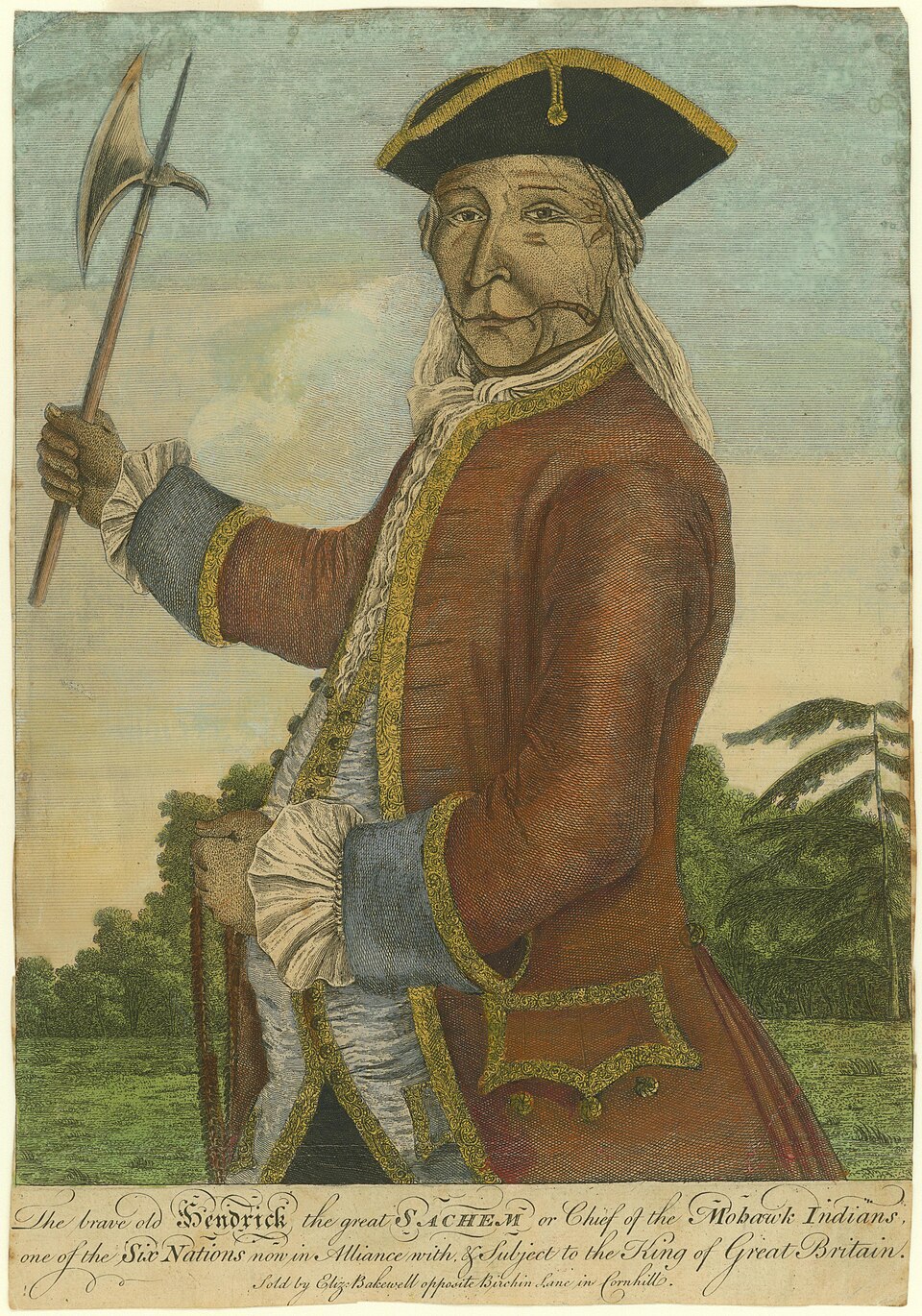
Look at the French, they are men; they are fortifying every where; but we are ashamed to say it, you are all like women, bare and open, without any fortifications.
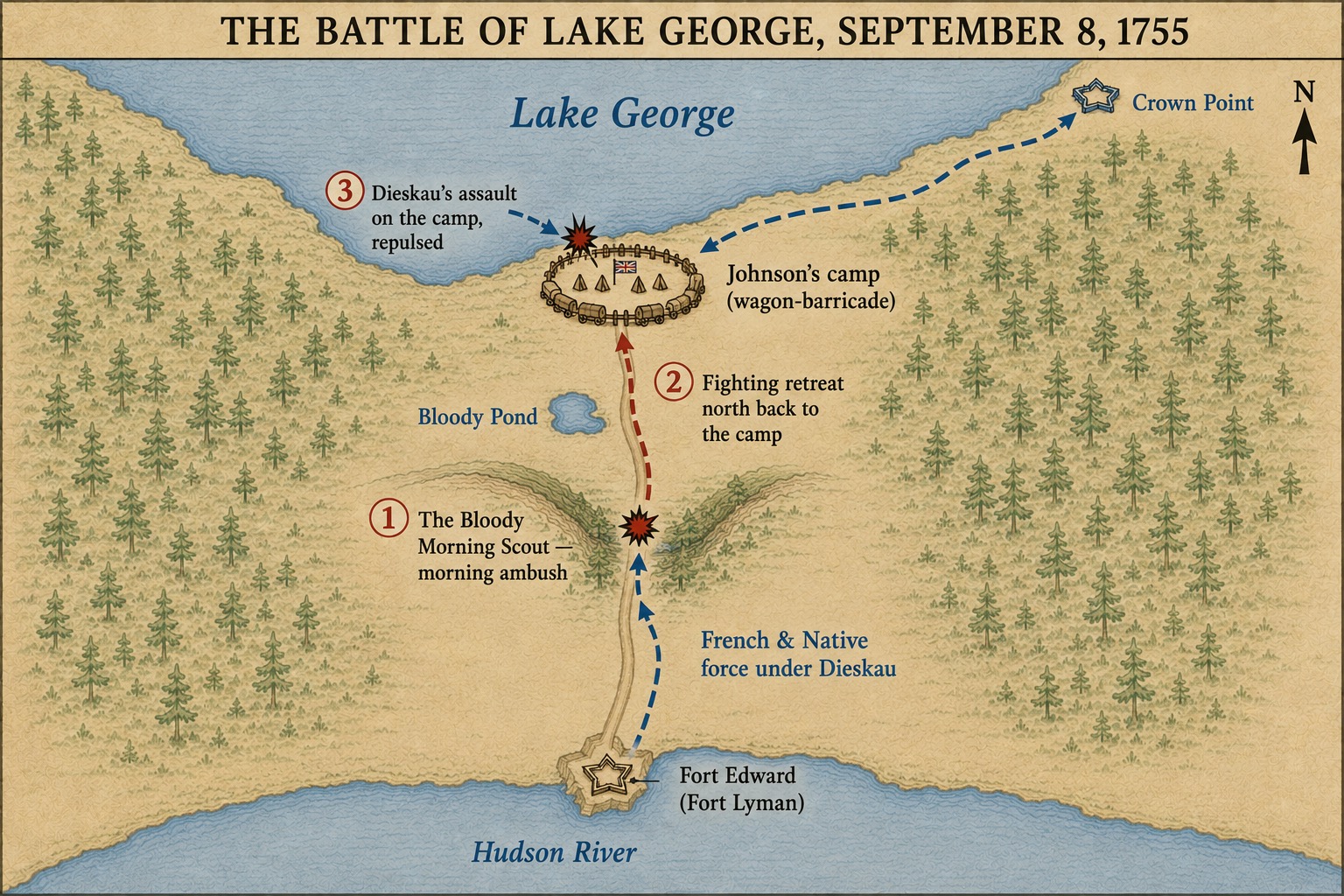
The French were indeed men, and they were moving. Baron Jean-Armand Dieskau (French), a professional major general, had come up the lake to strike first, not to wait at Crown Point to be besieged. He took a detachment south of about fifteen hundred: roughly two hundred and twenty French regular grenadiers (elite assault infantry, the biggest and steadiest men in the army) from the regiments of La Reine and Languedoc, some six hundred Canadian militia (colonial troops born in New France), and six or seven hundred Native allies. And here is the heart of the whole thing, the part that no map of the corridor can show. Many of those warriors on the French side were themselves Mohawk: the Caughnawaga, also called Kahnawake, a Mohawk community that had relocated north to the St. Lawrence and now fought for France. They were kin to the Mohawk waiting in Johnson's camp. Among Dieskau's allies too were Abenaki and Nipissing. Dieskau aimed first at the supply post on the Hudson and then at Johnson's camp. But the kinship in his own ranks had already begun to work against him: as his column neared the British post on the Hudson, the Caughnawaga refused to attack it, unwilling to fall on kin on that ground, and that refusal turned his blow away from Fort Lyman and toward Johnson's camp instead.
On the night of September 7 Johnson learned the French were near Fort Lyman, his lifeline on the Hudson. On the morning of the eighth he decided to send out a column to meet them: about a thousand provincials under Colonel Ephraim Williams (British) of Massachusetts, a popular officer of around forty, and some two to two hundred and fifty Mohawk under Hendrick. Hendrick argued against splitting the force. By tradition he picked up sticks to make the point, that a bundle held together could not be broken but the sticks taken one at a time could be snapped, and gave the warning that has been remembered ever since.
If they are to be killed, they are too many; if they are to fight, they are too few.
The wording of that line drifts from one retelling to the next, and the most careful biographical record of Hendrick does not carry it at all, so it is best treated as well-attested tradition rather than something we can put in his mouth word for word. But the sense of it was sound, and the column marched out anyway, with old Hendrick on horseback because by most accounts he was too old and heavy to march on foot.
About three miles south of the camp the road ran through a ravine, and Dieskau, warned by a deserter that the British were coming on, set his trap there. He put his grenadiers across the road to block it and spread the Canadians and the Native warriors along the wooded flanks, so the marching column would walk into a closed pocket of fire. It was the Monongahela in miniature, men in the open about to be hit from cover they could not see. The British column came on into the quiet ravine, ranks loose, the woods close on both sides and the road narrowing ahead, none of them knowing the trees were already full of men. Then the woods went off at once. Williams climbed up onto a rock to rally his men and was shot dead. Hendrick's horse was killed under him, and the old man, on the ground and unable to run, was bayoneted, and by most accounts scalped. In a single hour the British lost their two most important leaders in the field, and the Mohawk lost a sachem of a stature that could not be replaced.
The survivors did not all die in the pocket. Under junior officers the column turned and fought a stubborn retreat back up the road toward the camp, three or four miles of it, falling back from cover to cover. The fighting cost the French too. Jacques Legardeur de Saint-Pierre (French), the officer who led Dieskau's Canadian and Native contingent, was killed in the morning's fighting, and his death struck the French-allied warriors hard, because he was the man who held their trust and kept them moving with the French. The morning had been a disaster, and it gave the day its name, the Bloody Morning Scout. But it had done one thing for the British without their planning it: it had bled and slowed Dieskau, and it sent his blood up. He turned the whole of his force north and went straight for Johnson's camp, certain the rout would carry him over the barricade on the panic of the men running ahead of him.