On July 26, 1758, after about seven weeks, Drucour surrendered. He had hoped for the honours of war, the customary courtesy by which a garrison that had fought well was allowed to march out with its weapons, its flags, and its dignity, the same courtesy the French had extended to a beaten British garrison at Minorca. Amherst refused. The surrender would be unconditional. He pointed to what had happened at the surrenders of Fort Oswego and, the year before, Fort William Henry, where British soldiers who had laid down their arms under terms were set upon and killed. There would be no honourable march-out here. The hard terms had a hard purpose: an unconditional surrender meant the roughly five thousand six hundred men of the garrison were shipped to England as prisoners of war rather than paroled, the way the French garrison at Fort William Henry had been the year before. Paroled men could be exchanged and fight again; prisoners in England could not. Drucour, pressed by his own commissary on behalf of the trapped civilians in the town, accepted the hard terms. One French regiment, the Cambis, would not stomach it: rather than hand over their colors to the enemy, the men broke their muskets and burned their regimental flags.
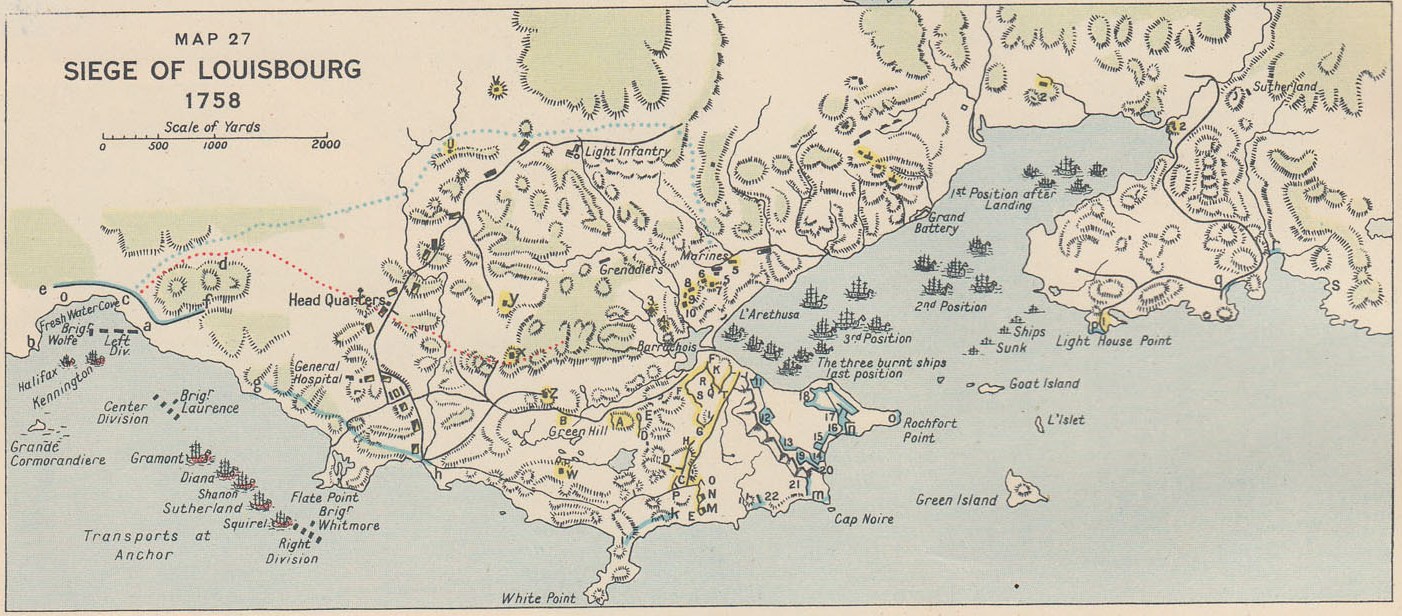
The cost on the field had been lopsided. The British lost roughly a hundred and seventy killed and three hundred and fifty wounded. The French lost about a hundred killed and three hundred wounded. But the surrender swept up far more than the dead and hurt: more than five thousand six hundred French soldiers became prisoners of war, along with some two hundred cannon and the wreck of the fortress itself.
The BattlesThe fall of Louisbourg opened the river road to Quebec, 1759What followed the surrender was harder than the siege, and it fell on people who had not fought it. With Louisbourg gone, the French settlers of the region, the Acadians (the French farming families who had lived in these maritime lands for generations), lost their protection, and the British set about deporting them. This was the second great wave of the expulsion of the Acadians, and it came in two separate clearances. One swept up the Acadians of Île Royale itself, the smaller of the two. The other was its own ordered campaign across the water on Île Saint-Jean (today Prince Edward Island), run by Lieutenant Colonel Andrew Rollo, who was sent to round up the island’s families and ship them to France. Around three thousand one hundred people were deported from Île Saint-Jean, and roughly sixteen hundred and forty-nine of them died, many drowned when the transports Duke William and Violet went down at sea, others killed by disease in the holds. That made the Île Saint-Jean wave the deadliest single episode of the whole Expulsion of the Acadians. It was a deliberate uprooting of a civilian population, and the human cost of taking Louisbourg is not honestly told without it.
Off the fieldThe deportation of the AcadiansThe army was not done with the Gulf either. Wolfe, with the naval officer Sir Charles Hardy, took some fifteen hundred troops up into the Gulf of St. Lawrence that autumn and worked the French coast. They burned around two hundred fishing vessels, but they burned far more than boats. They put the torch to the settlements themselves, a church and the houses at Miramichi, the villages at Grande-Rivière and Pabos, and they destroyed the dwellings of the Mi’kmaq, the Native people of these lands, who lived along this coast and whose homes were among those burned. The point was cold and strategic: those fisheries fed Quebec, and stripping them, and the people who worked them, weakened the city before the blow that was coming. It is named plainly here because it was a campaign against civilians, not only against ships.
And the blow was coming. That was always what Louisbourg was for. With the great fortress in British hands, the sea gate stood open, and the St. Lawrence lay clear all the way up to the capital of New France. The following spring, the same Brigadier Wolfe who had found the slot of rock at Freshwater Cove would sail up that river at the head of the army that took Quebec, and with Quebec, the war for the continent would turn for good. The British later blew Louisbourg’s walls apart with gunpowder so that no treaty could ever hand it back again. They had learned that lesson once.