The clearest atrocity of the French and Indian War was not a battle. It fell on farmers.
For a century and a half, French-speaking Catholic families had been draining the salt marshes of the Bay of Fundy, the great tidal inlet between present-day Nova Scotia and New Brunswick, and turning them into some of the best farmland in North America. They called their country Acadia (Acadie in French): mainland Nova Scotia and pieces of what are now New Brunswick and Prince Edward Island. They were not soldiers. They wanted no part of the wars their empire kept fighting. And when a new war came, the British colonial government rounded them up at gunpoint, burned everything they owned, and scattered them by ship across an ocean and a continent. Thousands died. The survivors never got their farms back.
What happened, and the people it happened to, runs through the Mi'kmaq, the Native nation whose land all of this sat on, and who were fighting their own war the whole time.
The marsh farmers
France planted its first North American settlement here in 1604, and founded the village of Port-Royal the next year, on the Annapolis Basin, an inlet off the Bay of Fundy in what would become Nova Scotia. Many of the families came from Poitou in western France. They arrived as fishermen and farmers, and over a few generations they invented something clever.
The Bay of Fundy has enormous tides. Twice a day the sea floods the coastal marshes with salt water, which is useless for crops. Starting near Port-Royal in the 1630s, the Acadians learned to wall those marshes off with earthen dykes (long banks of packed mud and sod) and to drain them with a device called an aboiteau. An aboiteau is a wooden sluice built into the bottom of a dyke with a swinging door in it. When rain and river water build up behind the dyke at low tide, the door swings open and lets the fresh water drain out to sea. When the tide comes back in, the pressure of the seawater swings the door shut, so the salt stays out. Do this for a few years and the trapped marsh slowly rinses itself of salt and turns into rich black pasture and cropland.
It worked spectacularly. By 1755 the Acadians had reclaimed roughly 13,000 acres of Bay of Fundy marsh this way. As their numbers grew they spread out from Port-Royal (which the British later renamed Annapolis Royal) to new marshland settlements: Beaubassin on the Chignecto Isthmus, the neck of land joining Nova Scotia to the mainland, and Grand-Pré on the Minas Basin, which became the largest and most prosperous Acadian district of all. On the eve of the expulsion there were somewhere between 13,000 and 14,000 Acadians living in the region. They were, by the standards of the day, doing very well.
Caught between two empires
The trouble was that Acadia kept changing hands. France and Britain fought each other for generations, and in 1713 a peace treaty signed at Utrecht handed Acadia to Great Britain at the end of one of those wars. The colony became British Nova Scotia. The Acadians were allowed to keep their land and stay, which made them, on paper, subjects of the British Crown.
But Britain wanted more than residence. It wanted an unconditional oath of allegiance: a sworn promise to be loyal British subjects, with no strings attached. The Acadians balked, and for a very specific reason. An unconditional oath could oblige them to take up arms for Britain, which might mean shooting at France, the country of their parents and grandparents, or at the Mi'kmaq, the Native nation they lived alongside and were in many cases related to by marriage. They did not want to fight anyone.
So they tried to thread a needle. They offered to swear a conditional oath instead, promising to be peaceful, law-abiding British subjects who would simply never bear arms, against either side. They called themselves the neutral French, or the French Neutrals. An early British governor, Richard Philipps, accepted a version of this arrangement, and for roughly four decades the uneasy compromise more or less held. The Acadians farmed their marshes, paid their respects to whichever flag flew over the fort, and stayed out of the fighting.
It was a genuinely awkward position, and it depended entirely on nobody forcing the question. Eventually somebody did.
"The Inhabitants may not have it in their power to return to this Province nor to join in strengthening the French of Canada in Louisbourg." — Charles Lawrence, deportation orders, 1755
The Mi'kmaq were fighting their own war
It is easy to tell this story as if it were only about Britain, France, and the Acadians caught in the middle. It was not. The very name "French and Indian War" is the British colonists' label for the enemies they expected to fight, but the Mi'kmaq were not fighting Britain's war as anyone's auxiliary; they were fighting their own war for their own land. That land everyone was quarreling over was Mi'kma'ki, the homeland of the Mi'kmaq, who had lived there long before any European arrived and who had no intention of being settled over. They were allied to France, but the alliance served their own ends. They were fighting, in their own right, to keep the British off their land.
That fight had a name: Father Le Loutre's War, also called the Anglo-Mi'kmaq War, which ran from 1749 to 1755. It started when Governor Edward Cornwallis arrived with thirteen ships in 1749 and founded the town of Halifax at a harbor the Mi'kmaq called Chebucto, on land the British had earlier promised they would not settle. Within a few years the British had moved more than 3,200 settlers in, more people than there were Mi'kmaq in the entire region (about 2,500). To the Mi'kmaq this was exactly what it looked like: an invasion. In September 1749 they protested formally, declaring their ownership of the land and their opposition to the British settling on it.
Then they acted, on their own initiative and for their own reasons. They seized a British vessel and took twenty prisoners near Canso. They raided the new settlement at Dartmouth, across the harbor from Halifax, and killed four settlers. These were not French operations; they were Mi'kmaq operations in defense of Mi'kmaq territory, led by their own chiefs. It was Chief Jean-Baptiste Cope who negotiated a treaty with the British in 1752, Chief Étienne Bâtard who organized the killing of a British officer, Edward How, in 1750, and Chief Paul Laurent who fought as one of their war commanders.
A French Catholic missionary priest, Jean-Louis Le Loutre, worked alongside the Mi'kmaq and the Acadian resistance, supplying them and urging them on. The British called him "Moses" and one historian called him "the soul of the Acadian resistance." He was an instigator and an ally, but he was not Mi'kmaq, and the Mi'kmaq did not need him to tell them their land was being taken.
The British answer to all this was brutal and worth naming plainly. In October 1749 Cornwallis issued a proclamation authorizing colonists to "annoy, distress, take or destroy" the Mi'kmaq, and put a bounty on them: ten guineas for a Mi'kmaq scalp, raised the next year to fifty. This was a price on the heads of a people for living where they had always lived. When Cornwallis was succeeded by a new lieutenant governor, Charles Lawrence, the aggressive push continued, with new British towns founded on contested ground. Lawrence is the man who, two years later, would order the Acadians deported. The fall of the French fort that anchored the resistance, in the summer of 1755, broke the organized French, Mi'kmaq, and Acadian campaign in one stroke, and is where the Acadians' story turns. But it did not end the Mi'kmaq war. Acadian and Mi'kmaq partisans fought on for years, in a guerrilla and privateer war led by the French officer Charles Deschamps de Boishébert and the Acadian militia leader Joseph Broussard, known as Beausoleil, alongside the Mi'kmaq, the Maliseet, and the Abenaki, into about 1758. The Anglo-Mi'kmaq War ended not on a battlefield but at a negotiating table, with the Peace and Friendship Treaties signed at Halifax in 1760 and 1761 and ceremonially sealed at the "Burying the Hatchet" ceremony of 25 June 1761, where Mi'kmaq chiefs washed away the war paint as a sign that the fighting was over. Those treaties ceded no land, and they are still binding law in Canada: the Supreme Court of Canada upheld their hunting and fishing rights as never extinguished in its 1999 Marshall decision.
The pretext
On the Chignecto Isthmus, the French had built Fort Beauséjour to block British expansion into what is now New Brunswick. In June 1755 a British force under Lieutenant Colonel Robert Monckton besieged it, and within about two weeks it surrendered. The fall of Beauséjour broke the organized French, Mi'kmaq, and Acadian resistance in one stroke.
It also handed Lawrence the excuse he had been looking for. Among the fort's defenders the British found some Acadians. It did not matter much that many had likely been pressed into service against their will; their presence was enough to let Lawrence argue that the famous Acadian "neutrality" was a fiction and that these people could not be trusted with a war coming.
In July 1755 he summoned Acadian delegates to the capital at Halifax and demanded, once again, that they swear the unconditional oath of allegiance. Once again, they refused. This time Lawrence did not let it pass. He threw the delegates in prison. And on 28 July 1755, Lieutenant Governor Charles Lawrence and the Nova Scotia Council made their decision: the Acadians would be deported. All of them.
The Grand Dérangement
In the second week of August 1755, Lawrence sent his orders out to the British officers in the field. They are chilling in their plainness. He instructed them to gather the people and get them onto ships, and if the Acadians would not come quietly, to use "the most vigorous measures possible," including this: to deprive anyone who escaped "of all means of shelter or support by burning their houses and destroying everything that may afford them the means of subsistence in the country." The point was not just to remove the Acadians. It was to make sure they could never come back.
"You must proceed by the most vigorous measures possible, not only in compelling them to embark, but in depriving those who shall escape of all means of shelter or support by burning their houses and destroying everything that may afford them the means of subsistence in the country." — Charles Lawrence, instructions to Major Handfield, 11 August 1755
The most famous scene of the whole upheaval played out at Grand-Pré. On 5 September 1755, a New England provincial officer named Lieutenant Colonel John Winslow, acting under Lawrence's orders, summoned the men and boys of the district into the parish church. Once they were inside, he read them their sentence. He seems to have known exactly what he was doing to them. "The Part of Duty I am now upon," he told the assembled men, "is what tho necessary is very disagreeable to my natural make & temper." Then he delivered the blow: their lands, their houses, their cattle and livestock "of all kinds and live stock of all sortes are forfitted to the Crown," and they themselves were to be removed from the province. (Those are Winslow's own words from his journal, in the loose spelling of 1755.)
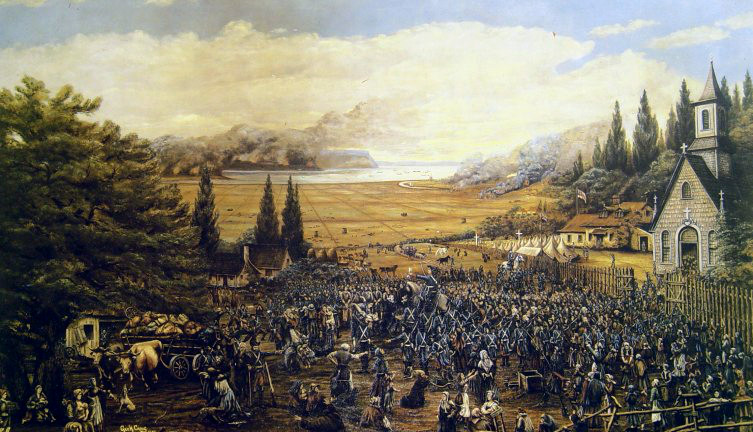
The roundups began. British troops collected families at gunpoint and put them aboard transport ships packed tight, roughly two people for every ton of the vessel's capacity. Behind them, the soldiers did what Lawrence had ordered: they burned the houses, the barns, and the crops, so that the marsh farms the Acadians had built over a century became smoke. Winslow watched the embarkation at Grand-Pré in October and wrote down what he saw. The people, he recorded, "went verry [solemnly] and unwillingly, the women in great distress carrying their children in their arms."
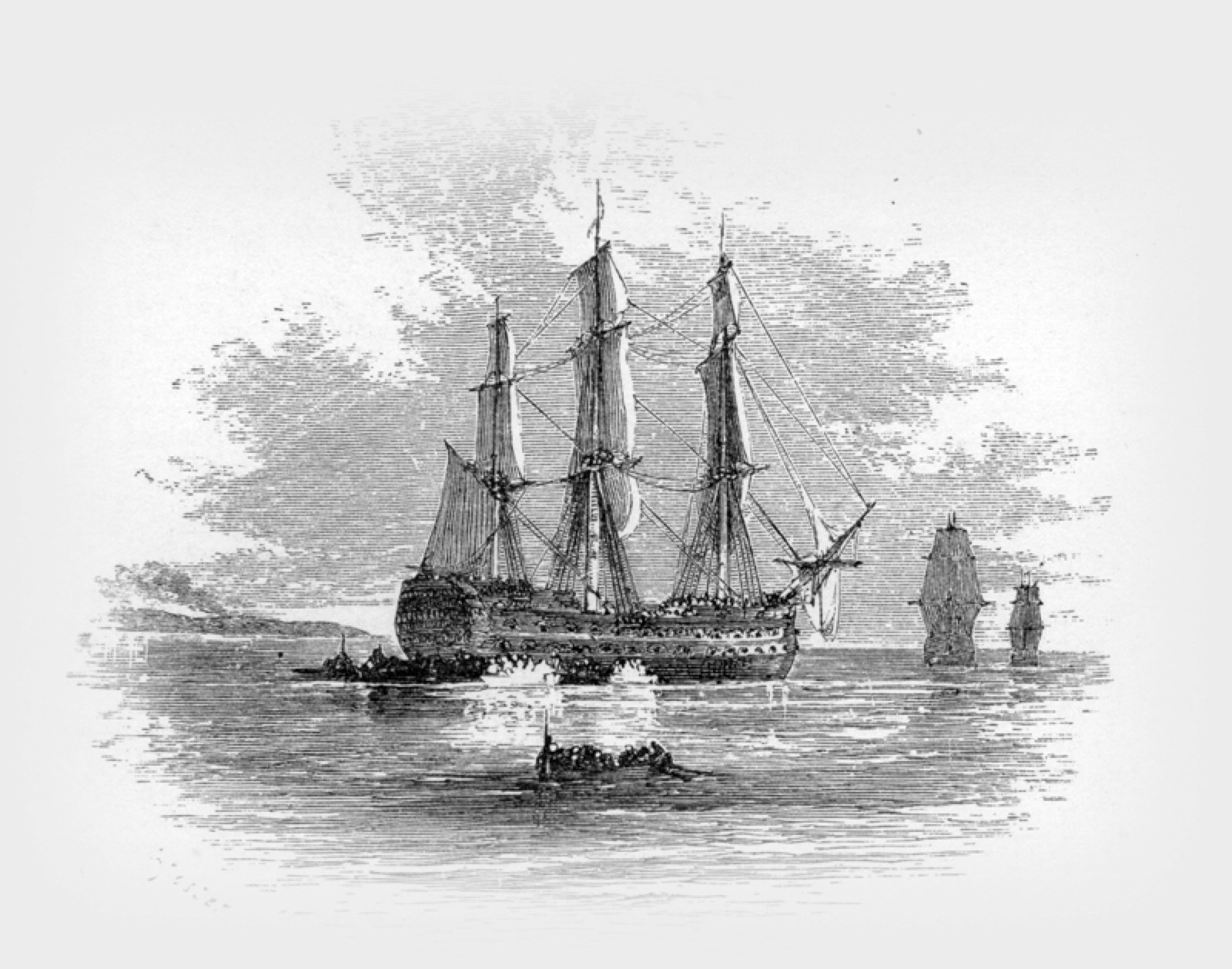
Lawrence had said, on paper, that whole families should travel together on the same ship. In practice that promise was broken again and again. Husbands were loaded onto one vessel and wives and children onto another, bound for different colonies, and never found each other again.
Over the next nine years, in waves running from the autumn of 1755 through 1764, the British deported more than 10,000 Acadians, by the most cited tally somewhere around 11,000 to 11,500 of a population of roughly 14,000. About 2,600 escaped into the woods or across to French territory and were still hiding in the region years later.
Scattered
The ships of the first wave, in 1755, were aimed at the British colonies down the Atlantic seaboard: roughly 2,000 Acadians to Massachusetts, 1,100 to Virginia, 1,000 to Maryland, and hundreds each to Connecticut, Pennsylvania, the Carolinas, Georgia, and New York. The idea, in Lawrence's words, was to disperse the Acadians "among his Majesty's Colonies upon the Continent of America," scattered so widely and thinly that they could never reassemble into a people.
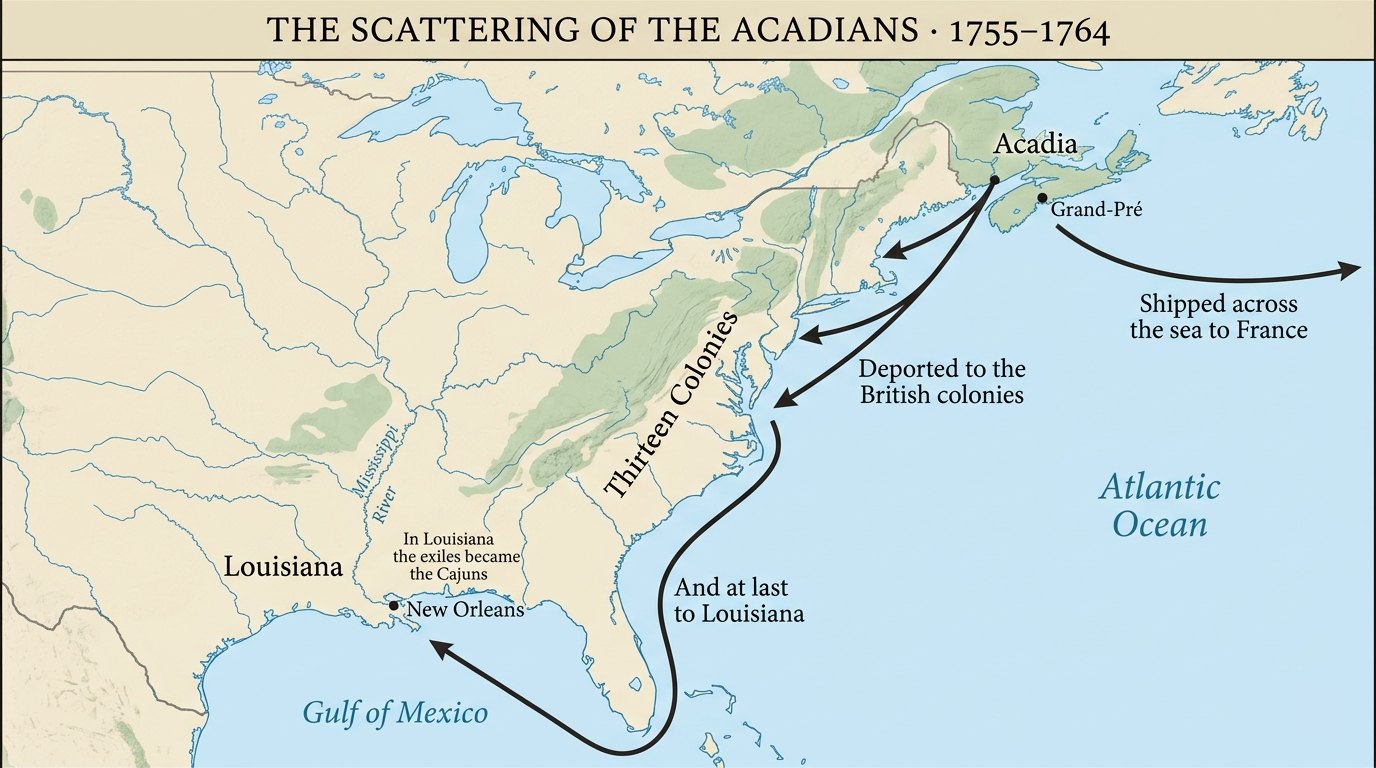
The colonies they were dumped into mostly did not want them. These were poor, French-speaking, Catholic refugees arriving by the boatload in Protestant English colonies that had been at war with France for as long as anyone could remember. Virginia refused to take its shipload and sent the exiles on to England. Elsewhere they were held in poverty, treated as a burden, kept at arm's length. People who had owned good farms a few months earlier were now beggars in a strange country whose language they did not speak.
The ships that sank
The deportation had a second, deadlier act. In July 1758 the British captured the great French fortress of Louisbourg, on Cape Breton Island.
With Louisbourg gone, the British turned on Île Saint-Jean, the island that is now Prince Edward Island, and deported its more than 3,000 inhabitants, this time shipping them straight across the ocean to France. This was the worst phase of the entire expulsion. Over half of the people removed from Île Saint-Jean died, of shipwreck and of disease, before they ever reached anywhere.
The war storyLouisbourgThe horror of it concentrated into a few December nights. A convoy had left Île Saint-Jean in October 1758 bound for France, and three of its transport ships were lost that December. The Duke William foundered in the North Atlantic around 13 December with over 360 Acadians aboard, roughly 97 km (about 20 leagues) off the French coast; the captain survived, but the families did not. The Violet went down a day earlier with more than 280 Acadians, lost with all of them. The Ruby, carrying around 310, ran aground at Pico Island in the Azores, where about 213 of those aboard died. Across the three ships, close to 1,000 Acadians died in a single week.
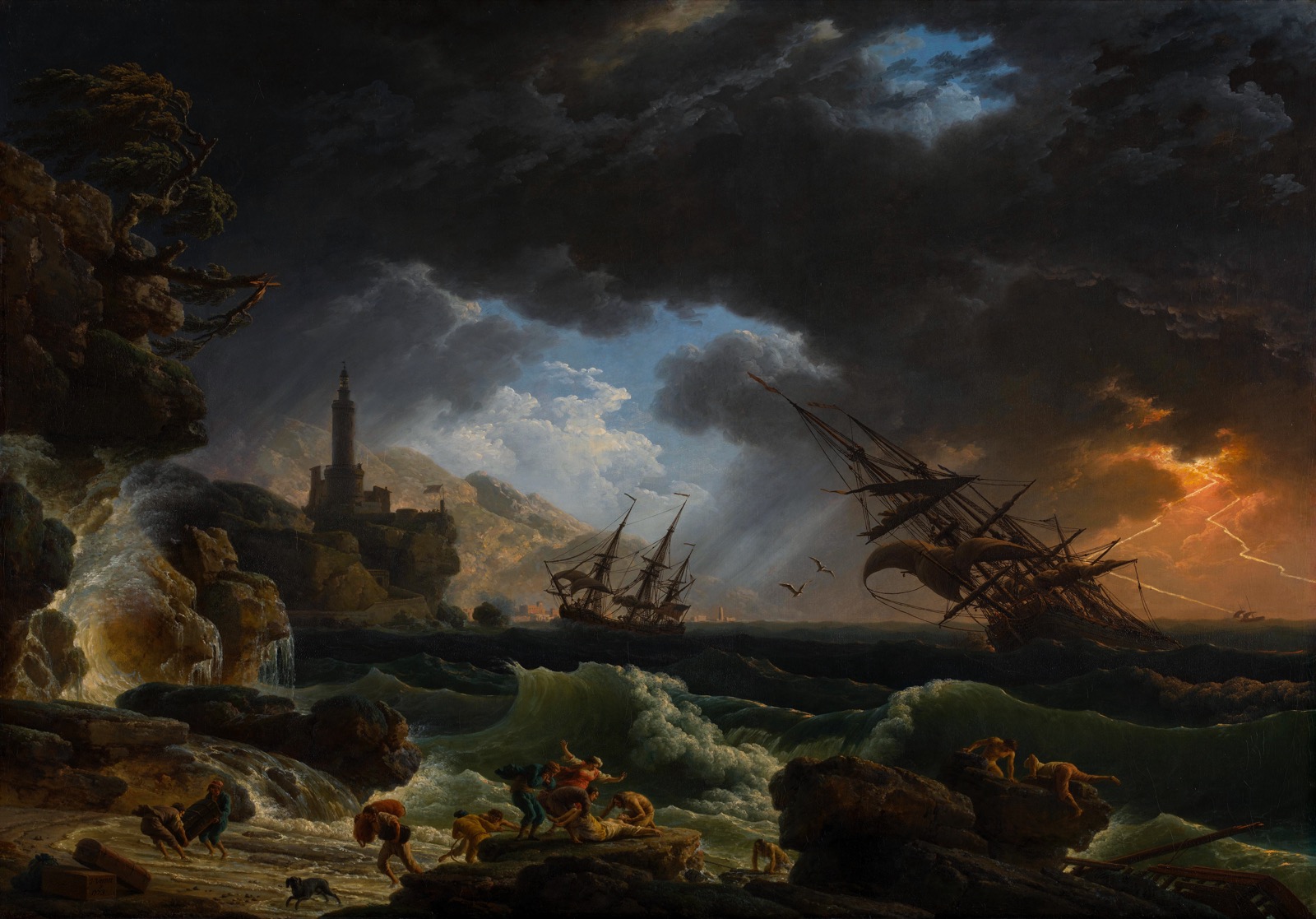
Aboard the Duke William was an elder named Noël Doiron, with his wife Marie, five of their grown children and their spouses, and more than thirty grandchildren. About 120 people of one family. None of them survived.
Across the whole upheaval, from 1755 to 1764, the death toll is not known with any precision. The most cited summary figure is around 5,000 dead, of disease, starvation, drowning, and exposure, and some historians put it considerably higher. The honest way to say it is: thousands, and we cannot give the exact number.
What they became
In 1764, with the war over, the British finally allowed Acadians to return to British territory. But the offer had teeth in it. They could come back only in small, scattered groups, and only if they took the unconditional oath of allegiance they had spent fifty years refusing. Many did trickle back, resettling around mainland Nova Scotia, Cape Breton, and the rest of the Maritimes, but not onto their old marsh farms. Those had already been handed out to incoming British and New England settlers. The dykes the Acadians had built, someone else now farmed.
The largest piece of the diaspora, the scattered Acadian exiles, drifted somewhere unexpected. A first small band of Acadians who had escaped from New York reached French-influenced Louisiana in April 1764. In February 1765 about 193 exiles from Halifax, led by Joseph Broussard, known as Beausoleil, landed at New Orleans. More followed, and the biggest single migration came in 1785, when Spain, which by then controlled Louisiana, paid to ship roughly 1,600 Acadians who had ended up in France across to Louisiana. Across those two decades around 3,000 Acadians came to Louisiana, where Spain welcomed them as fellow Catholics and gave them land.
In Louisiana the word for an Acadian, "Acadien," wore down over time into "Cadien," and English speakers turned that into "Cajun." The farmers expelled from the Bay of Fundy became the founding core of Cajun Louisiana, its language, its cooking, its music. A culture that the British government had set out to erase did not disappear. It put down roots two thousand miles away and grew into something new.
The expulsion lodged in the wider public memory largely through a poem. In 1847 the American poet Henry Wadsworth Longfellow published Evangeline: A Tale of Acadie, about a fictional Acadian woman torn from her betrothed on the day of the deportation and searching for him for the rest of her life. It was enormously popular, and for generations of readers it was how they first learned the word "Acadia" at all.
Naming it
Strip away the poem and the propaganda and the military memos, and what is left is simple to state and hard to look at. A government uprooted an entire civilian population, farmers and their families who had harmed no one, burned their homes so they could not return, broke up their families across separate ships, and sent them to die at sea or starve in unwelcoming ports. That is the fact, and it should not be softened.
Historians still argue about the strongest label for it. The historian John Mack Faragher has compared the expulsion to ethnic cleansing, pointing to the anti-Catholic laws that barred Acadians from holding office, voting, or owning land. Others push back: the historian John Grenier has argued that calling it ethnic cleansing "carries too much present-day emotional weight," and the Acadian historian Maurice Basque has said flatly that "the term 'genocide' ... does not apply at all to the Grand Dérangement." Another historian, A. J. B. Johnston, cautions that "you can't just transfer concepts between centuries." Most historians also grant that the British had a cold military logic: the Acadians sat astride the supply and intelligence lines to the French strongholds at Louisbourg and Québec, and a hostile population behind the lines was a real danger in a real war.
That debate over what to call it does not change what was done, or to whom, or how many never came home. The contest underneath all of it, the one the empires were really fighting, was over land that belonged to neither of them, and the people who lost the most were the ones who had been there longest: the Mi'kmaq, whose homeland was settled over and put under a bounty, and the Acadians, who only ever wanted to be left alone on their farms.
Off the fieldThe Treaty of Paris & the Proclamation Line