On September 8, 1760, in the British camp before Montreal, Vaudreuil and Amherst signed the Articles of Capitulation, the formal written terms of surrender, fifty-five articles in all, and with a stroke of the pen Canada and everything that depended on it passed to the British crown. British grenadiers and light infantry marched into the town. The last French stronghold in North America was gone, and with it French rule on the continent. There would be no more French Canada.
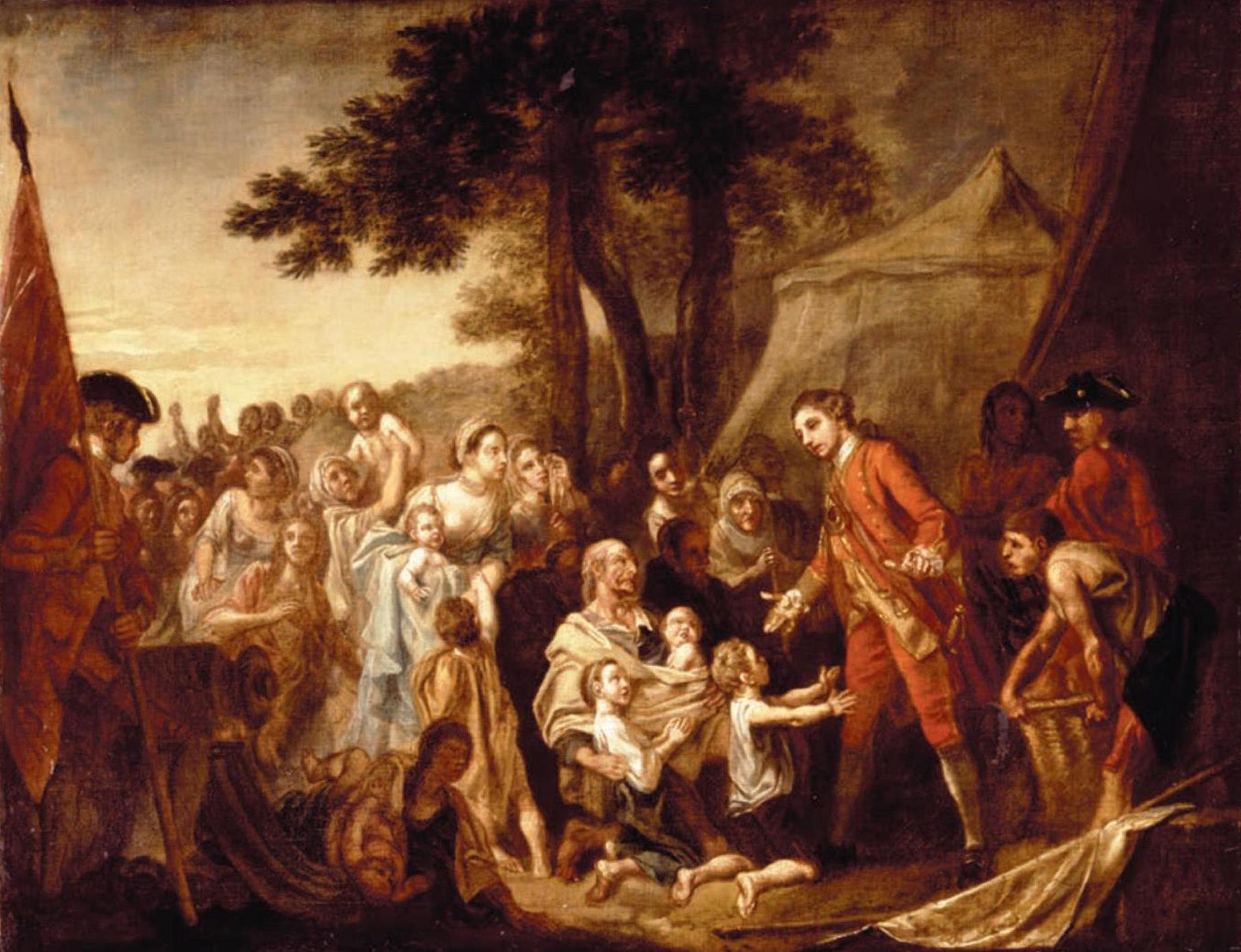
But the signing had a bitter coda, and it turned on an old soldier’s idea of honor. When a garrison surrendered in the wars of that age, the defeated troops were usually granted the “honours of war,” a ceremony in which they marched out under their own flags, carrying their weapons, allowed to keep their dignity before laying their arms down. Amherst refused it. He demanded that the whole garrison of Montreal and every French soldier in Canada simply lay down their arms and promise not to serve again for the rest of the war, even back in Europe. And he said why. Earlier in the war, French commanders had let their Native allies fall on prisoners and the wounded after surrenders (the killings after the fall of Fort William Henry in 1757 were the wound everyone remembered), and Amherst meant to punish that conduct. His terms stated, in his own words, that the French garrison would lay down their arms “for the infamous part the troops of France have acted in exciting the savages to perpetrate the most horrid and unheard of barbarities.”
To Lévis this was unbearable. To be beaten was one thing; to be denied the soldier’s right to walk out with his colors was, in his eyes, to be branded a criminal rather than an honorable enemy. Forbidden his last stand and denied the honours of war, he did the one defiant thing left to him. He ordered his regiments to burn their colors, the regimental flags that were the soul and battle-record of each unit, so that the British could never parade them as captured trophies. The seven French battalions in Montreal, about twenty-two hundred men still fit to stand, laid down their weapons over ashes where their flags had been.
The BattlesSainte-Foy, the last French victory before the endThere is a second story inside the surrender, and it belonged to people who were not even allowed in the room. The Native nations had been the hinge of every war in this country, and the reason Amherst’s army had floated down the rapids unharmed was that the most important of them had already made their own peace. These were the Seven Nations of Canada, the same St. Lawrence communities whose absence had left the rapids silent: a group of mostly Catholic Native nations along the river that included the Kahnawake Mohawk, settled just across the St. Lawrence from Montreal, and they had been France’s close allies for generations. In late August 1760, watching the French collapse, their representatives met with the British, and Sir William Johnson (British), the man London used to manage Native diplomacy, secured their neutrality. More than eight hundred warriors stepped out of the war. That is why the rapids were silent. In the weeks after the capitulation the bargain was sealed at a council at Kahnawake, where the Kahnawake Mohawk and the British formalized the peace and the Native side won what mattered most to them: free movement through their own territories, the right to keep trading between Montreal and Albany, no reprisal for having fought against the British, and their lands and their religion left untouched.
The capitulation itself even spoke to them, after a fashion. Article 40 of the fifty-five promised that the Native allies of the French king would be left on the lands they lived on if they chose to stay, would not be punished for having fought for France, and would keep their religion and their missionaries. It was, on paper, a generous and respectful clause. But it had been written by Frenchmen and Englishmen with no Native nation at the table, and that absence was the whole problem with what came next.
Here is what conquest meant for Native nations, and it is the part the triumphant maps never show. For as long as two European empires had fought over this continent, the nations in between had held real power, because each empire needed their warriors, their knowledge of the country, and their friendship, and would court them with weapons, goods, and respect to get it. A nation could lean toward the French one year and the British the next, and be paid for it both times. When France lost, that whole game ended overnight. Suddenly there was only one empire, and it no longer felt it needed to court anyone. Amherst, now master of the interior, decided that the customary gifts the French had always given Native allies, the guns, powder, cloth, and tokens that in Native understanding were the very substance of an alliance and a recognition of their land, were nothing but bribery he could now stop paying. To the nations of the Great Lakes and the Ohio Country, cutting off the gifts was not thrift; it was an announcement that the British saw them as a conquered people, not as allies.
Off the fieldWhat the conquest meant for Native nationsThey answered in 1763. That spring, nations across the Great Lakes and the Ohio rose against the British forts and settlements in a war that took its name from one of its leaders, the Ottawa war chief Pontiac. They could not drive the British out for good, but they made the new masters bleed, and they forced a lesson home: Britain quietly went back to giving the gifts and the diplomacy it had tried to abolish, and in the Royal Proclamation of 1763 it drew a line down the crest of the Appalachians and closed the country west of it to colonial settlement, a concrete boundary the war had won for the nations of the interior. The leverage Native nations had lost when France fell could not be restored, but it could still, at a cost, be felt.
The paper came later. France did not formally cede Canada until the Treaty of Paris of 1763, the European peace that ended the Seven Years’ War and handed Britain almost all of mainland French North America, but the thing itself was already finished on that September morning before Montreal. What ended there was not a battle and not a treaty. It was a country.
New France had never been large. Perhaps seventy thousand people, strung in a thin line of farms and missions and trading posts up the St. Lawrence and out along the rivers, had built something that reached from the Gulf of St. Lawrence to the mouth of the Mississippi, and they had held it for a century and a half against a neighbor twenty times their number. When the colors burned in the camp before Montreal, that was the end of it. The Chevalier de Lévis, denied his last stand, watching his regiments’ flags go up in smoke so the British could never carry them home, was burning the memory of an army that no longer had a country to fight for. The habitants had already gone, slipping away down the back roads to get the harvest in, because the harvest was still real when the empire was not. And the Native nations of the river, who had read the meaning of the conquest faster and more clearly than the British themselves, had stepped out of a war that could no longer offer them anything but a choice of masters. An empire of seventy thousand people, the New France that had paddled the rivers and named the lakes and fought beside the warriors of half a continent, simply stopped being. Two empires had reached for North America. After that morning, there was one.