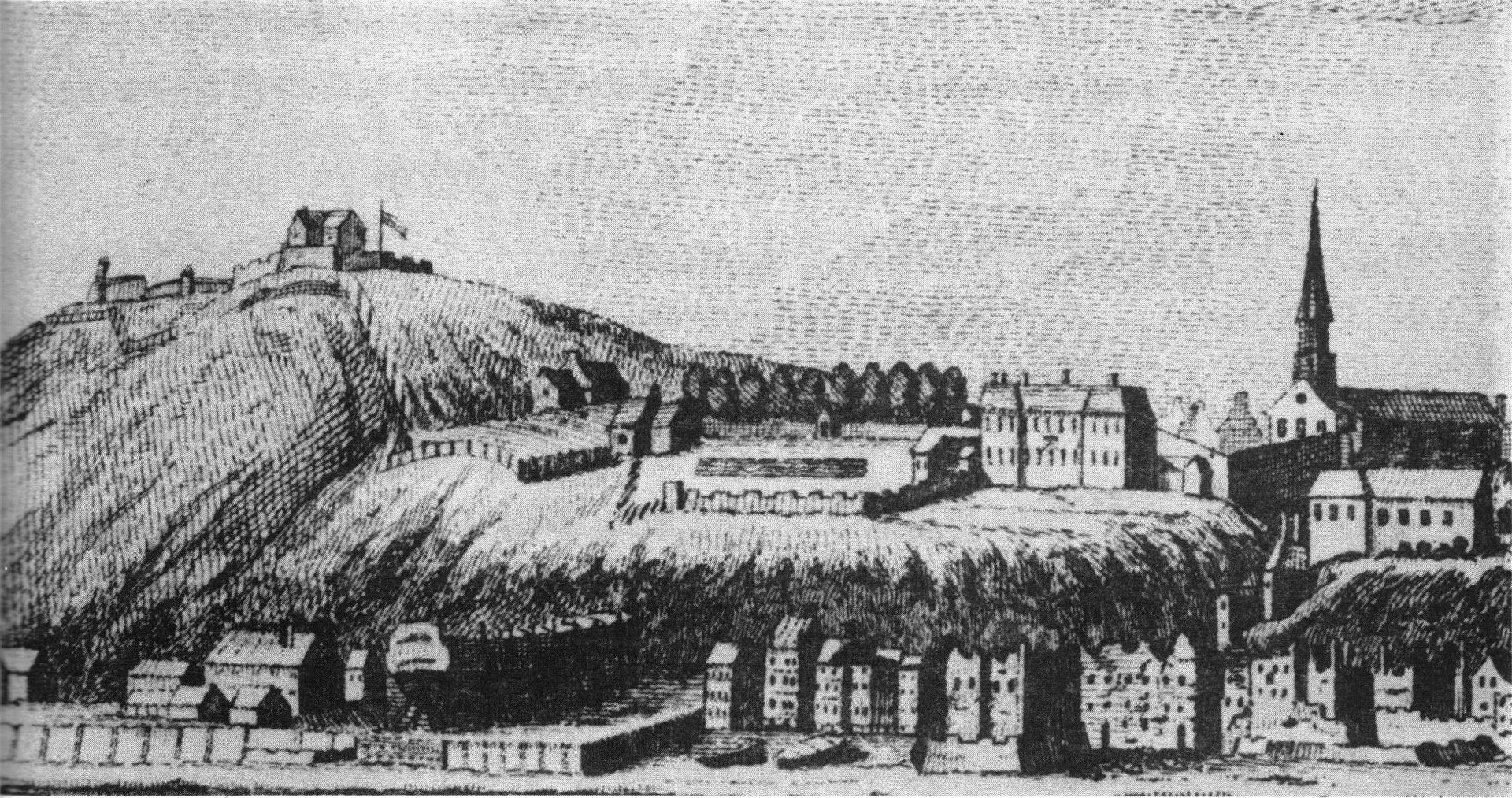
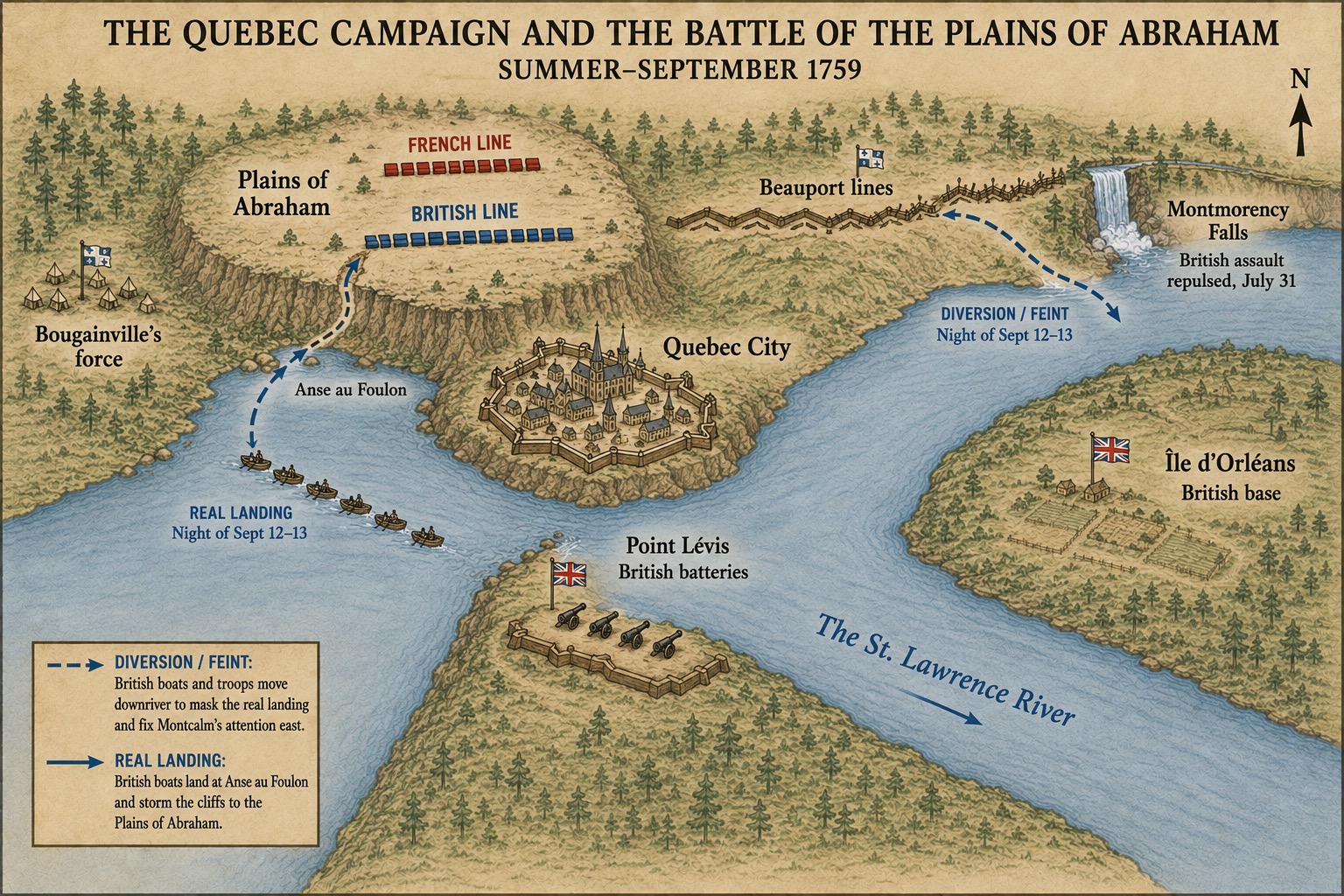
If Montcalm would not come down to fight, the British would have to get above him, onto the plateau outside the city walls where he could not refuse battle without surrendering the open ground at his own gate. The problem was the cliffs. West of the city the heights ran sheer along the river, and a landing there meant putting an army up a wall of rock in the dark, under the noses of French sentries, with the city’s whole garrison a short march away. It was a wild gamble, and Wolfe chose the wildest version of it. He fixed on a small cove called the Anse au Foulon, where a single narrow path climbed the cliff to the heights. Why exactly he chose that spot has never been fully explained; the workable plan was largely his brigadiers’, and his own contribution, the precise landing place, only added risk.
The whole thing turned on the navy and on misdirection. On the night of September 12, Vice Admiral Saunders ran a loud feint, a fake attack meant only to draw the enemy’s attention, far downriver, off the Beauport lines, with boats and bombardment, as if the long-awaited blow were finally falling there. Montcalm’s eyes stayed fixed on Beauport, downriver, while the real army slipped the other way, upriver, in the dark. Around two in the morning on the 13th, the warship Sutherland hoisted two lanterns as the signal, and a line of some thirty boats pushed off and rode the ebbing tide about ten miles down to the cove. The river had been charted for the fleet earlier in the campaign by a young naval master named James Cook, the same man who would later map the Pacific.
As the boats drifted down in the dark a French sentry on the bank challenged them. A Highland officer who spoke good French answered him in French, and the boats were waved on; the French were half expecting a convoy of provisions to come down that night, and the answer fit. The trick held just long enough.
At about four in the morning the first boats grounded at the Anse au Foulon. Light infantry scrambled ashore and went straight at the cliff, hauling themselves up the path and the broken rock by roots and handholds in the dark. At the top sat the guard that should have stopped them cold, a small post of about a hundred Canadian militia under a captain named Vergor (French). They were caught flat-footed. Lieutenant Colonel William Howe (British) led companies up and over the lip and overran the post almost before it knew what was happening. The path was open.
Then the army came up it. Boatload after boatload landed and climbed, and as the sky began to gray, the red-coated battalions formed up on the open ground at the top, the Plains of Abraham, a stretch of farm fields and pasture just outside the walls of Quebec. By around eight in the morning Wolfe had roughly forty-four hundred men drawn up in line of battle on the plateau, with two small cannon they had dragged up the cliff. The impossible part was done. The British army was standing, in good order, on the open ground at the city’s gate, exactly where Montcalm had sworn it could never be.