Word reached Montcalm at his Beauport headquarters that the British were not downriver after all but standing in line of battle on the heights behind the city. It was the one place he had told himself they could never be, and now they were there, between his army and the open country, threatening to dig in and cut the city off for good. What he did next has been argued over ever since. He could have waited. A mobile force of about three thousand men under Colonel Louis-Antoine de Bougainville (French) was upriver to the west, behind the British, and could have been brought down to catch Wolfe between two fires; the city’s own guns and walls were close at hand. Instead Montcalm chose to attack at once, that morning, with the troops he had gathered, before the British could entrench. His own reasoning was not foolish: he believed the city’s land walls were weak and could not stand a long siege, so to him waiting was not the safe option it can look like in hindsight, but a slow surrender of the initiative to an enemy already inside his guard. He did not even send word to Bougainville himself that the enemy had landed; it was the governor, the Marquis de Vaudreuil (French), with whom Montcalm had quarreled all war over how to defend the colony, who sent the message. Vaudreuil, Canadian-born, had always wanted to fight this war the Canadian way, with militia and Native allies harrying the British in the bush and behind their lines rather than meeting them in a stand-up European battle, and he had been overruled. Many historians since have called the decision to fight in the open the choice that lost the battle.
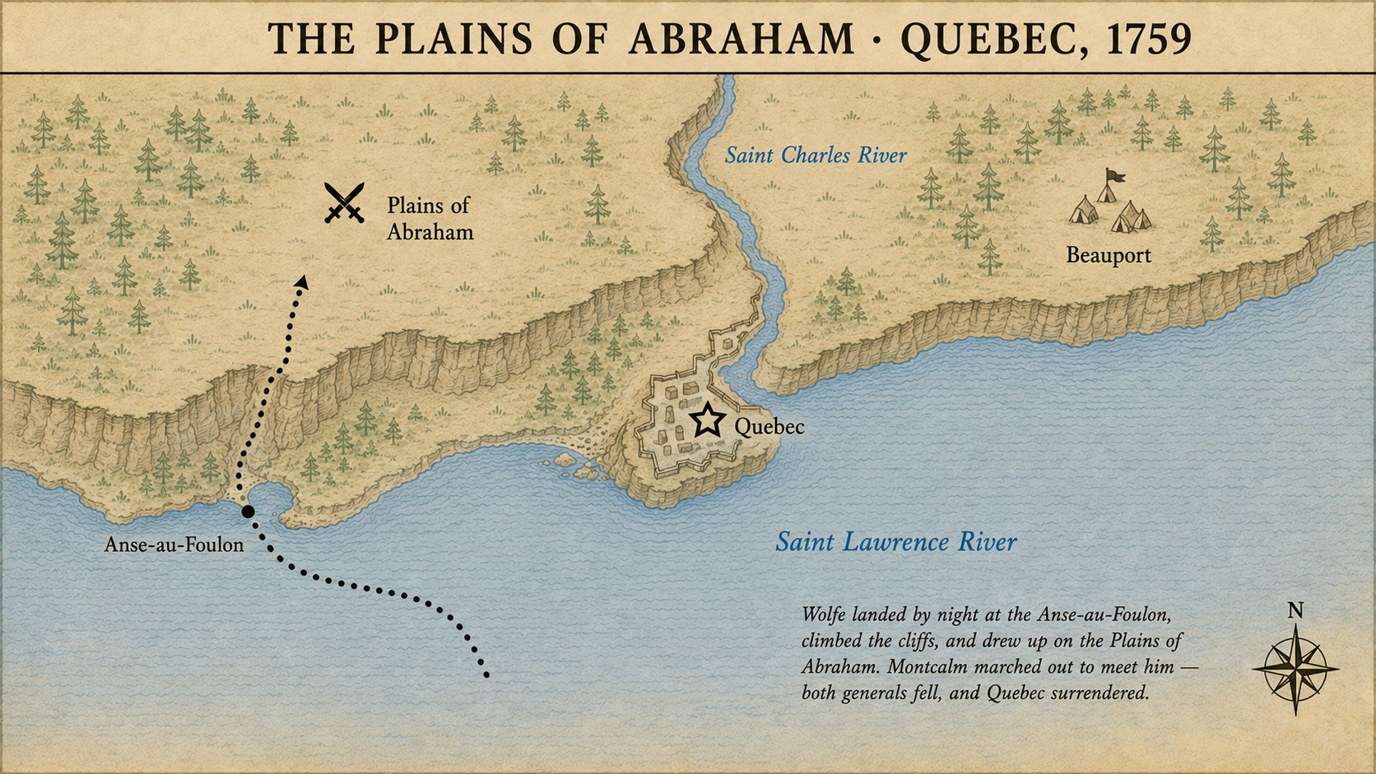
He brought up roughly the same number of men Wolfe had, somewhere between four thousand and forty-five hundred, but they were not the same kind of force. The core was French regulars, the king’s professional soldiers, perhaps two thousand of them. Around and among them were the Canadian militia and the Native allies, perhaps four hundred warriors drawn from the Mi’kmaq, Maliseet, Abenaki, Wendat, Odawa, and Potawatomi nations, some of the Odawa led by the Canadian officer Charles-Michel Mouet de Langlade. The militia and the warriors were brave and they were deadly in the woods and along the flanks, but they were not trained to stand in a European line and fire volleys on command, and Montcalm had folded many of them into his regular battalions, where that gap would tell.
The British just waited. Wolfe formed his line, two ranks deep across the open ground, and held it still, and ordered his men to hold their fire. Many of their muskets were loaded with two balls apiece for this one moment. Then Montcalm’s line came on. It came on raggedly, the regulars and militia at different paces, and the militiamen in the line did what militiamen did, firing early and then dropping to the ground to reload, which broke the formation into clumps. The French fired as they advanced, and men in the red ranks fell, and still the British line stood and held its fire, the officers walking it steady, letting the French come closer, and closer, and closer.
They let them come to somewhere around thirty-five yards, point-blank for a smoothbore musket, close enough to see faces. And then, for one held breath, nothing. The British line stood unbroken and silent, muskets level, the officers steady in front of it, the French coming on through the smoke of their own ragged fire with the redcoats simply waiting, watching them close the last few steps. Then the order came, and the whole British line fired at once.
It was less a battle than a single, controlled, annihilating blow, two great crashing volleys delivered battalion by battalion into a target that could not have been better placed if it had been staged. The smoke rolled out, and when it thinned the French front line was simply gone, shattered, the men who could still move turning and running. Two volleys had broken Montcalm’s army. The British leveled bayonets and swept forward across the field, and the French retreat became a rout streaming back toward the city gates.
It was not a clean slaughter, and that is to the credit of the men the line had been built to despise. The Canadian militia and the Native warriors, fighting from the brush and the flanks where their kind of war worked, poured fire into the British as they advanced and covered the broken regulars as they ran. Their stubborn rearguard fire is much of why the British, having broken the main French line and routed it in roughly fifteen minutes, did not destroy the French army outright on the field; the wider action, the advance, the rout, and the rearguard fight that covered it, ran on longer than that famous quarter-hour. The men who could not stand in the open line saved what was left of the men who could.