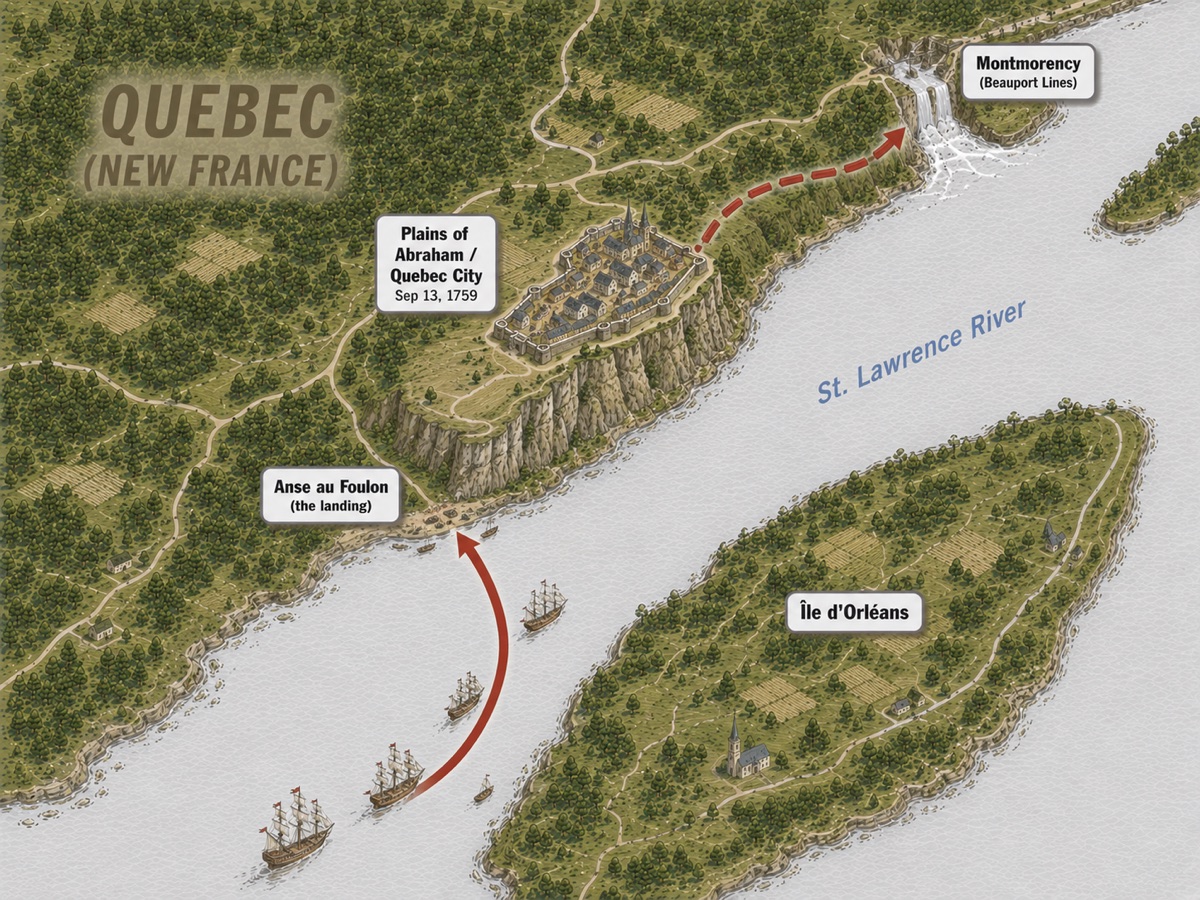
Quebec was the capital and the heart of New France, the French colony of Canada, and in the summer of 1759 it was the prize the whole war had been circling toward. The city sat on a high rock above the St. Lawrence River, walled on its landward side, guarded on the river side by cliffs, and ringed below by the farms and parishes that fed it. Take Quebec and you cut the colony’s head off. So the British came for it, and 1759 was the year they could, because the year before they had taken the great fortress of Louisbourg at the mouth of the river, the lock on the door, and the door now stood open all the way upstream.
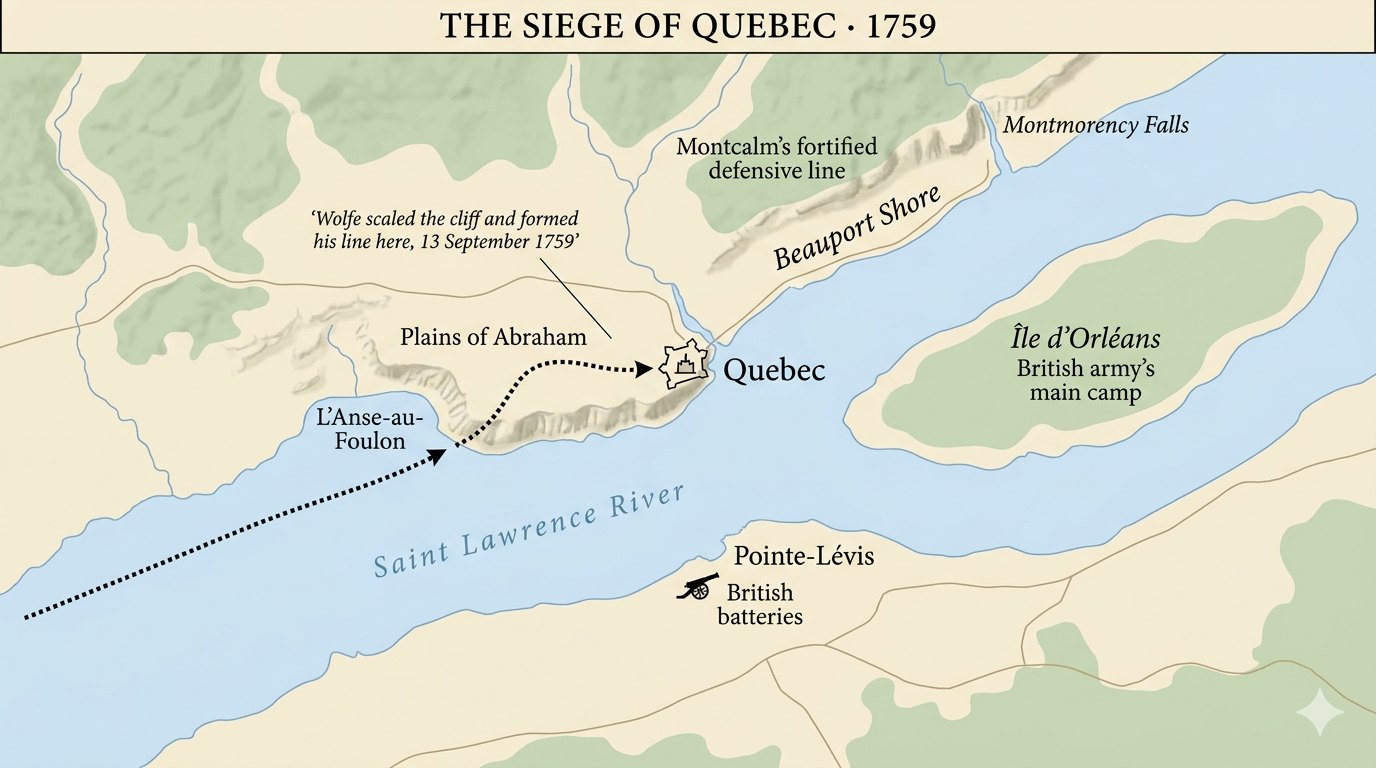
Getting there was itself a feat. The St. Lawrence is a long, narrow, treacherous channel, and no large fleet had ever taken a battle force that far up it. The man who did was Vice Admiral Charles Saunders (British), and the navy that threaded the river was as much the author of what followed as the army it carried. On June 26, 1759, the British began landing on Île d’Orléans, an island in the river just below the city. Their commander on land was Major General James Wolfe (British), thirty-two years old, thin, sickly, and ferociously ambitious. By the middle of July he had cannon and mortars planted at Point Lévis, on the south shore directly across from Quebec, and he opened fire on the town. The bombardment went on for weeks. It knocked the city about and it was meant in part to break the nerve of the people inside it, but it did not take the rock.
The trouble was the man on the other side. Lieutenant General the Marquis de Montcalm (French) had dug his main army into a line of entrenchments along the north shore east of the city, the Beauport lines, and there he stayed. He would not come out and fight in the open, where British discipline could tell, and Wolfe could not get at him behind his ditches and guns. Through the long, hot summer the two armies sat and stared at each other across the water, and nothing broke.
Wolfe grew sick and he grew frustrated, and out of the frustration came the ugliest chapter of the campaign. He turned on the countryside. Through August and into September, British raiding parties went up and down both shores burning the farms, the houses, and the barns of the Canadian habitants, the colonial farmers, parish by parish. The point was cold and deliberate: make the militiamen in Montcalm’s lines desert to go home and save their families, and starve the colony for the winter to come. One officer, Major George Scott, reported burning nearly a thousand buildings on the south shore alone. The parishes downriver, places like L’Ange-Gardien, Château-Richer, and Saint-Joachim, were put to the torch, and the destruction reached far down the St. Lawrence. It was not only property that was destroyed. At Saint-Joachim, surrendering militiamen and civilians were killed by the raiders, and the burning was at times accompanied by killing. By one careful estimate something close to fourteen hundred homes and farms were burned over the campaign. Only the churches were generally spared. It did not break Montcalm’s line either, but it left a wound on the country that long outlasted the battle.
Then Wolfe tried to force the issue and it went badly. On July 31 he threw an assault at the Beauport position near the Montmorency Falls, downriver of the city, trying to land troops and storm the French entrenchments head-on. The tide and the confusion fouled the landing, the grenadiers, the army’s heavy assault infantry, picked companies sent in first against the strongest works, charged ground that was stronger and closer than expected, and the attack was thrown back with heavy loss, roughly four hundred and forty British killed and wounded against a French handful. Wolfe had exposed himself recklessly in the fire and gained nothing. Summer was running out, the river would freeze, the fleet would have to leave before the ice, and the great expedition was no nearer to taking the city than the day it arrived. The deadlock had to be broken some other way, or not at all.