Murray had a choice, and he made the bold one. He could stay inside Quebec and stand a siege behind its walls, or he could march his sick, outnumbered garrison out into the open and fight Lévis’s fresh army in the field. The orthodox, safe move was to hold the walls. But Quebec’s walls were poor, battered by the previous year’s bombardment and never strong to begin with, and Murray did not believe his shrunken force could defend them well. He was also, by the account of his own biographers, a hot-headed and impetuous man. He chose to attack, and the ground he chose to attack on was the same ground where Quebec had been won the year before. There was a lesson buried in that field, if Murray cared to read it. Montcalm had lost the city in 1759 by throwing his men forward in clumsy columns and getting them shot to pieces in the open. Lévis would not make that mistake. But it was Murray, this time, who would march down into trouble.
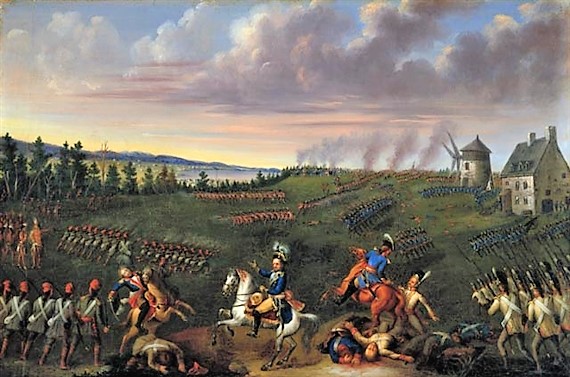
So on the morning of April 28, 1760, Murray marched out of the city with about thirty-eight hundred men and a powerful train of artillery, more than twenty cannon and two heavier guns, onto the high ground west of Quebec near the village of Sainte-Foy, the same field as the Plains of Abraham. In one respect his decision looked shrewd: Lévis had only about three guns up with him on the field, his heavy artillery still coming, so the British had a crushing advantage in firepower if they could bring it to bear. Murray meant to hit the French before they finished forming up. To do it he pushed his army down off the high ground and forward into the low, open snow, and that was where the ground turned on him. The spring thaw had left the field a foot deep in half-melted snow, and as the British advanced the heavy artillery carts bogged down in the slush, unable to keep up with the infantry or get clear shots.
At first the attack worked anyway. Murray struck while the French were still deploying, and the British advanced with success. But then the thing that should have been his great advantage turned against him. As his infantry pushed forward, they got in front of his own bogged guns and masked them, so the artillery that was supposed to win the day could no longer fire into the enemy without hitting British backs. The battle closed to short range and turned into a straight, grinding, close-quarters fight that ground on for about two hours.
Lévis got his line formed faster than Murray expected, steadied it, and then went over to the attack. French counterattacks, including a bayonet charge, drove in on the British and into their left side, collapsing the British line from that flank inward. The British guns, stuck in the snow and short of ammunition, had to be left behind. Murray’s men, the ones who had survived the winter only to be marched into this, were beaten. They broke off and fell back into Quebec, abandoning their artillery on the field, and Lévis held the heights.
It was a French victory, and a costly one for everybody. The British lost on the order of eleven to twelve hundred men, with close to three hundred killed; one regiment, the 15th Foot, lost about a third of its strength. The French lost something over eight hundred, nearly two hundred of them killed. Roughly two thousand men were struck down between the two armies, against about thirteen hundred on the Plains of Abraham the autumn before. Sainte-Foy was bloodier than the Plains of Abraham, and by some measures the bloodiest engagement of the war in North America. Murray had marched out to keep the French off his weak walls. Instead he had handed Lévis the field, lost his guns, and shut himself and his survivors back up inside exactly the fortress he had not wanted to defend.
The war storyThe wider British tide of 1758 to 1760