By the start of 1758 Britain had been losing this war for three years, and the losses had a sameness to them. The fort at the Forks was French. Braddock's army was still bones in the forest west of the Appalachian Mountains. Fort Oswego on Lake Ontario had fallen to the French in 1756, Fort William Henry on Lake George in 1757, and the second had ended with French-allied warriors killing prisoners the French could not control. The frontier from New York to Virginia bled all summer, every summer, while British generals quarreled with the colonial assemblies whose men and money they needed and could not seem to get. Then, across the Atlantic, in the offices of a London government most of these soldiers would never see, one politician took hold of the war and changed almost everything about how it was fought. The year was 1758, and by the time it ended the tide of the whole continent had turned.
The Man Who Said He Could Save the Country
The man who turned it around never fired a shot in this war and never crossed the ocean. William Pitt the Elder was a politician, brilliant, arrogant, and convinced of his own indispensability, and in June 1757 he formed a government that handed him what he wanted. The arrangement was odd. The Duke of Newcastle, Thomas Pelham-Holles, was the nominal head, managing the House of Lords, the Treasury, and the vast machinery of political patronage. Pitt took the title of Secretary of State for the Southern Department (the British minister responsible, among other things, for the American colonies), which on paper made him a senior minister but not the head of government. In practice it made him the war minister of the British Empire in all but name. Newcastle ran the politics; Pitt ran the war. Of his own fitness for it Pitt had no doubt at all.
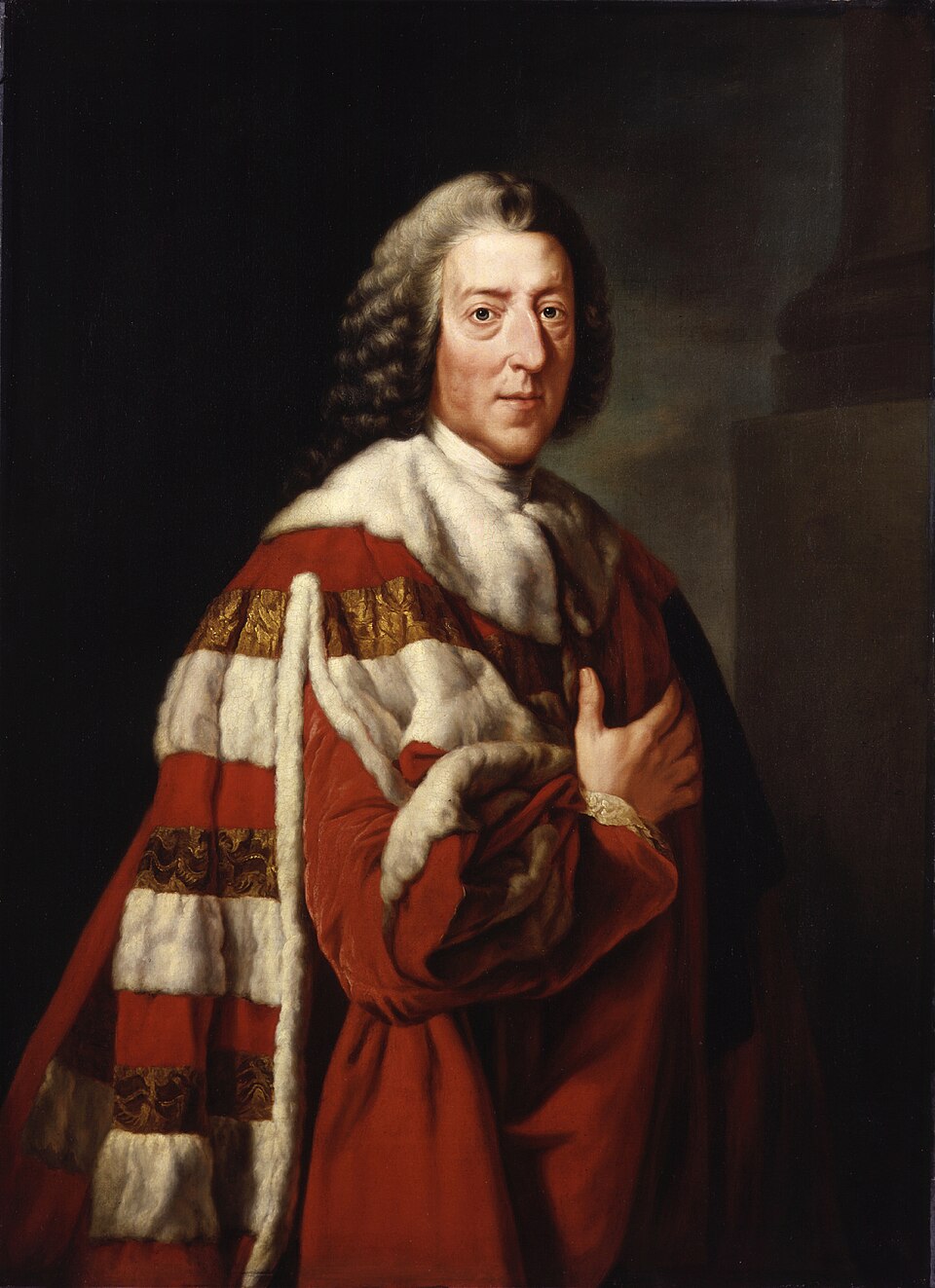
My Lord, I am sure I can save this country, and no one else can. — William Pitt, on forming the coalition
The war he inherited was being lost partly because of how Britain had treated the colonies. The previous commander in North America, the Earl of Loudoun, Lieutenant General John Campbell, had run the colonial assemblies the way a general runs reluctant subordinates: demanding men, money, and quarters for his troops, pressing colonists into service, overriding local officials. The friction was constant, and in places it tipped into what one account called outright mutiny. The friction turned partly on the gulf between two kinds of soldier. Regulars were full-time professionals of the standing British army, the king's own troops; provincials were short-term troops raised by an individual colony for a season's campaign and then disbanded. Worse, a 1754 order had ruled that any officer of a colony-raised provincial regiment ranked below the lowest regular officer holding the king's commission, so a colonial colonel had to take orders from a British lieutenant. To the men Britain needed most, the message was that their service was second-class. Pitt recalled Loudoun in late December 1757 and set about changing the message.
His strategy had four parts, and together they amounted to a different war. The first was to fight France in Europe with someone else's army. Rather than pour British troops into the Continent, Pitt paid Frederick the Great (Prussian), the king of Prussia, an annual subsidy of roughly £670,000 to £700,000 to keep France's armies tied down in Germany. A bankrupt France fighting on the Rhine could not also reinforce Canada. Pitt is remembered for the idea, often paraphrased since, that he had won Canada on the banks of the Rhine: the cheapest way to take New France was to keep France too busy in Europe to defend it.
The second part was to treat the colonies as partners rather than subjects. Parliament granted Pitt what one account called almost unlimited funds, and he used them. He promised the colonial assemblies that the Crown would generously reimburse the war expenses they ran up raising provincial troops, turning recruitment from a grievance into a paying proposition. A 1757 warrant softened the rank insult, lifting provincial officers of colonel rank and above to near-parity with regulars. The friction eased; the men came.
The third part was the Royal Navy. Britain's fleet was the one weapon France could not match, and Pitt made it the lever of the whole war: blockade the French ports, cut the sea lanes that fed and reinforced Canada, and carry British armies wherever the empire wanted to strike. Starve the pipeline, and every French garrison in North America would slowly wither.
The fourth was the prize itself. Pitt aimed not at the frontier forts but at New France's heart, the fortified towns on the St. Lawrence River, the river that was Canada's spine and its lifeline to the sea. Take the gateway to the St. Lawrence, then take Quebec, and any peace negotiated in Europe would have to start from a conquered Canada. By the summer of 1758 the reimbursement policy and the rank reforms had helped put roughly 50,000 men in British uniform in North America, regulars and provincials together, a number close to the entire white population of New France. France had the debts of a near-bankrupt monarchy; Britain now brought the resources of an empire and aimed them all at the same target.
Three Blows at Once
Pitt's plan for 1758 was to hit New France in three places at the same time, so that wherever the French concentrated to defend, they would leave two other doors open. One army would take Louisbourg, the great fortress on Cape Breton Island that guarded the mouth of the Gulf of St. Lawrence, the only deep-water sea route to Quebec and the heart of New France; with Louisbourg taken, a British fleet could sail up that river to Quebec the next year. A second, the largest, would drive north up the Lake Champlain corridor against Fort Carillon, the gate to the heart of Canada. A third would push west through the Pennsylvania wilderness to Fort Duquesne, the French strongpoint at the Forks of the Ohio that had started the whole war.
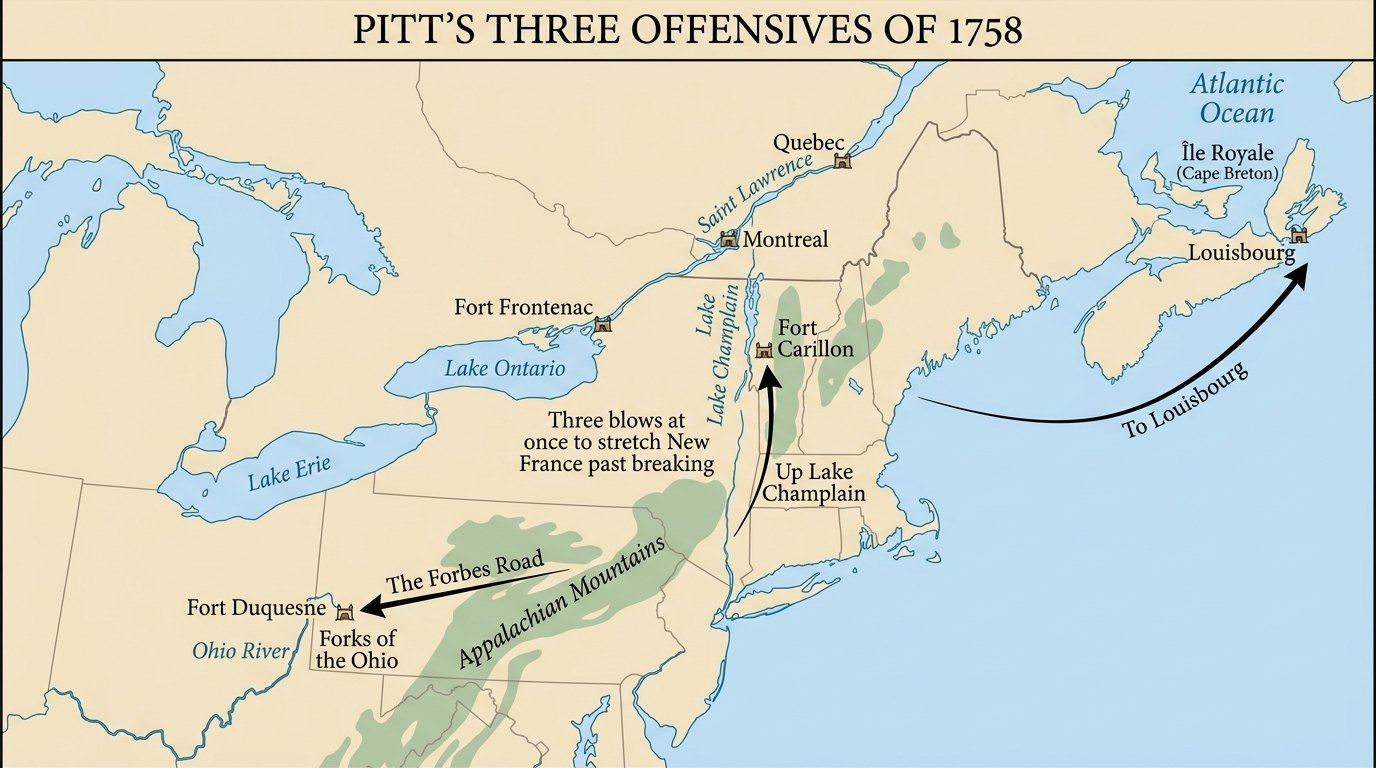
Three thrusts, one logic: a France too stretched to be strong everywhere. Two of the three would succeed. The third would become the bloodiest disaster of the entire war. And a fourth blow, not even in the original design, would turn out to matter as much as any of them.
The Gateway Falls
The first blow landed on a fortress in the sea fog off Nova Scotia. Louisbourg sat on Île-Royale, today's Cape Breton Island, and it guarded the mouth of the St. Lawrence; whoever held it held the door to Quebec. The British came at it with overwhelming force: somewhere between 11,000 and 14,000 troops under General Jeffery Amherst, carried and covered by a fleet of forty warships and a hundred and fifty transports under Admiral Edward Boscawen. Inside the walls, the governor and commander Chevalier de Drucour had about 7,000 defenders, a squadron of warships in the harbor, and the Mi'kmaq (pronounced "MIG-maw"), the Indigenous nation of the region and longstanding allies of France, who fought alongside the garrison throughout the siege.
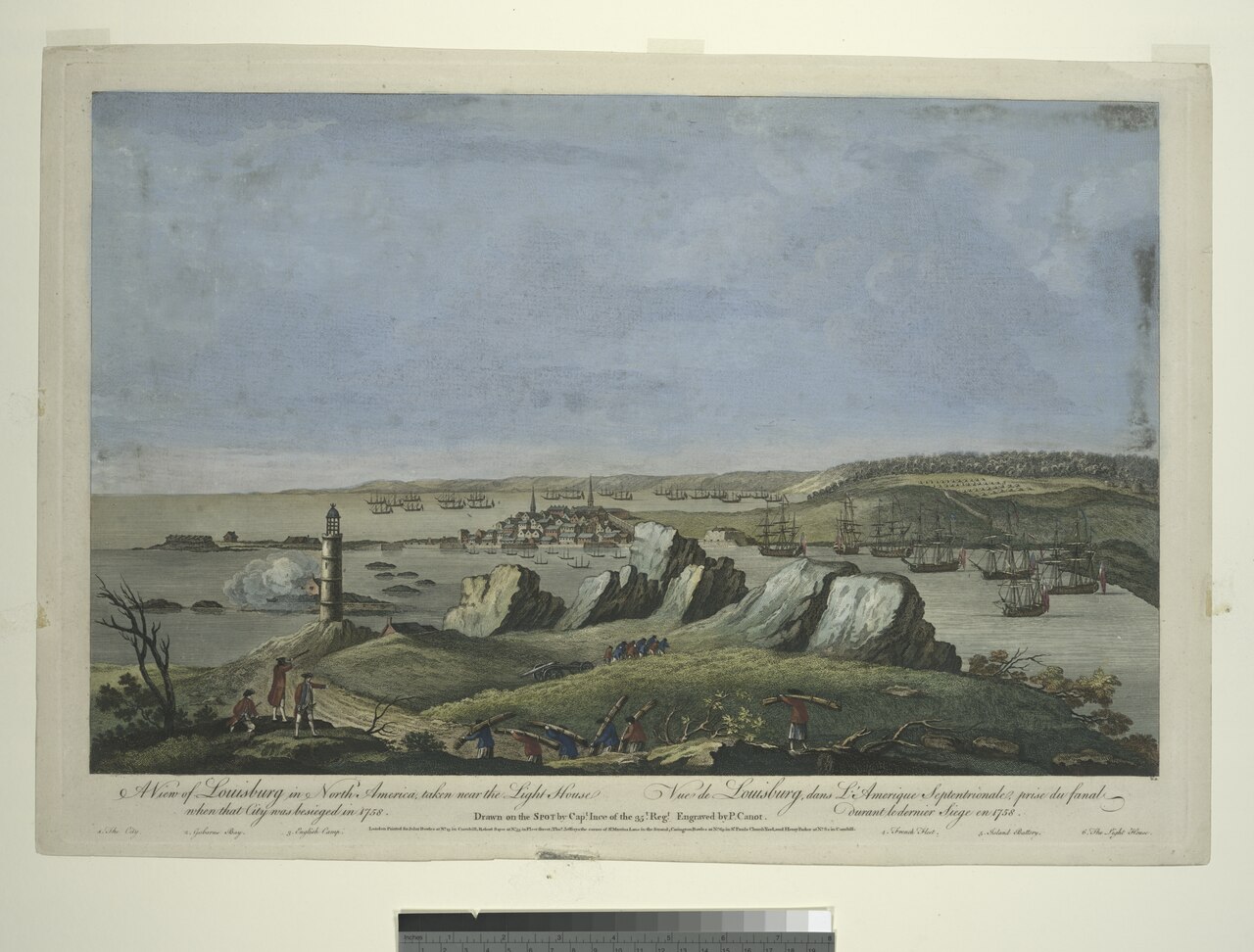
The hinge of the whole operation was the landing, and it nearly failed. On June 8, 1758, Brigadier General James Wolfe led his division at Kennington Cove, a rocky beach the French had judged too dangerous to need much defending and then defended anyway, throwing back the first boats. As Wolfe's men were being repulsed, some of his light infantry boats drifted east along the shore and stumbled on an undefended slot in the rocks. They went ashore on their own initiative and held it, and the rest of the division followed them in. Unsure how many British had landed, the French pulled back toward the fortress and gave up the outer defenses.
After that it was a siege, the patient, grinding kind. For seven weeks British guns dismantled the walls. On July 21 a mortar shell struck the French warship _Célèbre_; the fire spread to two more ships and burned them in the harbor. The King's Bastion burned on July 23. On July 25 a British boat raid captured one of the last French ships and burned another that had run aground, clearing the harbor for the Royal Navy to sail in. Drucour asked for the honors of war, the customary courtesy of letting a beaten garrison march out under arms. Amherst refused.
We give your Excellency an hour to determine on the only capitulation we are willing to grant, which is, you surrender yourselves prisoners of war. — Jeffery Amherst, July 1758
Drucour accepted the hard terms to spare the town's civilians. The articles were signed at midnight on July 26, 1758. The cost had been modest as these things went, around 172 British and 102 French killed, but the prize was enormous: roughly 6,600 French troops marched into captivity and shipped to France as prisoners, the harbor squadron was destroyed or taken, and the mouth of the St. Lawrence stood open. The single greatest obstacle on the road to Quebec was gone.
The war storyLouisbourgA Slaughter at the Log Wall
The second blow was the largest army Britain had ever sent into the American interior, and it walked into the worst defeat of the war. The target was Fort Carillon, on the narrows between Lake George and Lake Champlain at present-day Ticonderoga, New York, the gate to the Lake Champlain corridor that ran straight into the heart of New France. Against it came roughly 15,000 men, about 6,400 regulars and 9,000 provincials, under Major General James Abercromby, a fifty-two-year-old officer with powerful political connections and little battlefield experience, though he had managed the logistics of that vast force capably enough to get it there.
The army's heart broke before the battle did. Its second-in-command was George Augustus, Viscount Howe, a young brigadier unlike almost any other British officer in America. He had learned wilderness fighting from Major Robert Rogers and his rangers, and he made his regulars fight the way the forest demanded: cropped coats, shortened muskets, no powdered wigs, no parade-ground nonsense. The colonial provincials, who trusted almost no British regular, trusted Howe. On July 6, two days before the assault, his column collided with a stray French detachment in the woods at Trout Brook, and a musket ball killed him on the spot. One officer's dispatch caught what his death did to the army.
In Lord Howe, the soul of General Abercromby's army seemed to expire. — A British officer, July 1758
What Howe's death left behind was an army with no one to steady its hand. Across the narrows, the French commander Montcalm had perhaps 3,500 regulars and militia, fewer than a quarter of the force coming at him. He had almost none of the Native warriors who had been the backbone of French campaigns: at Fort William Henry the year before he had fielded some 1,800, but most had since left, many disgusted by restrictions on plunder, and by the day of the battle fewer than a hundred remained and took essentially no part in it. The defense at Carillon would be carried entirely by French regulars and militia. He could not hope to win a maneuvering battle at those odds, so he chose the ground and dug in. On a ridge three-quarters of a mile in front of the fort, his men spent the day and night of July 6 and 7 building a defense in roughly twenty-four hours: a log breastwork at least eight feet high, zigzagged across the heights so its defenders could rake any attacker from the side, and in front of it an abatis (pronounced "AB-uh-tee"), a band of felled trees with their sharpened branches pointed outward, thirty yards deep, functioning like a tangle of barbed wire.
Then Abercromby made the decision that killed his men. He sent an engineer, Lieutenant Matthew Clerk, to scout the French line from a nearby hill; Clerk reported that infantry could storm the breastwork without waiting for the heavy siege cannon. Abercromby, confident in his numbers, believed him. On the afternoon of July 8, 1758, he ordered his regiments straight at the log wall, with no artillery brought up to batter it, no attempt to work around its flanks, no siege to starve it out. The attack he had planned as one coordinated blow along the whole French front dissolved almost at once into separate, isolated charges. The abatis broke the British formations apart; the French poured fire down from behind eight feet of timber into men snarled in the sharpened branches. The regiments came on again and again, the same impossible ground, for hour after hour through the afternoon, and each wave was cut down where the one before it had fallen. One observer compared the killing ground to a slaughterhouse. By evening Abercromby ordered the retreat, and the next day the largest army in America was streaming back down Lake George.
The losses are contested in the sources, but the range is grim: somewhere between 1,600 and 2,000 British killed, wounded, and missing, with more than 500 dead, against French losses of fewer than 400. It was the bloodiest battle of the entire war in North America, and it stayed the bloodiest day the continent had seen until the Civil War a century later. Montcalm, who had won a near-impossible defensive victory against four-to-one odds, was celebrated across New France. Abercromby was recalled to Britain in September and replaced by Amherst; his political connections spared him any formal disgrace, and he was promoted by seniority, but he never held a field command again. The fort itself would fall to the British the next year and be renamed Ticonderoga.
The war storyCarillon (Ticonderoga)For all its horror, Carillon could not change the war. Montcalm had won by gambling nearly his entire effective field force on one piece of ground; he could defend Carillon, or he could defend somewhere else, but he could not be everywhere. Every door he held shut left two others open, and while he was holding this one, the British walked through the others.
The Supply Line Cut
The third blow that summer was not even part of Pitt's original three-pronged plan, and it may have done more damage than Carillon's slaughter cost. While the main armies fought on the lakes and at Louisbourg, Lieutenant Colonel John Bradstreet, an officer of part-Acadian descent (the French settlers of the Maritime colonies) who understood the inland waterways better than any of Pitt's marquee generals, led a force of provincials, around 2,600 men, against Fort Frontenac. The fort stood where Lake Ontario drains into the St. Lawrence, at present-day Kingston, Ontario, and it was the warehouse and transit hub of the entire French west: every barrel of supplies and every keg of powder bound for Fort Duquesne, Fort Niagara, and the Great Lakes posts passed through it.
It was almost undefended. The garrison numbered perhaps 100 to 150 people under an elderly commander, Pierre-Jacques Payen de Noyan, and could not resist a siege. Bradstreet landed on August 25, set up his guns, and the fort surrendered on August 26 or 27, 1758, at a cost of two French dead and eleven British wounded. The haul was strategic out of all proportion to the fight: more than sixty cannon, hundreds of barrels of provisions, furs and trade goods worth around 800,000 French livres (the entire season's surplus of the western trade), two warships taken, and the rest of the French presence on Lake Ontario destroyed. Bradstreet demolished much of the fort and left.
With Frontenac gone, the French forts to the west were cut off from Montreal and Quebec, dangling at the end of a severed supply line. Fort Duquesne, the strongpoint at the Forks of the Ohio, was now isolated and effectively starving before any British army reached it. After the catastrophe at Carillon, the news also did something for British morale that no amount of casualties at the log wall could undo.
The war storyFort FrontenacThe Slow Road West
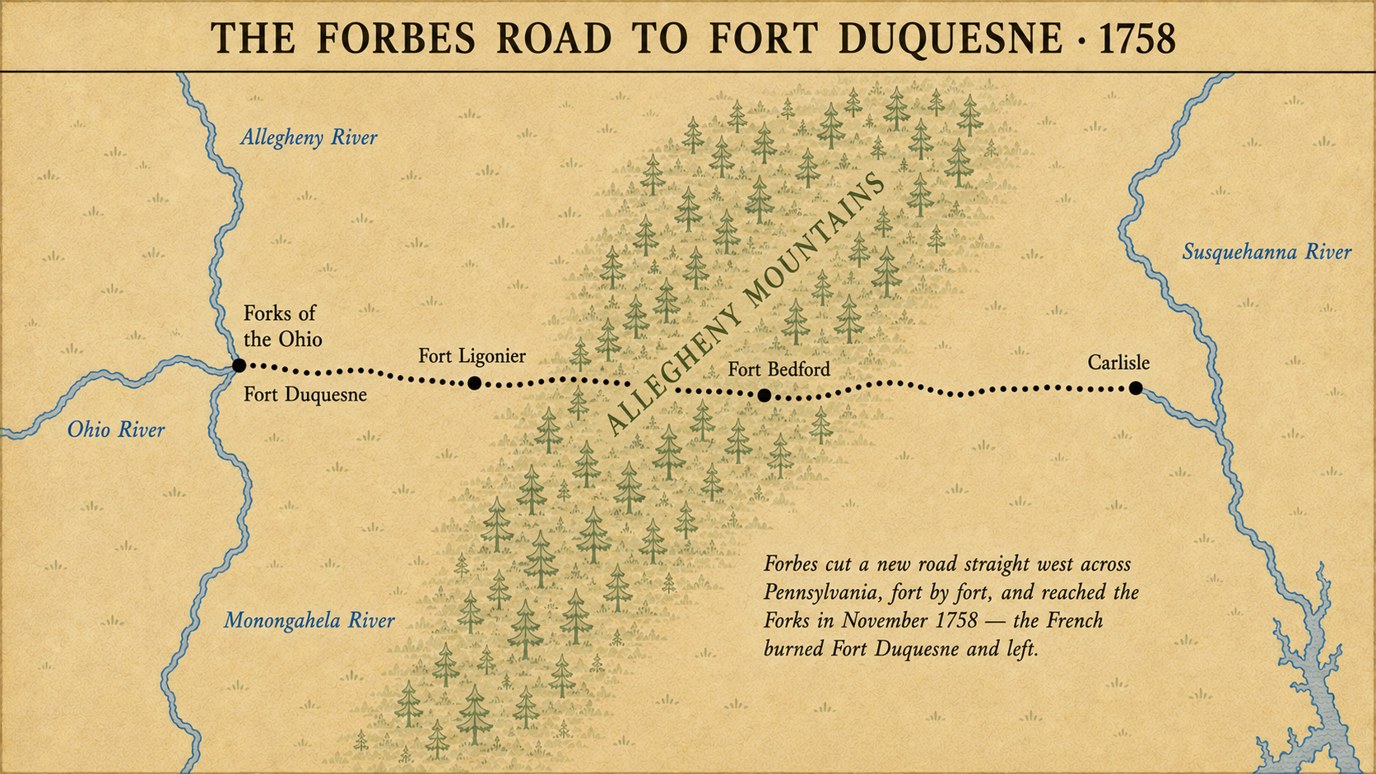
The last blow of 1758 went back to where the war had started. Fort Duquesne sat at the Forks of the Ohio, the point where the Allegheny and Monongahela rivers meet, the most valuable spot on the continent and the one the French had seized in 1754 to begin the whole conflict. The man Pitt chose to take it back was Brigadier General John Forbes, a Scottish officer who was methodical, respected, and no glory-seeker, which made him the opposite of the general Braddock had been on the same ground three years before. Forbes was also dying. There is an irony at the center of this campaign worth stopping on: the most patient and methodical advance of the entire war, a road built mile by deliberate mile across a mountain wilderness, was run by a man so wasted by dysentery that he could not sit a horse and had to be carried the whole way in a litter, a sling slung between two horses, fore and aft, that bore him west like a stretcher. Most day-to-day command fell to his operational deputy, Lieutenant Colonel Henry Bouquet, a Swiss professional soldier. Forbes won the greatest victory of his life while slowly succumbing to the sickness that was killing him, and he died in Philadelphia a few months later, in March 1759.
His method was the opposite of Braddock's fatal speed. Rather than reopen Braddock's old road up from Virginia, Forbes ordered a brand-new road cut due west across the Pennsylvania mountains, building fortified supply depots, Fort Bedford and Fort Ligonier, at each stage as he went. Colonel George Washington, commanding the Virginia troops in the army, argued hard for the southern Virginia route; Forbes overruled him and built his own. The Forbes Road advanced slowly and could not be cut off behind itself, an iron tether the French could not sever the way they had savaged Braddock.
The advance was not bloodless. In September a detachment under Major James Grant of the Highlanders, around 850 men sent forward to scout Fort Duquesne, split itself into separate pieces that could not support one another. On September 14, 1758, the French garrison and roughly 500 Native warriors sortied out and destroyed the fragments one at a time. The British lost some 342 men killed, wounded, and captured, Grant himself among the prisoners, against a French and Native loss of around sixteen. It was a sharp reminder that the Native nations of the Ohio were still, for now, fighting for France, and that as long as they did, the French could hold the country.
What changed that was not a battle. It was a treaty, and it is the hinge of the entire western campaign.
The Calculation at Easton
For four years French power in the Ohio Country had rested less on French soldiers than on Native allies, the Lenape (also called the Delaware), the Shawnee, the Mingo, and others who fought alongside France because the French came to trade and garrison while British colonists came to clear forest and stay. A French fort was a trading partner with cannon; a British farm was the leading edge of dispossession. That calculation had pushed the Ohio nations toward France since the war began. In 1758 it was reconsidered, and the reconsidering was theirs.
Behind that reconsidering lay a specific, festering grievance. In 1737 the Penn proprietors, the sons of William Penn who governed Pennsylvania, had taken roughly 1.2 million acres of Lenape land in a swindle remembered as the Walking Purchase. They produced a likely-forged 1686 "deed" promising them all the land a man could walk in a day and a half, then hired the colony's fastest runners, who covered about 70 miles in a single day along a pre-cleared path, far more ground than the Lenape had understood they were giving up. Teedyuscung, whose own people had been dispossessed by it, had been hammering on the Walking Purchase as fraud at every Easton conference since 1756. By 1758 the Ohio nations also read the war for what it was becoming: Louisbourg gone, Frontenac gone, French supplies failing, France losing. A defeated ally is no protection. Holding the British at arm's length looked, in that autumn, like the better bet.
In October 1758, more than 500 Native people gathered in an open-air council at Easton, Pennsylvania, representatives of thirteen nations: the Six Nations of the Iroquois Confederacy (the Mohawk, Onondaga, Oneida, Cayuga, Seneca, and Tuscarora), the eastern and western Lenape, the Shawnee, the Mingo (Iroquois living in the Ohio Country), and a number of smaller nations. The principal Native negotiator was Teedyuscung (pronounced "tee-dee-US-kung"), a Lenape leader the British styled "King of the Delawares," who had been pressing his people's grievances at Easton councils since 1756, advised by Charles Thomson, a Pennsylvanian who would one day become secretary of the Continental Congress. The principal British negotiator was William Denny, the lieutenant governor of Pennsylvania.
What the British promised was, on its face, exactly what the Ohio nations wanted. Britain recognized Native hunting rights in the Ohio valley. It pledged to forbid colonial settlement west of the Allegheny Mountains once the war was over, the single thing the British farm threatened that the French fort did not. Pennsylvania agreed to return large blocks of land the Iroquois had ceded a few years before in disputed deals. And there was a payment, around 1,000 Spanish dollars, as partial consideration. In exchange, the nations made the commitment that decided the west: they would not fight on the side of the French in this war. What the treaty pointedly did not do was undo the Walking Purchase or pay a penny of restitution for it; the fraud that had driven the Lenape west in the first place was left exactly where it stood. That unhealed grievance would matter later.
That was the whole game in the Ohio Country. The French could hold a fort this remote only because their Native allies did the scouting and the raiding that kept the British road deadly, the work that had annihilated Braddock and bloodied Grant. Pull those allies out of the alliance, as Easton did, and the few hundred men at Fort Duquesne were left isolated at the end of a supply line Bradstreet had already cut, with Forbes's 6,000 grinding toward them down a road they could no longer make dangerous. Easton did not reinforce the Forbes Expedition; it hollowed out the enemy in front of it. The road was the hammer, but the treaty cleared the ground the hammer would strike. The Ohio nations did not have to be beaten. They chose, for their own reasons and on their own terms, to step aside, and that choice was worth more than a battle.
The promises did not last. The pledge to bar settlement west of the mountains was written, in a fashion, into the Royal Proclamation of 1763, which reserved that land for Native peoples, and then it was simply not enforced. British colonists poured west within a few years, and the terms made at Easton were broken almost as soon as the war that prompted them was won. The Lenape and Shawnee who had withdrawn from France on the strength of those promises would take up arms again in 1763, in the rising known as Pontiac's War, fought over the very betrayal the Easton council had set in motion. The treaty is a study in what an empire will promise to win a war and discard once it has won.
Off the fieldThe Contest for Native AlliancesThe Fort with Pitt's Name
By mid-November 1758 the pieces had all fallen into place against Fort Duquesne, and none of them was a great battle. Bradstreet had cut the supply line from the north. Easton had stripped away the Native warriors who had held the country. Forbes's road had brought 6,000 men to within striking distance without ever offering the ambush that had destroyed Braddock. The French commander looked at a garrison of a few hundred men, no supplies, no allies, and an army he could not stop, and drew the only conclusion the situation allowed. On November 25, 1758, the French blew up the fort's powder magazine, burned the buildings, and retreated; the British took possession of the smoking ruins the next day. George Washington personally led three scouting parties into the wreckage as it fell. The place the entire war had begun over was taken without a fight, because everything that had made it defensible was already gone.
Two days later Forbes, carried into the ruins of the fort he had spent his health to capture, wrote to the man whose strategy had made it possible.
I have used the freedom of giving your name to Fort Duquesne, as I hope it was in some measure the being actuated by your spirits that now makes us masters of the place. — John Forbes to William Pitt, November 27, 1758
On the site rose Fort Pitt, a great five-sided fortress with projecting corner strongpoints, the largest and most elaborate British work in America, and around it grew the city that still carries the name: Pittsburgh, named for the fort, and so for the war minister who never saw it.
The war storyFort DuquesneThe Tide at Year's End
Set the year's ledger side by side and the change is unmistakable. Britain had taken Louisbourg and opened the St. Lawrence; had taken Fort Frontenac and severed the supply line to the entire French west; had taken Fort Duquesne and expelled France from the Ohio Country; and had detached the Ohio nations from the French alliance at Easton. France had won exactly one thing, Carillon, a spectacular defensive victory that had cost the British more blood than any other day of the war and changed nothing about the strategic picture.
The reasons the tide turned were the reasons Pitt had bet on. The Royal Navy strangled New France's reinforcement and resupply until its garrisons could barely feed themselves. The reimbursement policy and the rank reforms had brought the colonial assemblies and their men into the war on Britain's side, roughly 50,000 against the entire population of New France. And at Easton, the people the war was named against had made the calculation that the British, not the French, were the ones to be kept at arm's length, and stepped out of the French alliance that had held the west for four years. Montcalm could win battles. He could not be in two places at once, and Britain was now coming from three.
The year set up the next. With Louisbourg gone, a British army could sail up the St. Lawrence to Quebec. With Frontenac gone, Fort Niagara was the next domino. With Duquesne gone and Easton signed, the whole Ohio Country was British. The losing empire of 1757 had, in a single year, rebuilt its war and turned it around, and 1759 would be the year the bill came due for New France.
One ledger entry, though, was written in disappearing ink. The Ohio nations who had made the western victory possible had been promised a barrier against settlement that the British would not hold. The same machine now grinding toward Quebec would, within five years, leave them facing the British alone, settlers already pouring over the mountains the Crown had pledged to keep them behind, and the Lenape and Shawnee would take up arms again in 1763. The men who turned the war in the west would be among the first the peace betrayed.