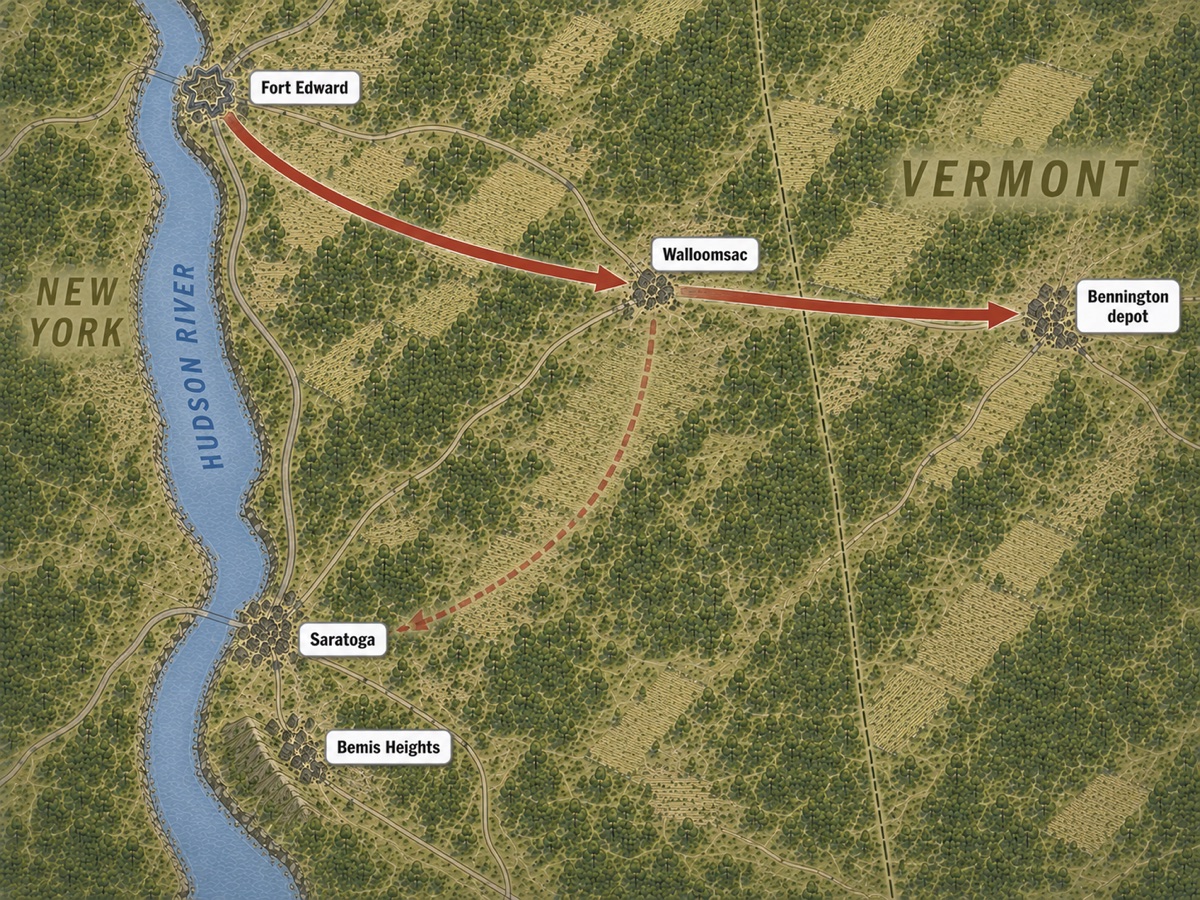
Lieutenant General John Burgoyne (British), commanding the invasion army on the Hudson, got nothing he had sent for. The expedition he had dispatched toward the supply depot at Bennington was supposed to come back with horses for his unmounted German cavalry, draft animals and carts for his starving supply line, and cattle and flour for his men. It came back with nothing. Baum's column never came back at all, and Breymann's came back broken, without its cannon, its wounded, or its baggage. Across the two fights of August 16 at Walloomsac, New York, Burgoyne lost about 900 to 1,000 men, roughly one in seven of his field army: some 200 to 230 killed and wounded left on the field, and about 700 taken prisoner, along with all four cannon. The dragoons (the German cavalry regiment that had marched from Canada on foot) still had no horses; most of the regiment's survivors were now prisoners, and it effectively ceased to exist as a fighting unit. The army still had to drag its food forward by hand. The "energy and dispatch" Burgoyne had said the captured cattle and carts would buy him never arrived, because the cattle and carts never did.
The defeat also cost him his eyes. Most of the Native warriors allied to the expedition, whose confidence in the campaign broke at Bennington, abandoned Burgoyne in the weeks afterward, and with them went much of his army's screen of scouts and its reach into the countryside for food. His letter to London four days after the battle is a study in a general discovering what country he is actually in. "Wherever the King's forces point," he wrote, "militia, to the amount of three or four thousand, assemble in twenty-four hours; they bring with them their subsistence, etc." And of the region that had just destroyed a seventh of his army, the Hampshire Grants (the frontier territory that is now Vermont), he wrote the campaign's epitaph in advance.
The Hampshire Grants in particular, a country unpeopled and almost unknown in the last war, now abounds in the most active and most rebellious race of the continent, and hangs like a gathering storm upon my left.
The storm broke on schedule. Crippled for transport, Burgoyne halted on the Hudson for weeks, scraping together about 30 days' provisions before he dared move; he did not cross the river until September 13. Every one of those days was a gift to the Americans. In them, the American northern army got a new commander (Horatio Gates, replacing Philip Schuyler), got Daniel Morgan's riflemen and thousands of arriving militia, and got time to fortify the high ground at Bemis Heights, the position Burgoyne would have to break to reach Albany. He never broke it. On October 17, 1777, two months after Bennington almost to the day, Burgoyne surrendered his army at Saratoga. Bennington did not cause that by itself, but it shortened the road: it took a seventh of his army, his Native allies, and weeks of campaigning season, and gave all of them to the other side.
The war story1777: Burgoyne's campaign, and the surrender that bought a navyIt also proved something. The men who destroyed Baum and Breymann were not Continentals (the American regular army); they were militia, most of them raised in roughly a week in July, commanded by a general who held no Continental commission and answered only to New Hampshire. Militia raised in days had enveloped and destroyed two detachments of European regulars in the open field, and New England knew it immediately. The victory electrified recruiting at exactly the moment Burgoyne needed the countryside cowed. And it closed the books on John Stark's grievance: the Continental Congress, which had promoted junior men over his head that winter and driven him to resign, voted him a Continental brigadier general's commission on October 4, 1777.
The prisoners' fates split along the line of what kind of war this was. The captured Loyalists (Americans who had fought for the king) were treated not as prisoners of war but as traitors; local tradition says they were marched to Bennington tied in pairs and driven like cattle, a detail told ever after with more relish than documentation. The German prisoners were marched through Bennington, the town they had been sent to take, and on into captivity in Massachusetts. Many of the captured Brunswickers never saw Germany again, and not only because of the war: among the Brunswick troops taken in this campaign, a substantial number eventually stayed and settled in America. Men who had been marched across an ocean to fight farmers ended, in some numbers, as citizens of the country they had been sent to fight.
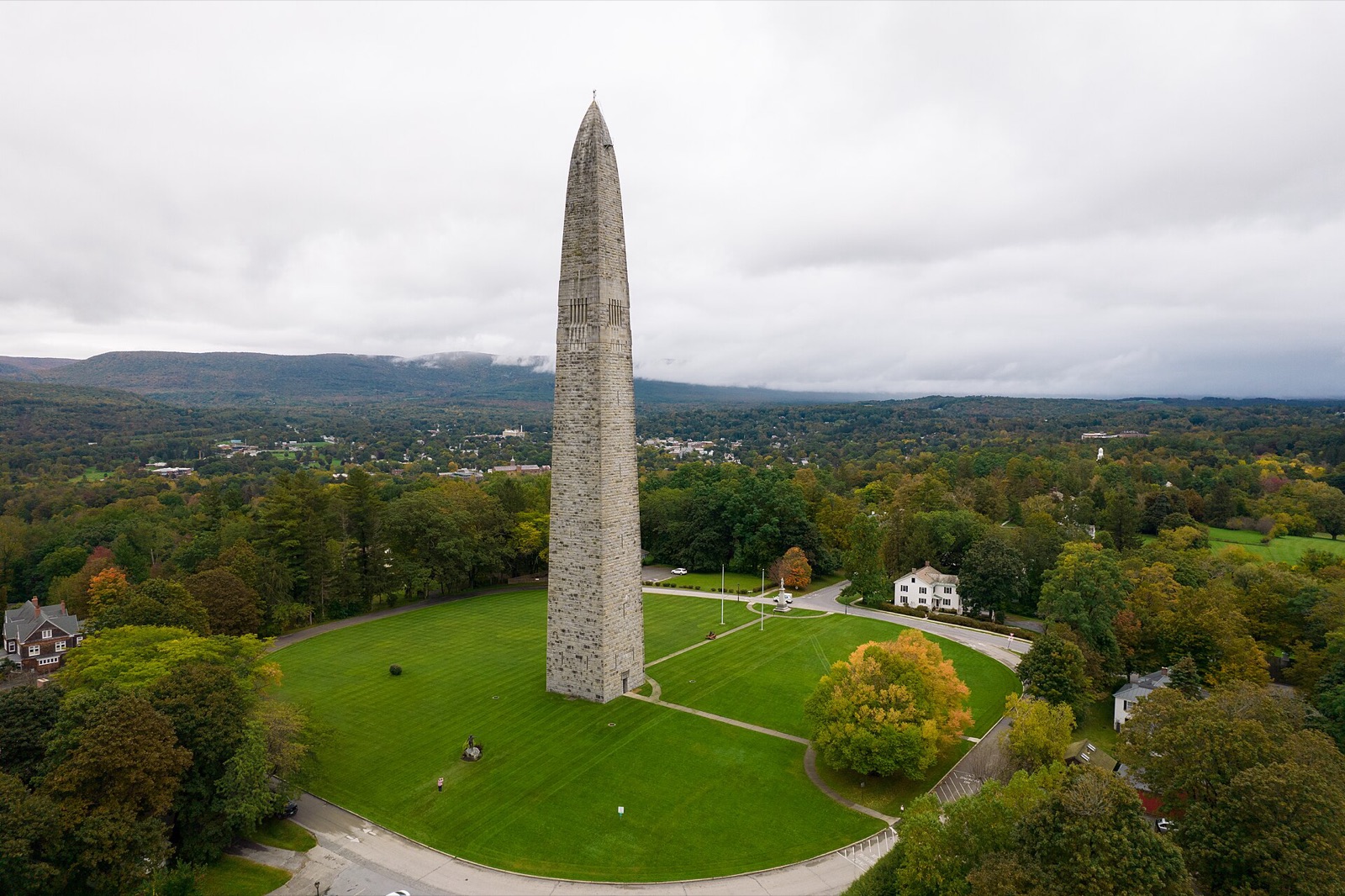
The Battle of Bennington was not fought at Bennington, and not in Vermont. The battle is named for its objective, the depot, not its ground. The actual field sits along the Walloomsac River at Walloomsac, New York, about 10 miles northwest of Bennington and roughly 2.5 miles west of the state line; it is preserved today as the Bennington Battlefield State Historic Site, in New York. The 306-foot Bennington Battle Monument, completed in 1889, stands in Old Bennington, Vermont, at the site of the depot, which is to say it marks the thing Baum never reached, with statues of Stark and Warner standing nearby. Vermont, which contains the monument, the depot site, and none of the battlefield, still keeps August 16 as a legal holiday, Bennington Battle Day, in honor of a battle fought in New York. Nobody tell them.