In the summer of 1777 Britain had two armies loose in America, and they were marching in opposite directions. One came down out of Canada, hacking south through the woods toward Albany on the Hudson River, sure it was about to cut New England off from the rest of the rebellion and end the war. The other loaded itself onto a fleet at New York and sailed away, south by sea, to take Philadelphia, the rebel capital, sure that capturing the largest city in America would end the war. Neither commander thought he needed the other, and nobody in London had forced the two plans to mesh. Across the ocean, in Paris, the foreign minister of France was watching both campaigns for one thing only: proof that this rebellion could survive long enough to be worth a war. The year would end with Britain holding a captured capital that decided nothing and missing an entire field army that had ceased to exist. The story of 1777 runs on two calendars, and the men under each could not hear the other one running.
The plan that wasn't one
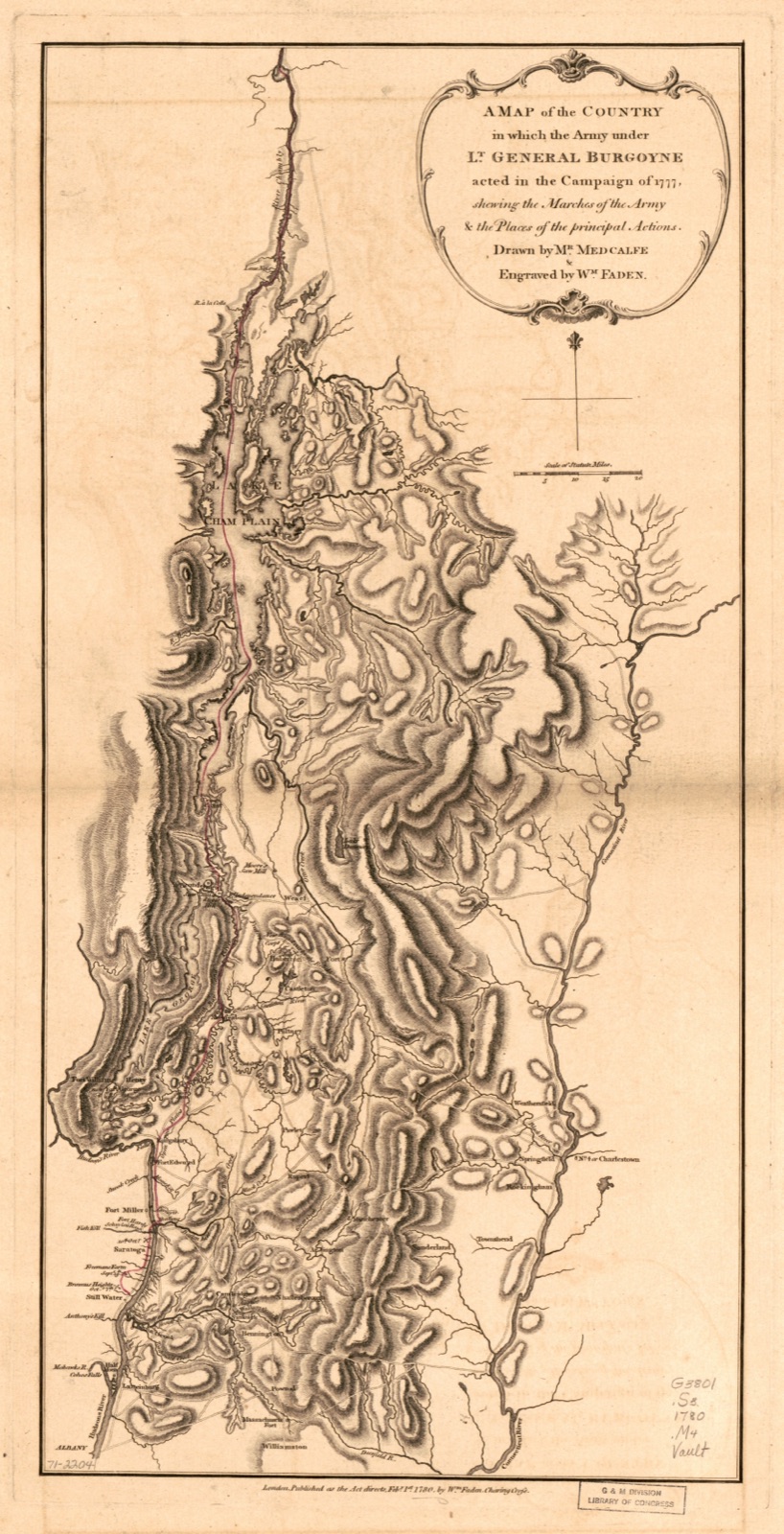
Start with the man who would lose the army. Lieutenant General John Burgoyne was a cavalry showman, a member of Parliament, and a playwright with one comedy already staged in London, and his friends called him "Gentleman Johnny." Over the winter of 1776 and 1777 he had been in London lobbying past his own superior in Canada, and in February he handed the government a paper titled "Thoughts for Conducting the War from the Side of Canada." The plan had a clean logic to it. A main army would push from Canada up Lake Champlain to Albany; a smaller force would come down the Mohawk Valley to the west to meet it; and the whole point was to seize the line of the Hudson and split New England, the granary and the manpower of the rebellion, off from the rest of the colonies, the head cut from the body. The Hudson was the corridor that mattered: the main artery up which men, supplies, and dispatches moved between New England and everywhere else, and a British army sitting across it would mean New England's soldiers and food could no longer reach the war. On paper, after the lessons of 1776, it made sense.
The other British general had his own plan, and he changed it more than once. General Sir William Howe, holding New York, had drawn up a scheme the previous November that included a strong prong up the Hudson to meet whatever came down from Canada. By his letters of early April 1777 he had dropped it. He would take Philadelphia instead, the rebel capital and the largest city in America, and he would take it by sea. He told London plainly that he could no longer support a junction, by which the generals meant the two armies physically linking up into one force on the Hudson. His theory was that seizing the capital would finally drag George Washington into the open, decisive battle the war kept refusing to produce. It was a real theory, wrongly weighted, not idiocy.
The man in the middle was Lord George Germain, the cabinet secretary running the American war from London across an ocean that took a letter six to ten weeks to cross one way. He approved Burgoyne's plan in March 1777, and Burgoyne had it in hand in Quebec by early May. He approved Howe's Philadelphia plan too, and Howe got the word in early June while he was already preparing to embark. On the eighteenth of May Germain wrote Howe a letter approving the Philadelphia expedition while trusting that it would be done in time for Howe to cooperate with the army coming from Canada.
That was a hope, not an order. It reached Howe in mid-August, at sea, long past the point where he could have turned around to act on it. Nobody in London ever issued a positive command making one of the two plans serve the other.
There is a famous story that explains the disaster as an accident of paperwork, and it is mostly a myth. The tale goes that an order positively directing Howe up the Hudson was drafted, but that Germain, impatient to leave for his country estate in Kent, would not wait for a clean copy, so the order was filed in a pigeonhole and never sent, dooming Burgoyne for want of a single dispatch. It is a good story. It traces to a much-later secondhand reminiscence, and historians working from the full published correspondence reject it as the explanation. Howe knew Burgoyne's plan; Germain had sent him a copy of Burgoyne's instructions. Howe had told London in April that he would not support a junction, and Germain approved the Philadelphia move anyway. The failure was not a missing piece of paper. It was a system that let two field commanders file separate war plans and a minister who ratified both without ever forcing them to fit together. A lost dispatch is a better story. It is not the true one.
Sir Henry Clinton, left holding New York with a reduced garrison of about seven thousand men, mostly loyalist and Hessian units, told Howe to his face that the move was wrong. He was overruled. So in the summer of 1777 the two British armies in the thirteen colonies set off in opposite directions, Burgoyne south toward Albany expecting cooperation, Howe south by sea toward Chesapeake Bay and away from him, with the Atlantic too slow for anyone to fix it once it had started.
Burgoyne comes south
Burgoyne left Canada in June with something like seven thousand eight hundred regulars, roughly half of them British and half German troops from Brunswick and Hanau under Major General Friedrich Riedesel, plus a long artillery train, several hundred Canadians and loyalists, and ultimately around five hundred Native allies whose numbers rose and fell through the campaign. By the first of July he stood before Fort Ticonderoga, the great stone-and-earth work guarding the narrows between Lake Champlain and Lake George that the colonists had been calling the Gibraltar of the North. It was held by Major General Arthur St. Clair with an understrength garrison of perhaps two thousand five hundred to three thousand men.
The fort fell without a battle, and it fell to a hill. Southwest of Ticonderoga rose Sugar Loaf, a steep height the Americans had left unfortified on the assumption that nobody could drag guns up it. Burgoyne's engineers cut a road and dragged cannon to the summit. As the army's own story had it, the artillery commander put the principle simply: where a goat can go a man can go, and where a man can go he can drag a gun. When the garrison woke to a battery looking straight down into their works, the position was finished. On the night of the fifth and sixth of July, St. Clair evacuated, slipping his men out southeast and floating his supplies down to Skenesborough, and the British walked into Ticonderoga on the sixth without firing a shot. The rearguard was caught and mauled the next day at Hubbardton, the only real fight of the episode, but the covering force got the army away. The American public, raised on the legend of the Gibraltar of the North, was stunned; St. Clair was court-martialed for giving up the fort and later acquitted, having saved his army by losing the fortress. In London, by Horace Walpole's gossipy account, George III burst in on the Queen crying that he had beaten the Americans, all of them. It is the same ground, exactly, where a British army had bled to death in front of these walls in the last war, at the battle the French called Carillon in 1758; in 1777 the place changed hands twice over without a battle. And in New York that same week, Howe was still loading his fleet, his army not yet at sea, his face already turned the other way.
The BattlesCarillon, 1758The BattlesFort Ticonderoga: the full battle storyThen the woods slowed everything down. From Skenesborough, Burgoyne chose the overland route to the Hudson through the drowned lowlands of Wood Creek rather than backtracking to the Lake George portage, the longer water route by which boats had to be hauled overland between the lakes. Major General Philip Schuyler, commanding the American Northern Department, turned the wilderness into a weapon: about a thousand axmen felling great trees across the track, some forty bridges destroyed, boulders rolled into the creek, the crops burned, the cattle driven off. Burgoyne's army, hauling its guns and an enormous baggage train, made roughly twenty miles in about three weeks, close to a mile a day, and reached the Hudson at Fort Edward at the end of July. Every day Schuyler stole was a day off Burgoyne's food and a day for the militia to gather, because an army that could not move could not feed itself off a wilderness it had already burned. Schuyler got no thanks for it. Congress, full of New England delegates who detested him and wanting a scapegoat for Ticonderoga, replaced him in August with Major General Horatio Gates, a former British officer turned Continental administrator with a gift for the politics of command and a cooler battlefield hand than the men around him. The fairness of it is plain in hindsight: Schuyler's delay bought the weeks that made September possible.
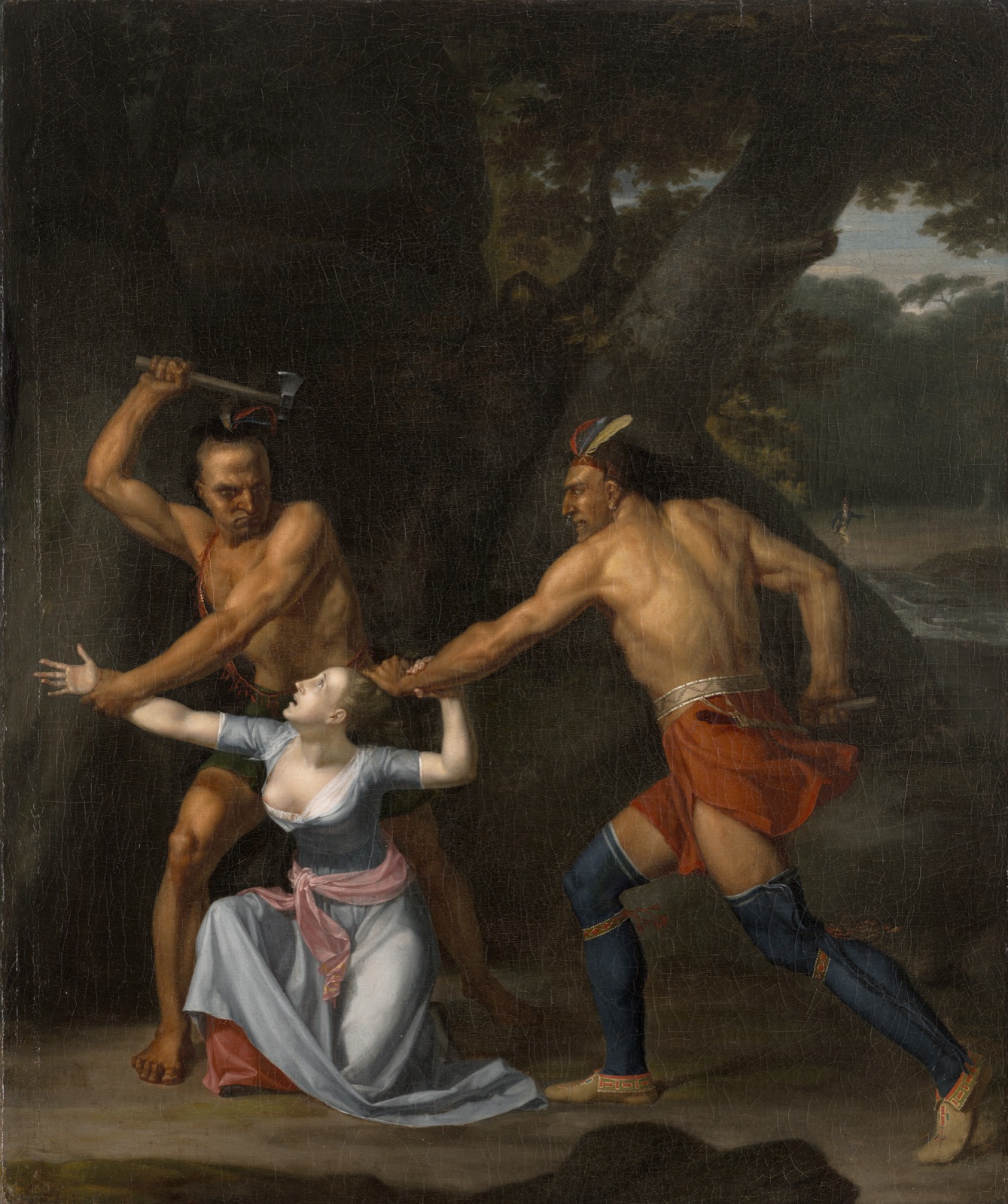
It was on that slow march, near Fort Edward on the twenty-seventh of July, that a killing became a weapon. Here is what is solid. Jane McCrea, a young woman from a patriot family but engaged to a loyalist officer serving in Burgoyne's own army, was taken by Native warriors attached to the British advance, and she was killed and scalped; her scalp was carried into the British camp, where her fiancé recognized her hair. How she died is not solid. The man blamed was said by one account to have killed her in a quarrel over the reward for escorting her; he himself claimed she had been hit by the musket fire of a pursuing American party. A nineteenth-century exhumation was reported to show bullet wounds and no tomahawk wound, and that report is itself contested. The honest line is the narrow one: she was killed in the custody of Britain's Native allies, and the details beyond that were argued over from the first week and still are.
What was not in doubt was the use the story was put to. Burgoyne demanded that the killer be executed, then pardoned him, afraid that hanging the man would cost him his entire Native contingent, which read in the American press as proof that the British general could not, or would not, police his own allies. The killing of a loyalist's fiancée, a woman engaged to a man in Burgoyne's own ranks, became the perfect recruiting poster: an invading army that could not protect even the women of its own friends. The story ran through the New England newspapers and the recruiting speeches all that August, and the militia turned out in numbers in the weeks that followed. McCrea was not the only thing swelling the American ranks, the shock of Ticonderoga and the news from around Bennington fed the same surge, but the recruiting literature carried her everywhere, and Gates put her into a public letter to Burgoyne in September as a set piece of British savagery, propaganda built to travel. It traveled to London and into the speeches of the opposition in Parliament. And while her story was running through the New England papers that August, Howe's armada was at sea hundreds of miles to the south, beating toward the Chesapeake, unable to send Burgoyne a man.
The army the McCrea story was helping to raise was the same army Burgoyne now needed supplies to fight, and he was running short of nearly everything. Short of horses, draft animals, and food, in mid-August he sent Lieutenant Colonel Friedrich Baum with seven or eight hundred men, dismounted German dragoons, loyalists, Canadians, and Natives, toward Bennington in the Hampshire Grants, the disputed back country that both New York and New Hampshire claimed and that is now Vermont, on intelligence that a rebel supply depot there was lightly held. It was not. Brigadier General John Stark, a Bunker Hill and Trenton veteran who had quit the Continental Army over a passed-over promotion, had raised some fifteen hundred New Hampshire militia in under a week on the condition that he answer to New Hampshire alone. On the sixteenth of August Stark, with his militia and Seth Warner's Green Mountain men arriving late in the day, enveloped Baum's hilltop and destroyed his force; Baum was mortally wounded, and a German relief column came up too late, was wrecked at dusk, and barely escaped. The cost to Burgoyne was about nine hundred men he could not replace, commonly given as around two hundred killed and seven hundred captured, against roughly thirty American dead. Stark's famous line about his wife Molly sleeping a widow that night is one the storybooks gave him in variant forms decades later, not anything we can show he said.
The BattlesBennington: the full battle storyThis was the hinge of the northern campaign, eighteen days before the next one turned in Pennsylvania. Burgoyne had lost a tenth of his army for nothing, got no supplies, and watched his Native allies, already soured by his scolding over McCrea, begin to drift away in numbers. His own letter to Germain on the twentieth of August is the campaign's epitaph written in advance. In the same letter he admitted he had had no word from Howe confirming that anyone would cooperate with him at all.
A country unpeopled and almost unknown in the last war, now abounds in the most active and most rebellious race of the continent, and hangs like a gathering storm upon my left. — John Burgoyne to Lord George Germain, 20 August 1777
The western prong
Burgoyne's plan had a third arm, and it failed in the same weeks. Brigadier General Barry St. Leger came east by way of Lake Ontario and Oswego with somewhere between seventeen hundred and two thousand men, a few hundred regulars and German riflemen, loyalist regiments, and eight hundred to a thousand Haudenosaunee warriors, the Iroquois confederacy of Six Nations that controlled this country, largely Mohawk and Seneca here, with the Mohawk leader Joseph Brant among them. His job was to take the Mohawk Valley and meet Burgoyne at Albany. In his way stood Fort Stanwix, rebuilt and garrisoned by about seven hundred and fifty Continentals; St. Leger laid siege to it at the start of August.
On the sixth of August a column of some eight hundred Tryon County militia, mostly German-speaking Palatine settlers under Brigadier General Nicholas Herkimer, with Oneida allies, marched to relieve the fort and was ambushed in a ravine at Oriskany, about six miles short of the walls. The fight was point-blank and hand-to-hand, neighbor against neighbor and Oneida against Mohawk and Seneca, the Haudenosaunee confederacy's own civil war beginning inside the American one. The native-nations chapter owns that story. The militia took appalling losses, commonly given as around four hundred of the eight hundred, among the bloodiest small actions of the war, and never reached the fort. But while the ambushers were away from the siege lines, the garrison sortied and sacked the nearly empty Native and loyalist camps, a blow that soured St. Leger's allies on the whole enterprise.
The siege then collapsed over a rumor. Schuyler, before he was removed, had sent Major General Benedict Arnold west with about nine hundred Continentals. Arnold was already the most aggressive combat officer in the army, the man who had marched a force through the Maine wilderness to assault Quebec in the winter of 1775 and taken a leg wound on its frozen ramparts. Too short of men to fight his way through here, he weaponized a prisoner instead, releasing a loyalist-leaning local man named Hon Yost Schuyler, respected among the Mohawks, to run ahead and spread word that Arnold was coming on in overwhelming force. The core of this is documented: St. Leger's own report of the twenty-first of August records intelligence that Arnold was advancing "by rapid and forced marches, with 3,000 men," roughly triple the truth, and an Oneida messenger working the same rumor among the warriors mattered at least as much as Hon Yost did. The storybook garnish, the prisoner answering "how many?" by pointing at the leaves, is nineteenth-century decoration. On the twenty-second of August St. Leger's Native allies quit, and the siege fell apart in a near-rout back to Oswego, tents standing and guns abandoned. Burgoyne's western prong was gone, and Arnold had not fired a shot.
Howe sails away
The same days Burgoyne was dragging his guns through the drowned lowlands of Wood Creek, William Howe was loading fifteen thousand men onto ships in New York harbor to sail in the opposite direction. Between the fifth and the twenty-third of July he embarked something like fifteen to seventeen thousand troops on a fleet usually given as more than two hundred ships, his brother Admiral Richard Howe commanding the water, and on the twenty-third of July the whole armada sailed from Sandy Hook. Its destination was a secret even Washington could not crack for weeks; he marched his army back and forth across New Jersey and Pennsylvania chasing guesses while the British masts dropped below the horizon.
The fleet made it worse by sea. Off the mouth of the Delaware at the end of July, Howe took naval advice that the river approach to Philadelphia was too well defended, and stood back out into the Atlantic to go around by Chesapeake Bay, adding three sweltering weeks that killed horses and wrecked the cavalry. The army finally waded ashore at Head of Elk in Maryland on the twenty-fifth of August, about fifty-five miles from Philadelphia and, the whole point of it, hundreds of miles by sea away from Burgoyne. The braid is in the dates. Howe's troops were stepping onto the Maryland mud in the same ten days that Stark was wrecking Burgoyne's flank at Bennington and St. Leger's siege was collapsing on the Mohawk. Two British armies, two campaigns, the same fortnight, four hundred miles of water between them, and neither could hear the other. When Germain's letter of the eighteenth of May finally caught up with Howe, hoping Philadelphia would still leave time to help the northern army, he was at sea and the season was spent. He had already written Burgoyne, months before, that the northern army should expect little assistance from his direction.
Washington decided to fight for the capital, and he made his stand behind Brandywine Creek at Chadds Ford on the Philadelphia road on the eleventh of September, with around eleven thousand men. Howe, with roughly fifteen thousand, replayed the move that had beaten the Americans on Long Island the year before: a noisy feint at the obvious crossing while the real weight swung wide around the flank and came in from behind. One division demonstrated loudly at the ford to fix Washington's attention while Lord Cornwallis, with Howe and some eight to nine thousand men, swung seventeen miles north, crossed the creek at fords Washington's intelligence had dismissed, and came down on the American right and rear in the afternoon. This time it was not the Long Island panic. The American right wheeled to face the new threat and fought hard around Birmingham Meetinghouse; Nathanael Greene's division covered a real retreat in good order. A nineteen-year-old French volunteer named the Marquis de Lafayette, two months into his American service and serving without a command, was shot in the leg trying to rally troops, a small wound that would matter a great deal to the alliance story. By dark Washington's army was beaten but intact, falling back toward Chester. The losses ran to around six hundred British killed and wounded against something like a thousand to thirteen hundred Americans, the American returns too incomplete to give a hard number. A planned rematch a few days later dissolved when a downpour soaked tens of thousands of cartridges, and Congress had already slipped out of Philadelphia overnight on the eighteenth and nineteenth of September, warned that the river fords were open.
The BattlesBrandywine: the full battle storyA night attack followed that the Americans would remember by a name. Brigadier General Anthony Wayne, detached with about fifteen hundred men to harry Howe's rear near his own boyhood home, believed his camp near Paoli Tavern was a secret. Local loyalist intelligence had given it away. On the night of the twentieth and twenty-first of September, Major General Charles Grey attacked at midnight with the flints pulled from his men's muskets so no accidental shot could warn the camp, bayonets only, and the camp was overrun by firelight in minutes. About fifty-three Americans were killed, many of them with multiple bayonet wounds, which fed sworn depositions of atrocity and gave the night its name, the "Paoli Massacre." The brutality needed little embellishment, but the name overstates the case: quarter was given, the mercy of taking a surrendering enemy prisoner rather than killing him, and roughly seventy prisoners were taken. Modern assessments read it as a legal and brutally efficient night attack rather than a slaughter of the helpless. The Americans called it a massacre, and the name stuck, and "Remember Paoli" became a revenge cry.
On the twenty-sixth of September, Cornwallis marched about three thousand men into Philadelphia unopposed, cheered by the loyalist remnant of a half-emptied city. The largest city in America, the seat of Congress, the symbol Howe had spent the entire year and the whole strategy to reach, was British. And it decided nothing. Congress had not surrendered; it had simply moved. Having left overnight on the eighteenth and nineteenth, it sat one day in Lancaster, crossed the Susquehanna River, and reconvened at York, Pennsylvania, on the thirtieth of September, where it would run the war through the winter from a small courthouse town. In Europe, taking the enemy's capital ended wars. This capital was a meeting, and the meeting got up and moved. The river was not even open to supply the prize: the American forts below the city kept Howe's fleet out until late November, months of hard fighting after Philadelphia had "fallen."
A week later, beaten and reinforced, Washington turned and attacked. Howe had posted about nine thousand men at Germantown, five miles above Philadelphia, and on the fourth of October Washington came at them at dawn with some eleven thousand in four converging columns on a complicated night-march plan. In a dense fog thickened by powder smoke the plan came apart. Columns lost their schedule and lost each other; in the murk, by Washington's own later account, American units fired into one another. A small British force barricaded itself in a stone mansion, the Chew House, square in the American line of advance, and instead of leaving it masked and pushing on, the command stopped to batter the house and spent men and the morning's momentum on it; a large share of the American casualties fell around its walls. The army lost around a hundred and fifty killed, five hundred wounded, and four hundred captured or missing against perhaps seventy British killed and four hundred and fifty wounded, and it was a defeat. But the army marched off intact and, oddly, proud of itself, and Washington reported its spirits unbroken.
It served to keep our different parties in ignorance of each Others movements, and hindered their acting in concert. It also occasioned them to mistake One another for the Enemy, which, I believe, more than any thing else contributed to the misfortune which ensued. — George Washington, on the fog at Germantown, 1777
The BattlesGermantown: the full battle storyIt is widely said that this beaten army's nerve to attack a victorious enemy three weeks later impressed France as much as anything that autumn. The strong version, a single sentence put in the French foreign minister's mouth, cannot be pinned to any contemporary document, so put it softly: the news crossing to Paris that fall carried Philadelphia's loss together with Germantown's audacity, and French observers read even this defeat as evidence that the American army would not die.
Saratoga
Lay the two campaigns side by side at this exact moment and the year holds its breath. On the eleventh of September Washington's beaten but unbroken army was pulling back from Brandywine toward Chester, having failed to hold the road to one capital. On the thirteenth, four hundred miles north, John Burgoyne marched his army across the Hudson on a bridge of boats and cut his own line back to Canada, gambling everything on reaching the other prize at Albany. Eight days, four hundred miles, two armies that could not see each other, each staking a campaign on the same fortnight.
Below Burgoyne, Gates had dug in on Bemis Heights, bluffs commanding the river road, with the works laid out by the Polish engineer Thaddeus Kościuszko, and Gates's army was now something like seven to nine thousand strong and swelling every week with the militia that McCrea and Bennington had helped raise. Burgoyne had perhaps six or seven thousand men left and about a month of rations.
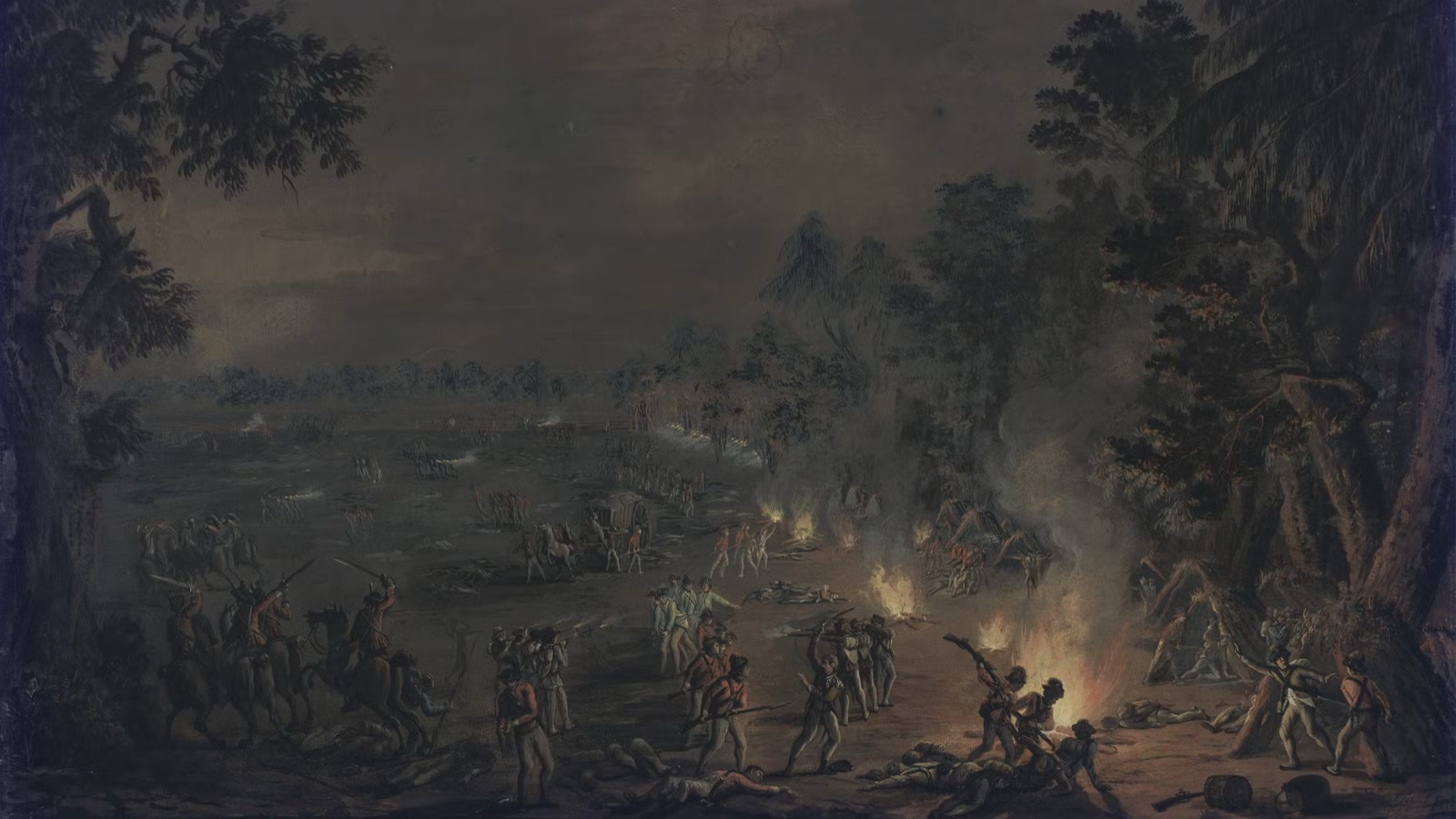
On the nineteenth of September, eight days after Brandywine, two armies four hundred miles apart fought on the same week's calendar. Burgoyne probed for the American left with three columns, and the fight opened at a clearing called Freeman's Farm, where Daniel Morgan's riflemen, the corps Washington had sent north, fired the first shots. Through the afternoon Arnold's wing fought the British center to a standstill in volley and countercharge until Riedesel's Germans, marching up from the river road, struck the American flank at dusk and saved the field. Where exactly Arnold himself was that afternoon is genuinely debated, on the field by some accounts, at headquarters by others; either way his wing fought the battle. The British held the ground and lost nearly six hundred men killed, wounded, or captured against more than three hundred Americans, and that arithmetic was the whole story: Burgoyne could not replace a single man, and Gates's camp grew by more than the day's losses inside a week. Burgoyne dug in and waited for help from New York.
The help came too late and too small. Sir Henry Clinton sortied up the Hudson from New York in early October, took two forts in the Highlands and burned Kingston, but he was more than a hundred and thirty miles short of Burgoyne and the season was closing. His couriers were caught; one was taken carrying his message inside a hollow silver bullet, which was retrieved and which hanged him. The relief that Burgoyne's whole campaign had assumed simply did not exist.
Inside the American camp the victory of the nineteenth had started a war of its own. Gates reported the battle to Congress without once naming Arnold, stripped Morgan's corps out of Arnold's command, and in the shouting match that followed relieved Arnold of command altogether. Arnold, vain and brave and nursing a year of real grievances over rank, refused a pass to leave and hung around the camp without a job, which is how matters stood when the army that the best combat officer on the continent had been forbidden to lead had to fight again. A quarrel between two difficult men, told straight, one of them the finest fighting general in the army that fall.
On the seventh of October, rations failing and the season gone, Burgoyne pushed a reconnaissance in force of fifteen hundred or more men, a probing attack meant to test the American left and find its edge, and Gates broke it in under an hour. Morgan, Poor, and Learned shattered the probe; Brigadier General Simon Fraser, rallying the British line, was shot dead by one of Morgan's riflemen. And then Arnold, without orders and without a command, rode into the fight. Accounts have Gates sending an aide to recall him who never caught up. Arnold helped sweep the field, led the failed rushes on one British redoubt, then swung against the redoubt on the far British right and was inside it when it fell, and in the last volleys his horse went down on top of him and shattered his left leg, the same leg he had been wounded in at Quebec two years before. The fall of that redoubt left Burgoyne's whole camp turnable, and he pulled back into the dark that night.
Burgoyne fell back to Saratoga in the rain, was surrounded by an American force now grown past seventeen thousand with militia still coming in, and opened talks. He extracted terms striking for a beaten army: not a surrender but a "Convention," under which his troops would march to Boston, sail home to Europe, and not serve again in North America. The catch was plain even as he signed it, since troops shipped home would free other troops to come over in their place. On the seventeenth of October, somewhere around six thousand British and German soldiers grounded their arms in the meadow by the Hudson. By the story as it was later told, the American bands did not jeer, and Gates received Burgoyne with courtesy. With Ticonderoga and Bennington and the campaign's battles added to the six thousand who laid down their arms here, Britain's entire northern army of around ten thousand had simply ceased to exist.
The BattlesSaratoga: the full battle story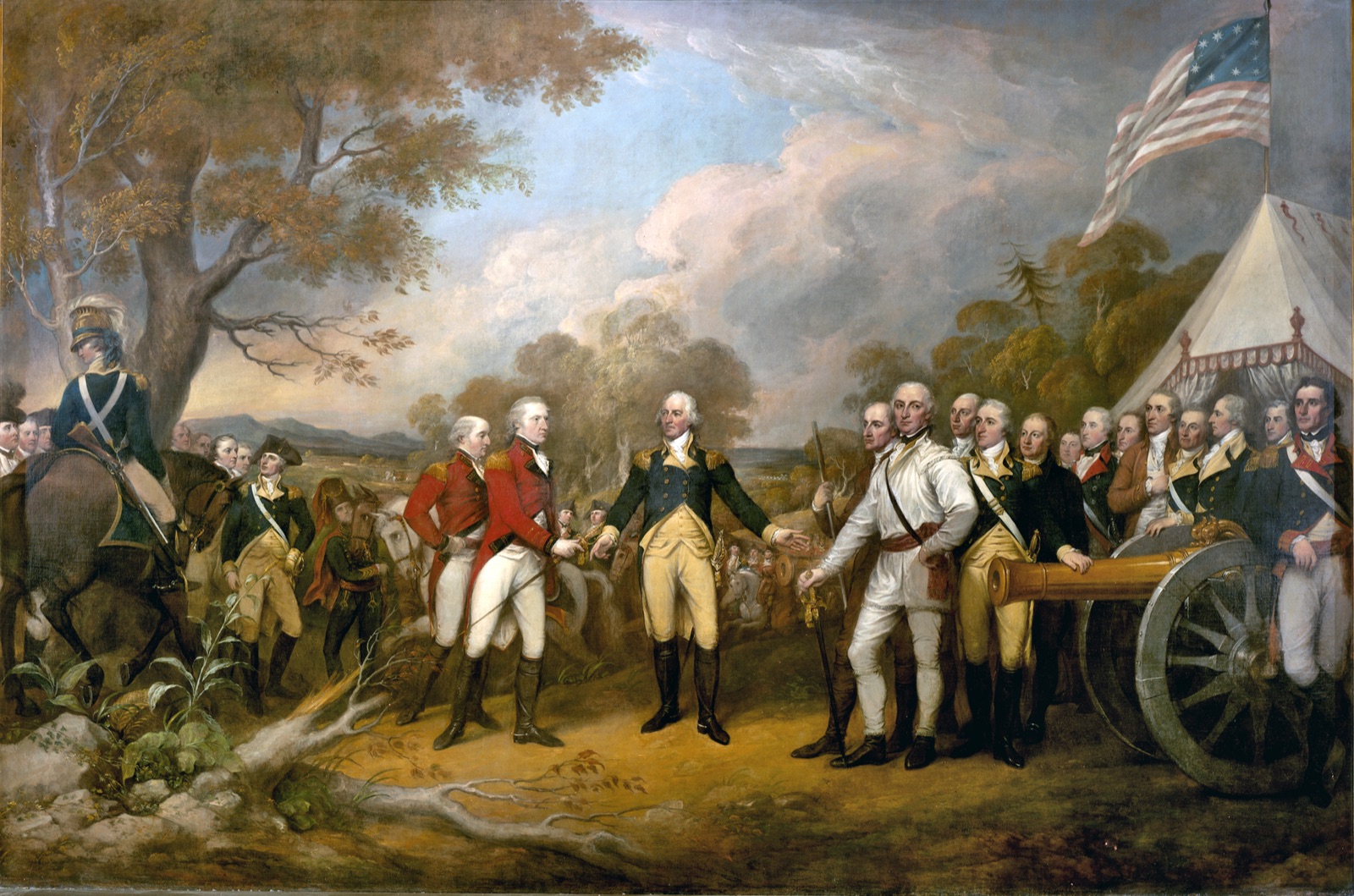
The Convention had a strange afterlife. Congress, smelling the catch and seizing on Burgoyne's refusal to hand over a list of his troops, repudiated the deal, and the army never sailed: legally shabby on the American side and strategically obvious in the same breath, and both things are true. The "Convention Army" sat a year around Boston and was then marched some seven hundred miles south to Charlottesville in Virginia, leaking deserters and escapees the whole way, many of them melting quietly into the American population; by war's end only a fraction remained in custody. A treaty-shaped object that turned into a long captivity.
York, Paris, Valley Forge
So the year ran down on two notes at once. In a borrowed courthouse at York, the Congress that had been chased out of its capital did the year's most underrated work: on the fifteenth of November it adopted the Articles of Confederation and sent them to the states, the rebel government writing its own constitution while it was homeless. And on the Hudson, the news of Saratoga went onto a fast ship for France.
Massachusetts put the Saratoga dispatches aboard a brigantine within hours and sent her off at the end of October. The courier, Jonathan Loring Austin, landed at Nantes at the end of November and reached Benjamin Franklin at Passy, the village outside Paris where Franklin lived as the American commissioner working the French court, on the fourth of December. The scene survives because Austin himself told it. Franklin, braced for the worst, called out before the rider had even dismounted to ask whether Philadelphia had been taken. Yes sir, came the answer. And then, as Austin told the story afterward: "But, sir, I have greater news than that. General Burgoyne and his whole army are prisoners of war." Within two days the French foreign minister's office had asked the American commissioners to reopen the conversation about an alliance. France committed to recognition in mid-December, and the treaties were signed early the next February. The french-alliance chapter carries the treaty from there; the spine carries only this hinge. Saratoga did not win the war by itself, and France did not enter on the strength of one battle. The decision rode on a year of covert aid and naval rearmament and ministerial argument, and the same dispatch pouch that carried Saratoga's proof carried Philadelphia's loss and Germantown's nerve. What the battle did was give the foreign minister of France the proof he needed to do the thing he already wanted to do. The army lost in the woods above Albany had bought a navy.
Franklin had a line for the other capital, too, the one Howe thought he had won. Told that Howe had taken Philadelphia, Franklin is said to have answered that Philadelphia had taken Howe. It is an anecdote, reported early and often, and it has the shape of the year in it.
On the nineteenth of December, Washington marched his army, eleven or twelve thousand men with perhaps a third of them lacking serviceable shoes, into winter quarters at Valley Forge, eighteen miles from a British army wintering warm in the captured capital. There was a whispering campaign that fall, too, a loose network of grumblers who admired Gates and thought less of Washington, never an organized plot and never a motion to remove him, that the survivors would later dress up with the name of a "cabal" and that collapsed early the next year. What that winter made of the army, the hunger and the drill and the force that marched out in the spring a different thing, belongs to the army-from-nothing story; the spine carries only the freeze-frame at the year's end.
Off the fieldThe army from nothingSo the year's ledger, told flat. Britain took Philadelphia and got nothing for it: Congress governed on from York, the army stood intact in its huts at Valley Forge, and the captured city decided nothing at all. Britain lost an entire field army, surrendered with its general and its guns and its band playing, the first time in the war that European opinion had a thing it could measure. Two campaigns, two prizes, and only one of them was ever real, because Howe got the capital while Burgoyne needed the army Howe took to get it. Hold the four pictures together at the year's end: a homeless Congress legislating in a country courthouse at York; the snow starting to fall on a barefoot army at Valley Forge; Burgoyne's veterans tramping under guard toward Boston and a captivity that would outlast the war; and at Passy, by a fire, a printer from Philadelphia reading that his city was lost and that the war, quite possibly, was won.