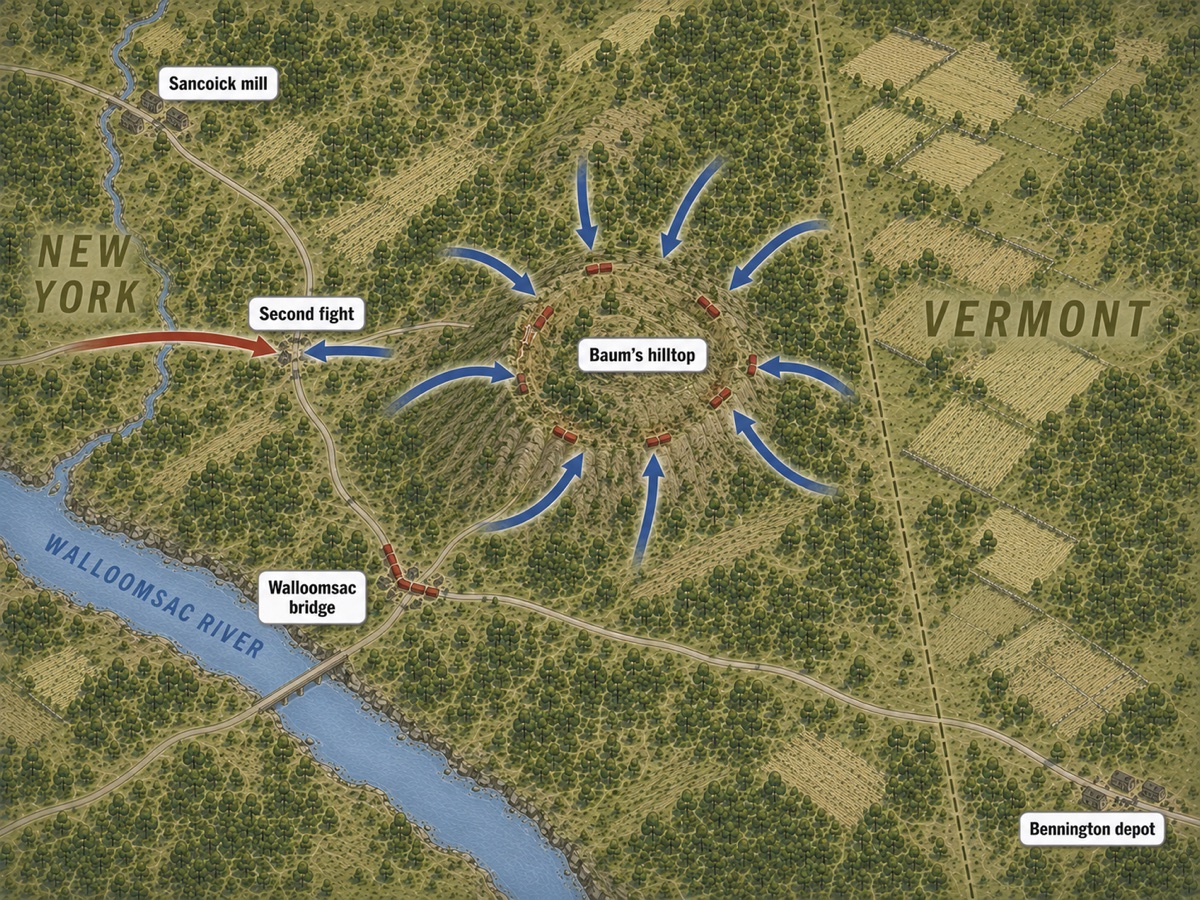
On August 15, 1777, it rained all day on two armies that could not see each other. On a steep hill above a bridge over the Walloomsac River, at the hamlet of Walloomsac, New York, sat Lieutenant Colonel Friedrich Baum (German, in British service) and the roughly 800 men that Lieutenant General John Burgoyne, the British invasion commander on the Hudson, had sent to seize the American supply depot at Bennington, 10 miles to the southeast. Baum knew by now that the depot was not weakly held: covering it was Brigadier General John Stark (American), whose New Hampshire militia (part-time citizen soldiers) and arriving allies would number between 2,000 and 2,500 across the day. The rain kept everyone's gunpowder wet and everyone's plans on hold.
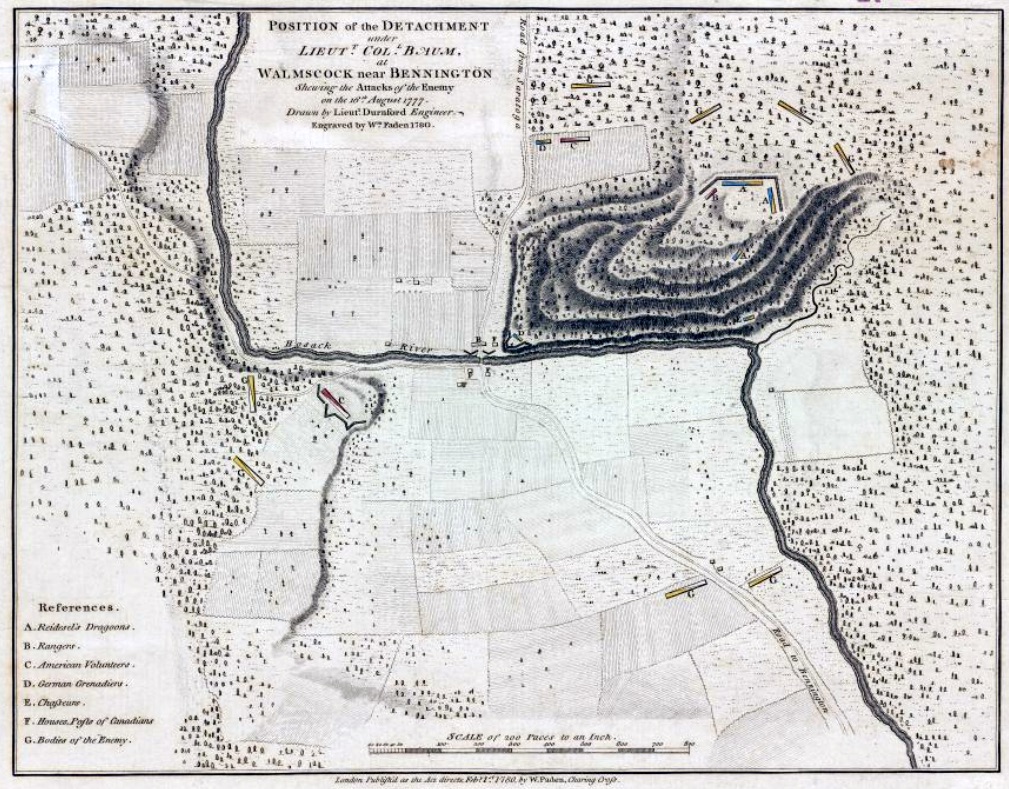
Baum spent the day fortifying, and the shape he built was the shape of his defeat. The best troops he had, his dismounted Brunswick dragoons (German heavy cavalrymen serving on foot, the men this whole expedition was supposed to find horses for) and the British marksmen, dug a redoubt (an enclosed earthwork) with one cannon on the hilltop, about 300 feet above the bridge. Across the river, his Loyalist volunteers (Americans fighting for the king) built a breastwork (a chest-high wall of earth and logs to shoot over) covering the bridge itself. His Canadians, Native allies, and German detachments held a scatter of smaller posts between. Each strongpoint was too far from the next to help it. The same rain was meanwhile doing the Americans a second favor to the west, where the relief column Baum had asked for, roughly 550 to 650 German grenadiers (an army's biggest and heaviest assault infantry) and light infantry with two heavier cannon under Lieutenant Colonel Heinrich von Breymann, was crawling over roads turned to soup: a march that became notorious, something like 25 miles in over a day and a half, the ammunition carts bogging and overturning in the mud. The rain cost Baum a day he could not afford and handed it to Stark, whose strength was still arriving; Massachusetts militia came in during the night of the storm.
All through the wet lull, locals walked into Baum's lines presenting themselves as the promised Loyalist countryside, and were taken at face value. Many of them were Stark's men, looking the position over from the inside. The story New England told ever after adds a lovely detail: that the militiamen wore slips of white paper in their hats, the field sign the real Loyalists used, and so passed as friends, some right up next to the redoubts. That detail is tradition rather than documentation; Baum left no record of any of it, because in two days he would be dead.
August 16 dawned clear, and Stark spent the morning doing something militia were not supposed to be able to do: a double envelopment of a fortified position (hitting it from both flanks and the rear at the same moment as the front). Colonel Moses Nichols with 200 to 250 New Hampshire men swung wide through the woods around Baum's left and rear. Colonel Samuel Herrick with about 300 Vermont rangers and Bennington militia circled to the right and rear. Two more detachments took the front of the Loyalist breastwork, and Stark himself held the center, in front of the hill. In the August heat, the accounts have the militiamen moving through the woods in their shirtsleeves, farmers stripped down for an afternoon's work. And here the intelligence failure closed like a trap: by most accounts, Baum watched armed men in plain clothes filtering through the trees around his flanks, read them as the promised Loyalist rising, and let them get into position. He may simply have been pinned and out of options; he never got to say. But the story is the cleanest statement there is of what the British thought this countryside was, and what it actually was.
Tradition gives Stark a line for the moment before the attack, one of the most famous things any American said in the whole war, which is awkward, because nobody knows what he actually said. No one wrote it down at the time. The earliest written version appeared in 1819, four decades later: "My boys, you see those red coats yonder, they must fall into our hands in 15 minutes, or Molly is a widow." The polished versions came later and multiplied ("this night Molly Stark sleeps a widow!" among them), so many variants that the original words are unrecoverable. Molly was real: Elizabeth "Molly" Page Stark, his wife. It is a legend, and a good one.
What is documented is what happened at about 3:00 p.m., when Nichols's men opened fire from the rear and every American column went in at once. Stark reported it to General Horatio Gates (the new commander of the American army facing Burgoyne) six days later.
It lasted 2 hours the hottest I ever saw in my life. It represented one continued clap of thunder.
The scattered posts went first. The Native warriors and Canadians broke out and fled between the closing pincers; the Loyalist breastwork was stormed; every surviving detachment fell back inward onto the dragoon redoubt on the hilltop. The dragoons stood at the center of it for two hours, until their ammunition gave out (in the standard account their reserve ammunition wagon caught fire and went up). What they did next belongs to them. Imagine the hilltop in that last half hour. The firing has come from every direction at once, out of woods you were told were full of friends. Your cartridges are gone; the wagon with the reserve has gone up behind you. The orders, when they come, come in German, on a hilltop in New York, in a country none of you chose. What was left was the weapon the dragoons had carried on foot all the way from Canada, and they drew it: the heavy cavalrymen of the regiment Prinz Ludwig came down the slope with their long straight broadswords, trying to cut their way out. The charge was shot apart at close range. Baum fell among his men, shot through the body, and the survivors surrendered. He died of his wounds within two days and was buried somewhere near the field; no one knows where his grave is.
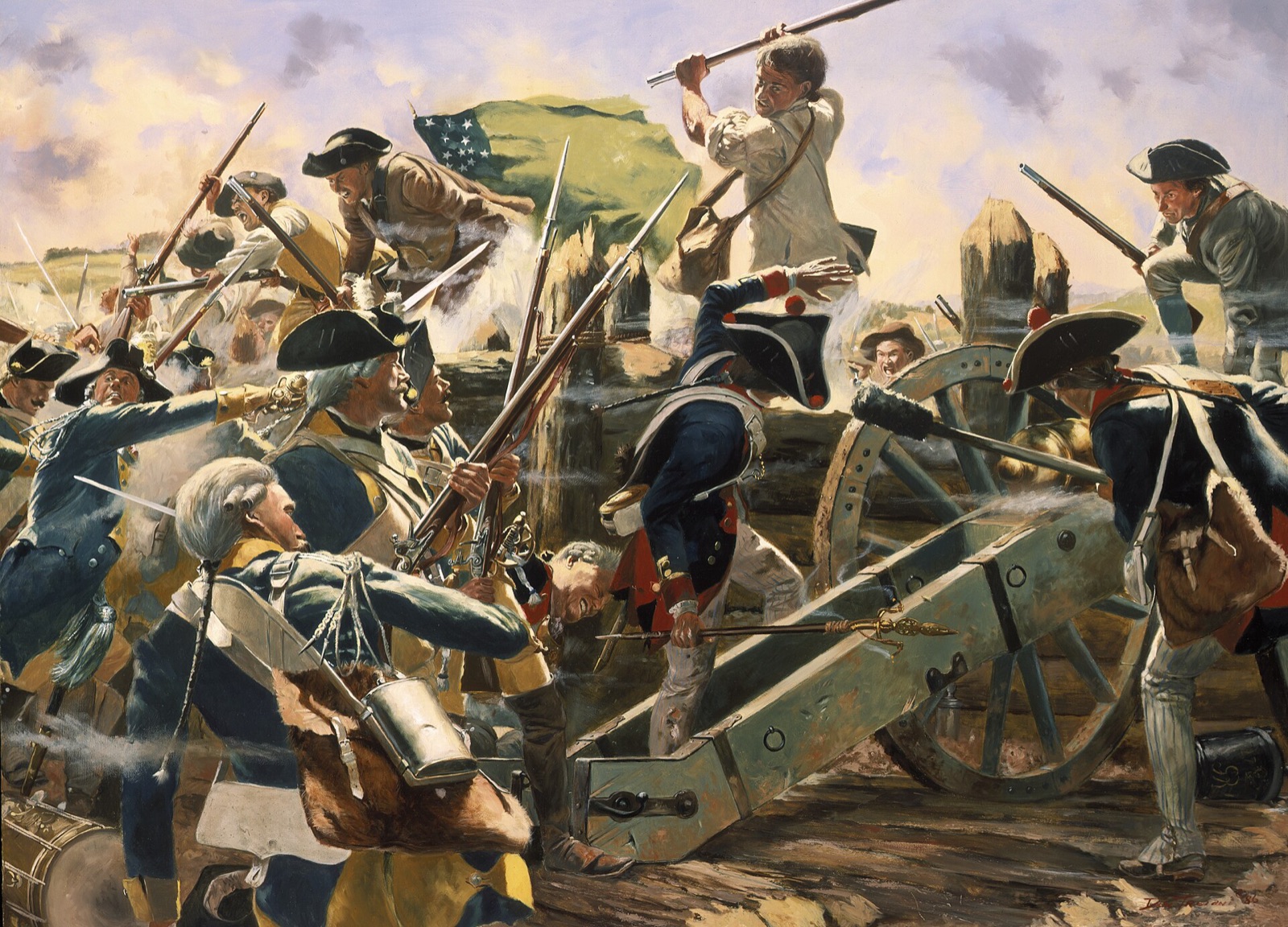
By about 4:30 the battle was won, and then it almost came undone. Breymann's grenadiers had been a day and a half on roads turned to soup, dragging their cannon and ammunition carts out of the mud, and they arrived from the west to find that the battle they had been marching to was already over. The hilltop was taken. The road ahead of them was full of American militia, scattered, loaded with plunder from the captured camp, herding more than 600 prisoners. Breymann did the only thing a column of regulars could do: he formed up and attacked into the wreckage, and for a stretch of that late afternoon it worked. The disordered Americans were pushed back, and the day hung in the balance.
It was Seth Warner's Continental regiment (the American regular army), the Green Mountain Boys, that turned it: about 330 men marching from Manchester (after, some accounts say, a pause to dry their muskets from the storm), arriving at the critical moment to counterattack beside Stark's rallying militia. "The battle continued obstinate on both sides till sunset," Stark wrote. At dark Breymann broke off, abandoning both his cannon, his wounded, and most of his baggage; wounded himself, he got away with perhaps two-thirds to three-quarters of his men only because the night ended the pursuit. Stark reckoned afterward that one more hour of daylight would have given him the whole force. As it was, the day's haul was all four cannon, some 700 prisoners, and hundreds of muskets, swords, and drums.