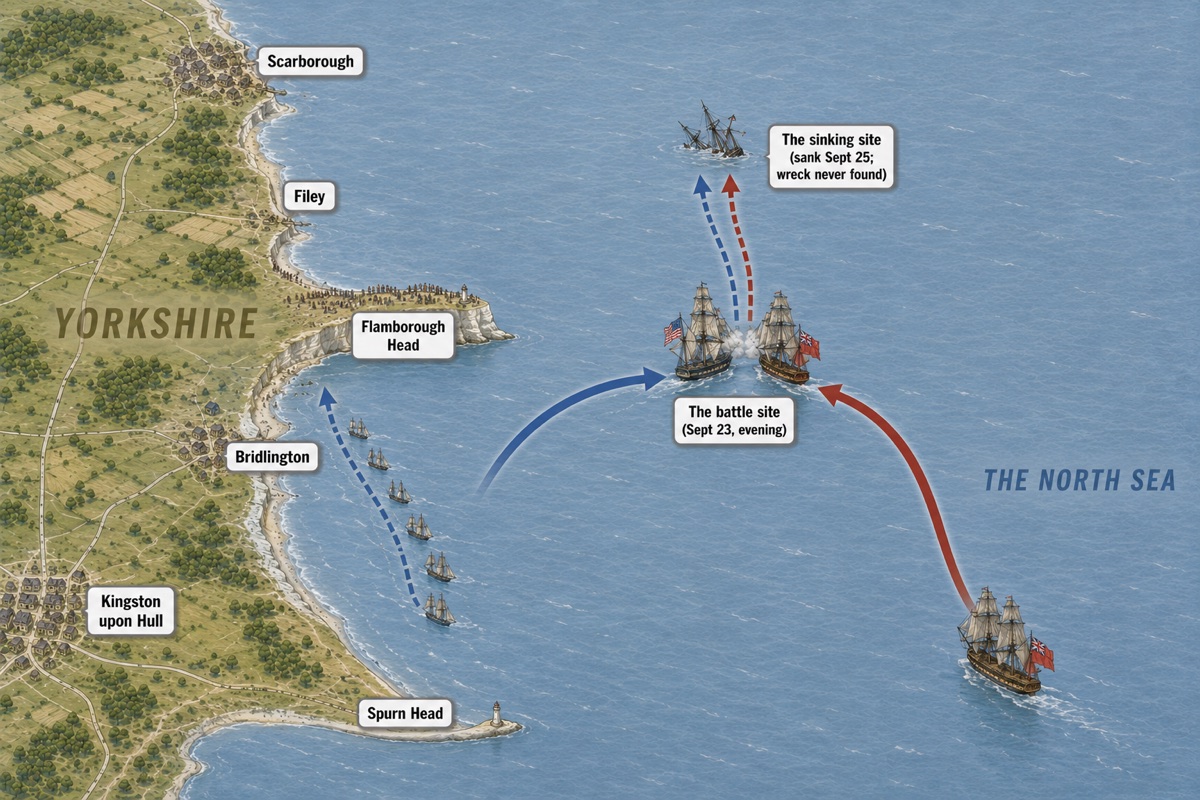
Captain Richard Pearson (British) understood his job in a moment. The convoy, not the glory, was what mattered, so as Jones's squadron came on he put the Serapis and the Countess of Scarborough between the strangers and his merchant ships and signaled the convoy to run inshore for the shelter of Scarborough and Bridlington. The merchantmen crowded sail for the coast and got away, nearly all of them. That decision settled the strategic question before a gun was fired: whatever happened next to Pearson's own ship, he had already won the only fight that counted to Britain. Then he turned to face an enemy he did not yet know was John Paul Jones.
About seven in the evening, in the last of the light, the two big ships drew within pistol shot. Pearson hailed across the water, asking who the stranger was. Jones, who had been flying false British colors to get close, answered with evasions, then ran up American colors and opened fire. Both ships loosed their broadsides at almost the same instant. A broadside is every gun along one side of a ship firing together, the basic blow of a sea fight, a wall of iron thrown at the enemy's hull all at once. Each captain afterward believed the other had fired first, and there is no way now to settle it. It hardly mattered. With that first exchange, disaster struck the Bonhomme Richard.
Two of Jones's six old eighteen-pounders, the heaviest guns he had, burst when they fired. The cannon themselves blew apart, killing almost all the men working them and tearing up the deck above. Jones's own report is flat about it: those guns "did no Service Whatever: two out of three of them burst at the first fire, and killed almost all the men Who Were stationed to manage them." He abandoned the whole heavy battery on the spot. Even before they burst, the match had never been fair. The Serapis carried twenty heavy eighteen-pounders on her lower deck alone, while Jones's "about forty guns" included only six eighteen-pounders, and two of those had just blown themselves apart. From that moment the Richard could throw only a fraction of the Serapis's weight of iron, his lighter guns against her twenty heavy ones. To fight a gunnery duel now, trading broadsides at a distance, was simply to be pounded to splinters and forced to surrender. Jones had one chance, and it was the opposite of caution: get in close and hold on, so close that the enemy's advantage in heavy guns turned into a knife fight where his own marksmen and boarders could matter.
So he grappled. After a confused half hour of maneuvering, collisions, and a British attempt to board that was thrown back, the two ships fouled together, the Serapis's bowsprit caught in the Richard's rigging, an anchor hooking, and Jones and his men lashing the hulls fast with their own hands. Pearson dropped anchor, hoping the tide would drag the two apart and let his heavy guns work at a distance again. The lashings held. The moon rose about half past eight into a clear night, and the two ships hung there as one, bow to stern, the gun muzzles of each touching the other's planking. And the fight could be seen from the land. Crowds gathered on the high Yorkshire cliffs, from Scarborough down to Flamborough Head, to watch two ships burn and hammer each other by moonlight a few miles off their own coast: England watching an American raider fight under her own cliffs.
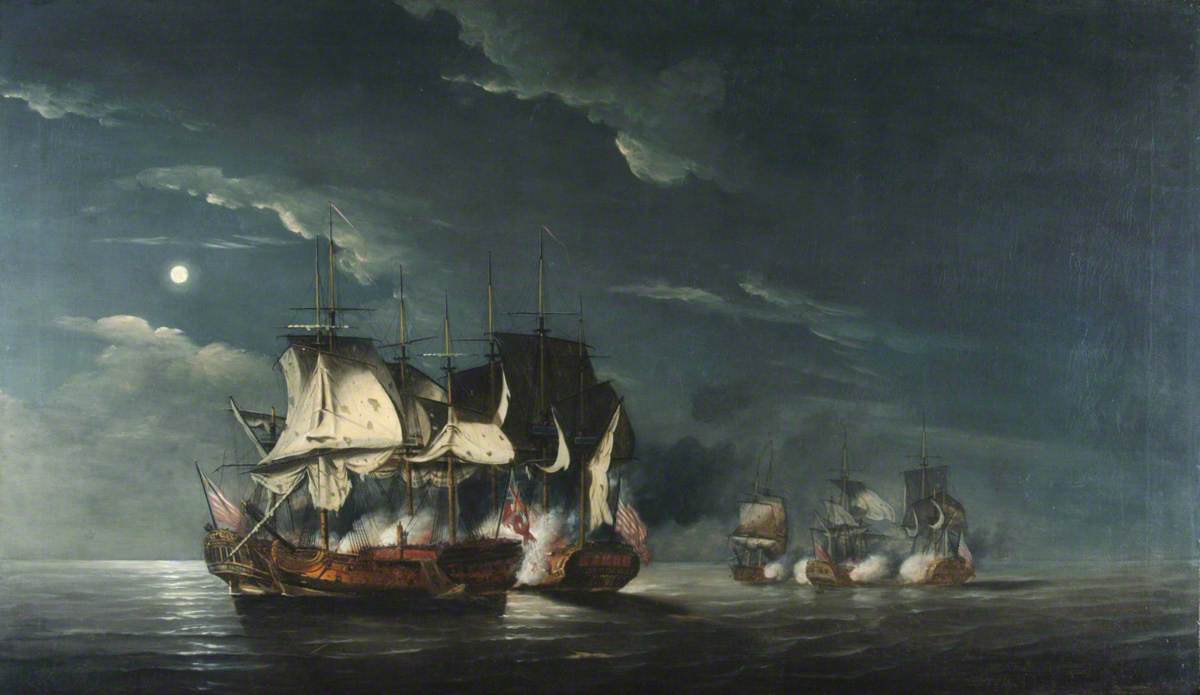
From then on it was a vertical battle, each ship winning the part of the other it could reach. The Serapis's heavy lower guns, firing point-blank, tore the Richard apart at and below the waterline, eventually firing clean through her hull and out the far side. But the Richard's tops, the fighting platforms high on her masts, swept the Serapis's open upper deck clear with musket fire and grenades (small hand-thrown bombs), until no British sailor could live in the open there. Each ship held a level the other could not. Both caught fire, again and again, and at moments the killing paused while crews on both sides fought the flames that threatened to burn them all together. Into that, the battle's single most consequential act came from one anonymous sailor. A man worked his way out along a yard, one of the long spars crossing a mast, the two ships lashed so close that the Richard's upper yards swung directly over the Serapis's open deck, until he hung over the enemy and dropped grenades down at her open hatches. One went through. It landed among a row of loose powder cartridges (the cloth bags of gunpowder for the guns) laid out along the lower gun deck, and the explosion ran the whole length of that deck, killing or horribly burning dozens of men and silencing gun after gun. Almost nothing else is known about the man who did it, not even, for certain, his name.
And then came the worst thing, and it came from Jones's own squadron. The Alliance (the American squadron's fresh frigate, untouched by the fight), under Pierre Landais (American), came up to the locked pair and fired her broadsides into both ships. Not once. She circled the two and raked them, raking being to fire down a ship's whole length, bow to stern, the deadliest angle in a sea fight, and the Alliance did it to her own flagship, again and again. Jones's report is anguished and precise: "Every tongue Cried that he Was firing into the Wrong Ship, but nothing availed; he passed round, firing into the B. H. R.'s head, stern, and broadside, and by one of his Vollies Killed several of my best men, and mortally wounded a good officer on the forecastle." The Richard took shots under the water from her own consort, the ship that was supposed to be helping her. Lanterns were shown to signal recognition; they were ignored. Whether Landais was incompetent, blind in the smoke, panicked, or something darker was argued for years afterward and never settled at the time. What is certain, and what Jones set down in his own hand, is the plain fact: one of the American ships spent the climax of the battle shooting into its own flagship. And it was the ship Jones had been given by France, under the captain the concordat had made his equal instead of his subordinate, doing the killing, the bad bargain of August coming due in iron.
By about ten o'clock the Bonhomme Richard was, by any reasonable judgment, lost. She was holed below the waterline and flooding, on fire and the flames working toward the magazine where the powder was stored, her pumps failing. Three of her warrant officers (the specialist petty officers who ran the guns, the rigging, and the hull), the gunner among them, decided she was sinking and that the only sane thing left was to surrender. The gunner ran aft to haul down the flag and found the flagstaff already shot away, so he began shouting for quarter instead. To ask for quarter is to ask the enemy to stop killing you and accept your surrender; to strike the colors, to haul down your own flag, is the formal signal of it, the universal language of a beaten ship. So consider the position from the cliffs, where the watchers could read it as plainly as the men aboard: the American's flag was gone, her gunner was bawling surrender across the water, she was visibly afire and settling, her own consort had just hulled her, and the heavier ship was lashed to her side firing through her hull. By every sign that a sailor or a spectator could see, the Richard was a beaten ship. Pearson hailed to ask whether the American had struck. What Jones said back, and what he did not say, is the most argued-over moment of the whole Revolution at sea, and it gets its own telling in a moment. The short version is that he refused, drove his own men back to their guns, and the battle went on.
Because the thing the dying Richard still had was her three remaining quarterdeck guns and Jones's refusal to stop. He had concentrated those guns on the Serapis's mainmast, firing double-headed shot (two iron balls joined by a short bar, which spun through the air and cut through mast and rigging) to bring it down. And on the British ship the picture was no better than on the American one. The grenade explosion had wrecked her lower gun deck; her upper deck was a killing ground swept by the Richard's marksmen; her mainmast was shaking and ready to fall; and the Alliance was loose and untouchable while Pearson was lashed to the one enemy he could not escape. About half past ten, Richard Pearson struck his own colors, in person. By the accounts that come down to us he had nailed the ensign to its staff before the battle so it could not be hauled down in a panic, and so had to tear it free himself. Jones's first lieutenant, Richard Dale (American), led the party that boarded and took possession of the Serapis. Moments after Pearson left her deck, his mainmast went overboard. Beyond the locked pair, in the dark, the second fight had already ended: the French Pallas had taken the Countess of Scarborough after about an hour. Jones had won. His own ship was sinking under him as he stood on the deck of the one he had captured.
The BattlesTrenton, 1776: the other time a beaten-looking attack stunned the enemyShe could not be saved. The Richard's rudder was shot away, her transoms (the structural timbers across the stern) torn out, her old timbers, in Jones's words, "mangled beyond my power of description." His wounded and his crew were moved across to the Serapis through the next day while men pumped to keep her afloat, and on the morning of September 25, two days after the battle, "it Was impossible to prevent the good old Ship from Sinking… a little after ten, I Saw With inexpressible grief the last glimpse of the B. H. R. No Lives were lost With the Ship," and the Bonhomme Richard went down somewhere off Flamborough Head, where her wreck has never been found. Jones shifted his flag to the captured Serapis and, with his squadron and some five hundred prisoners, ran east across the North Sea for neutral Holland.