At about five in the morning on September 11, 1777, the British army split itself in two at Kennett Square, Pennsylvania, and ran the Long Island play again: pin the enemy's front with a noisy fake attack while the real force marches around the end of his line, the same trick that had won General Sir William Howe (British), the commander in chief in America, his biggest victory the year before. Seven miles east, George Washington (American), commander of the Continental Army (the rebels' regular army), was dug in behind Brandywine Creek, a stream with no bridges along this stretch, crossable by an army only at fords (shallow wading places), covering the road to Philadelphia, 25 miles away. Howe sent Wilhelm von Knyphausen, a veteran lieutenant general of the Hessians (German troops in British service), straight down the Great Road toward the main crossing at Chadds Ford with about 6,800 men, artillery, and the baggage train. Knyphausen's orders were theater: make noise, look like the whole army.
Cornwallis, Howe's hard-driving subordinate, meanwhile swung north with Howe riding along and about 8,400 of the army's elite: grenadiers (the big assault infantry, the army's heaviest punch), light infantry (fast troops trained to fight loose and quick), the Guards (the king's own regiments), and jaeger riflemen (German huntsmen turned sharpshooters). Their route around the American right ran some fifteen to seventeen miles (Major John André of Howe's staff, who made the march, called it "a circuit of about fifteen miles"; the standard modern measure is about seventeen). A heavy morning fog covered the column's first hours.
Between about nine and ten thirty Knyphausen pushed Maxwell's American light infantry back across Chadds Ford in running skirmishes, deployed on the west bank, opened a bombardment, and then simply kept the show going for hours. The morning fight rolled right past Old Kennett Meetinghouse on the Great Road, where the local Quakers (the Society of Friends, pacifist by conviction) were holding their midweek meeting; September 11, 1777 fell on a Thursday, meeting day. They did not stop. As one of the Kennett Friends later wrote:
While there was much noise and confusion without, all was quiet and peaceful within.
The middle of Washington's day was consumed by reports that cancelled each other out. Around eleven, word came from Lieutenant Colonel James Ross, skirmishing on the Great Valley Road, that a large British column, maybe 5,000 men with Howe himself along, was marching north toward the upper fords. Washington liked what he heard: a divided enemy could be beaten one half at a time. He began issuing orders for a counterattack across the creek against Knyphausen. Then, around one, Major Joseph Spear of the militia reported that he had ridden the upper roads all morning and seen nothing. That made Ross's column sound like a feint (a fake move) designed to bait Washington into crossing. He cancelled the attack and waited.
While headquarters weighed Spear's nothing, the column he had not found was nearing the end of its circuit. Cornwallis's men had been on the road since five in the morning, the fog covering their first hours. They had waded Trimble's Ford on the West Branch of the creek; now the vanguard (the column's leading troops) was filing through Jefferis's Ford on the East Branch and into the narrow defile beyond it, a tight pass with no room to deploy, the kind of ground where a hundred men could have held up an army all day. Nobody was there. The column walked through.
Only around two o'clock, as the reports stacked up (a Major Eustace; Bland's light dragoons, scouts on horseback; the local squire Thomas Cheyney, who in the traditional telling rode in hot and was disbelieved until he offered his life on it) did the picture come clear: the British were not marching toward the upper fords. They were already across, and behind the army's right flank. Washington put it plainly in his report to Congress that night: the intelligence had been "uncertain and contradictory."
By two o'clock Cornwallis's column stood on Osborne's Hill, high ground squarely behind Washington's right, and rested after nine or ten hours of marching. Fooled by the same man, with the same move, twice in thirteen months.
The BattlesLong Island, 1776: the first time Howe marched around an open American flankWashington now did the thing that saved his army: he wheeled his right wing, which had spent the day facing west across the creek, a quarter-turn to meet an attack coming from the north. The divisions of two more of his generals, Lord Stirling (William Alexander, a New Jersey general who went by his claimed Scottish title) and Adam Stephen, and then John Sullivan's, with Sullivan in overall command of all three, swung north to the high ground around Birmingham Friends Meetinghouse, about two and a half miles north of Chadds Ford. The meetinghouse itself was already part of the war: the American army had commandeered it the day before as a field hospital (a makeshift hospital set up close behind the lines), so the Birmingham Friends had held their Thursday meeting in a wheelwright shop in Sconnelltown nearby. Joseph Townsend, a young Quaker who was there, remembered decades later that "some disturbance was discovered near the house," and "the meeting accordingly closed"; the Friends walked out into the sight of Cornwallis's army deploying across the fields.
Between three thirty and four, Cornwallis attacked off Osborne's Hill in parade-ground order. Sullivan's own division, still marching to its place on the left, was caught mid-deployment; Deborre's brigade broke almost at once, and the division was driven off in disorder. Stirling's and Stephen's divisions held the hill around the meetinghouse. Imagine standing in Stirling's line. You have been marching since the news broke; the meetinghouse at your back is the field hospital your own army set up yesterday; and coming up the slope toward you, in step, with bayonets fixed, is the army that was supposed to be on the other side of the creek, in front of Chadds Ford. Your guns on the knoll fire over your head. The line holds, breaks, takes the ground back, and holds again, for the better part of two hours, through some of the most intense close fighting of the entire war. British grenadiers came on with the bayonet; the light infantry and the jaegers worked the flanks; and at last Stephen's line broke, and then Stirling's.
Into that collapse rode the Marquis de Lafayette (American service), a nineteen-year-old French volunteer aide in his first battle, a major general by honorary commission for all of six weeks. He threw himself into Stirling's breaking line to rally it and took a musket ball through the left calf. He stayed on the field until the blood filling his boot forced him out. Decades later Lafayette remembered Washington telling the surgeon to treat him as if he were his son; the line is his own much-later recollection, but the bond it describes was real for the rest of both men's lives.
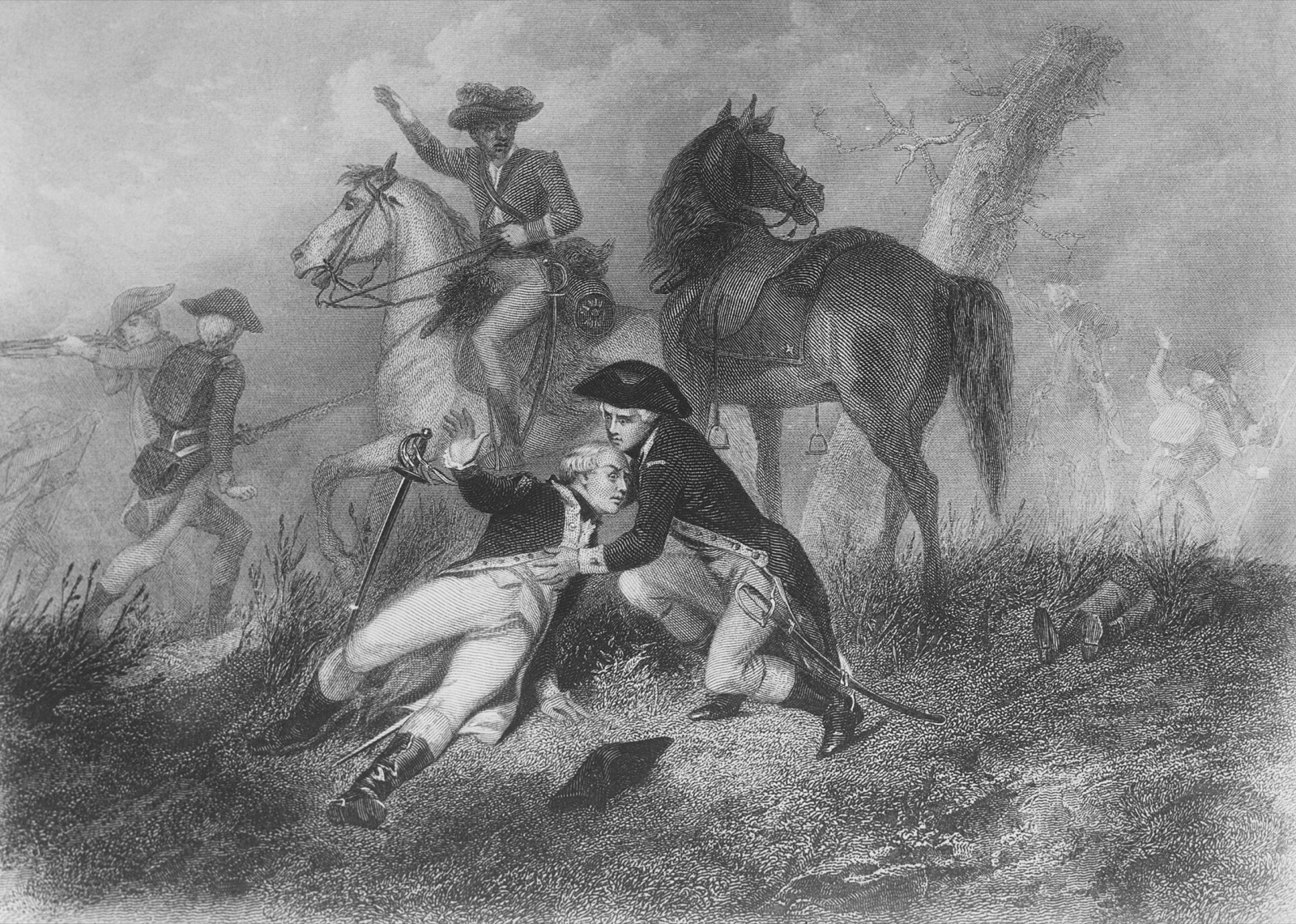
Down at Chadds Ford, Knyphausen heard Cornwallis's guns and stopped pretending. Between four and five his column stormed across Chadds Ford for real and broke through the weakened line of Anthony Wayne's American division and Maxwell's light infantry; with the artillery horses shot, most of the American guns there had to be abandoned (of fourteen American pieces on the field, eleven were lost before the day ended). John Armstrong's Pennsylvania militia downstream, never engaged, withdrew. The American center and right were now both collapsing, and Washington fed in his last fresh formation: Nathanael Greene's division, pulled from the center, which covered roughly four miles at a run, by tradition in about 45 minutes. Greene's regiments opened their ranks to let the fugitives stream through, closed them again, and with Weedon's Virginia brigade made a stand south of the village of Dilworth that held the pursuit for nearly an hour at sunset, until dark stopped it.
The army retreated east toward Chester, on the Delaware River about 14 miles away, beaten but not broken. Lafayette, wounded leg and all, helped rally the column at the Chester bridge, and most of the army was in by midnight, stragglers through the morning.