By the end of 1779, the war in the North had gone nowhere. Five years in, Britain held New York City and not much else, France had come into the war on the American side, and George Washington's army could not be destroyed and would not go away. So Britain changed the board. It decided to win the war in the South.
The reasoning was not foolish. The southern colonies were rich: rice and indigo (a plant that yields a deep blue dye) were the export crops whose wealth helped finance the rebellion, and the ports that shipped them sat conveniently near the British sugar islands of the Caribbean. Better still, London believed the South was full of Loyalists (Americans loyal to the king) who would rise the moment a British army gave them cover, and then hold the reconquered ground themselves, so that Britain could roll the rebellion up colony by colony with only a thin garrison. There was even a proof of the idea. In December 1778 a small British force had taken Savannah, Georgia, and in October 1779 it held the city against a combined French and American siege that ended in a bloody allied failure. Benjamin Lincoln (American), the major general commanding the American forces in the South, had led the American half of that failed assault and fallen back to Charleston. Savannah's successful defense convinced the British commander in chief, Sir Henry Clinton (British), that the moment had come to go for the real prize.
The prize was Charleston, or Charles Town as it was then spelled: the largest and richest city in the South and the fourth largest in America, around 12,000 people, roughly half of them enslaved. It was the South's principal port and the seat of the rebel government in South Carolina. Take Charleston and the whole door to the South stood open.
Clinton sailed from New York on December 26, 1779, with about 8,500 troops and 5,000 sailors aboard some ninety transports, escorted by fourteen warships under Vice Admiral Marriot Arbuthnot (British), with Lord Cornwallis (British) as his second in command. And then the weather nearly destroyed the whole expedition before it ever reached Carolina. The winter of 1779 to 1780 was one of the worst of the century, the same "Hard Winter" that was freezing Washington's army at Morristown, and it fell on the fleet at sea. Storms scattered and battered the ships for five weeks on what should have been a ten-day run. An ordnance ship (carrying the army's heavy guns and stores) foundered and went down. One transport with about 200 Hessians aboard (German soldiers hired into British service) was blown clean across the Atlantic and fetched up in Cornwall, in England. And worst of all for what was coming, nearly all the cavalry and artillery horses died in the holds or were thrown overboard to lighten the laboring ships. A Hessian officer of the Jäger (light troops), Captain Johann Hinrichs, counted fifteen of his thirty-six days at sea as outright storm. Tarleton's cavalry (dragoons, mounted soldiers trained to fight from horseback) would step ashore in Carolina with no horses at all.
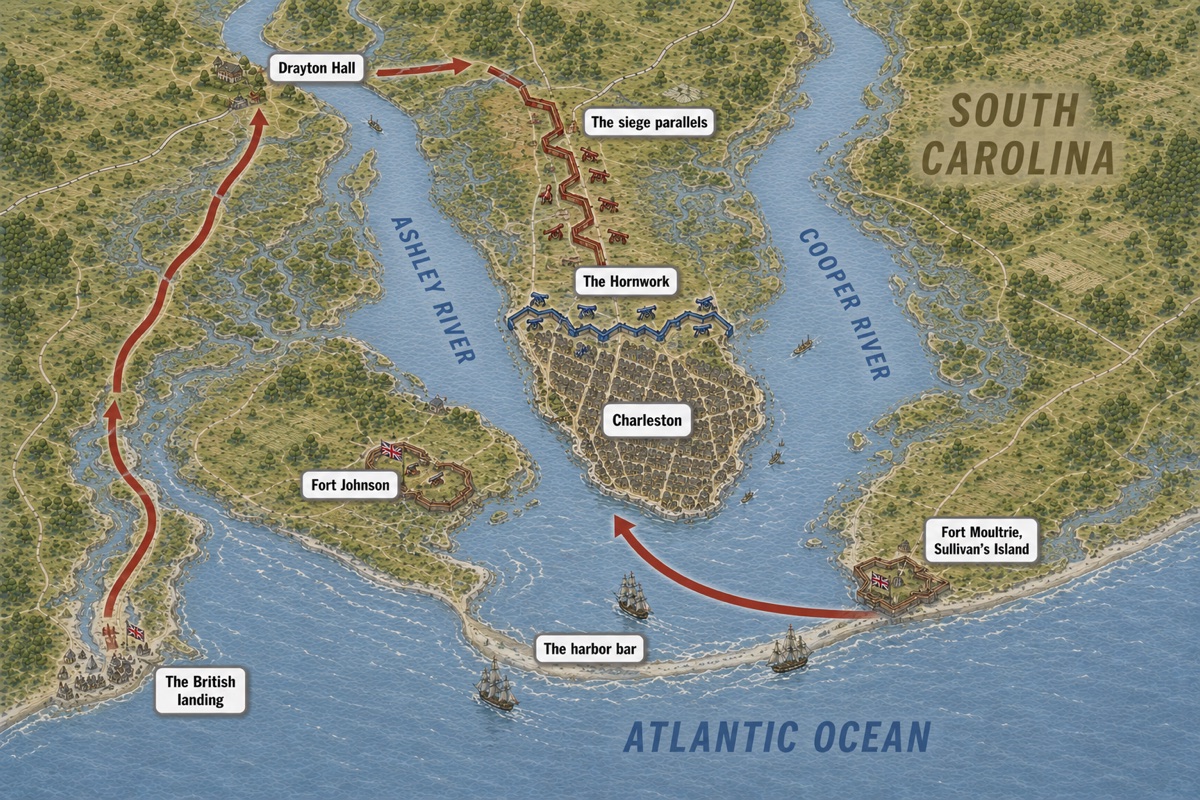
The fleet regrouped off Savannah at the start of February, and now Clinton's caution took over completely. He had been to Charleston before. In 1776 a British attempt on the city had been beaten off in humiliating fashion at the harbor mouth, and Clinton, who had been there, was not going to repeat it. He landed his army thirty miles south of the city, on Simmons Island (today Seabrook Island), on February 11 and 12, and then he simply refused to hurry. For six weeks the army worked its methodical way north through a maze of marsh and sea islands: across the Stono River, onto James Island by early March, through the Wappoo Cut, then up the west bank of the Ashley River. Hinrichs wrote of the country they crossed.
Through a wilderness of deep sand, marshland, and impenetrable woods where human feet had never trod! What a land to wage war in!
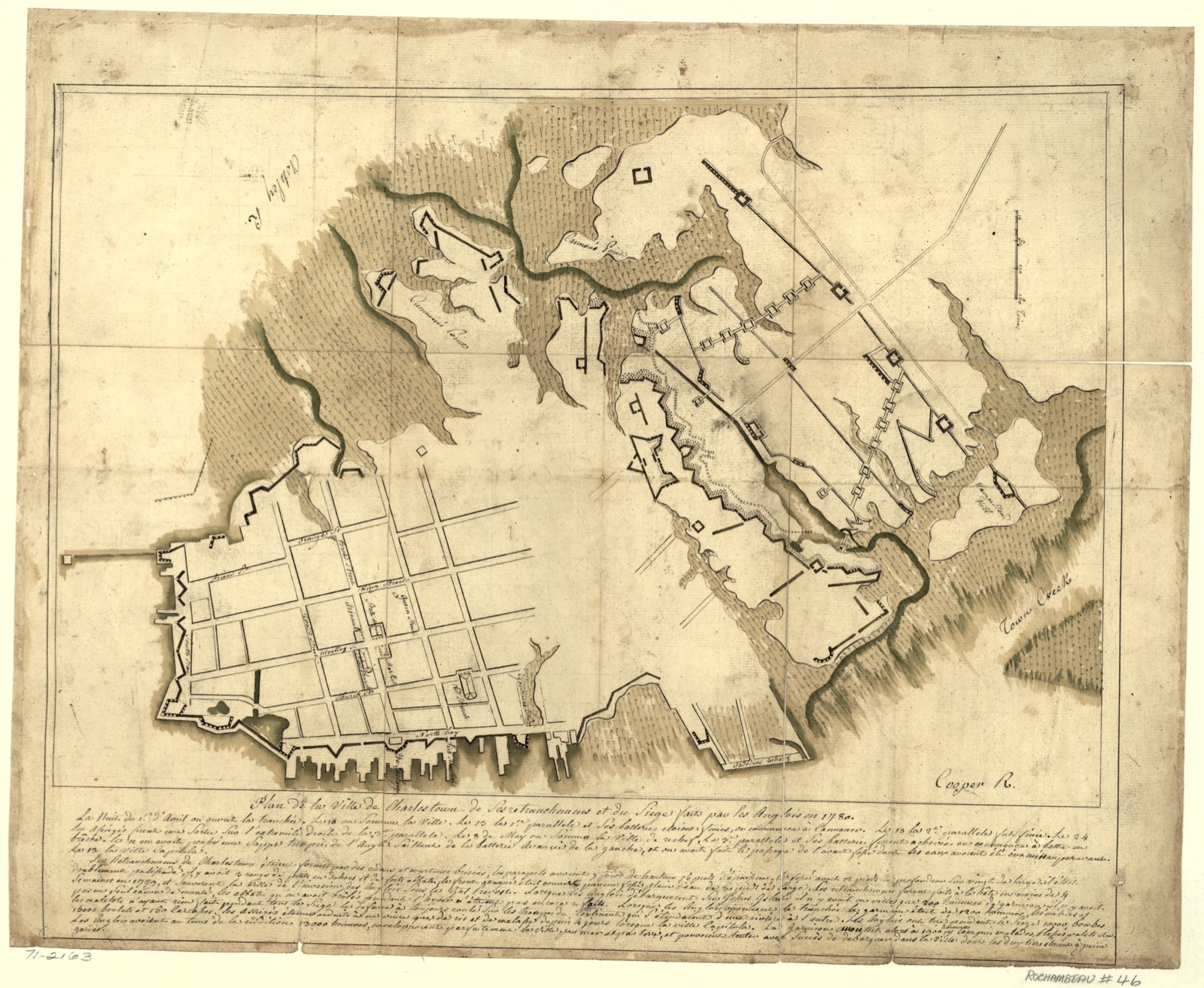
On March 29 the army crossed the Ashley unopposed near Drayton Hall and walked down onto Charleston Neck, the strip of land at the top of the peninsula that was the city's only land door. Clinton had taken three months to move thirty miles, and he had not put a foot wrong. Now he stood on the one piece of ground from which Charleston could be besieged.
Inside the city waited Benjamin Lincoln and the entire Continental establishment in the South. He held the lines across the Neck with roughly 2,500 to 2,800 Continentals (the full-time paid regulars of the Continental Army), Carolinians and Georgians, soon joined by some 750 Virginians under Brigadier General William Woodford (American), who marched in on April 7 after a brutal forced march of some 800 miles from Morristown, arriving just in time to be trapped. Add 2,000 to 3,000 militia (part-time citizen soldiers) and armed townsmen, and Lincoln had perhaps 5,500 to 6,000 men behind a fortified line, fronted by a wet ditch and anchored at the gate by a strongpoint of tabby (a local concrete of oyster shells and lime, very hard) called the Hornwork. It was a respectable force. It was also, as the professional soldiers among them could see, in the wrong place.
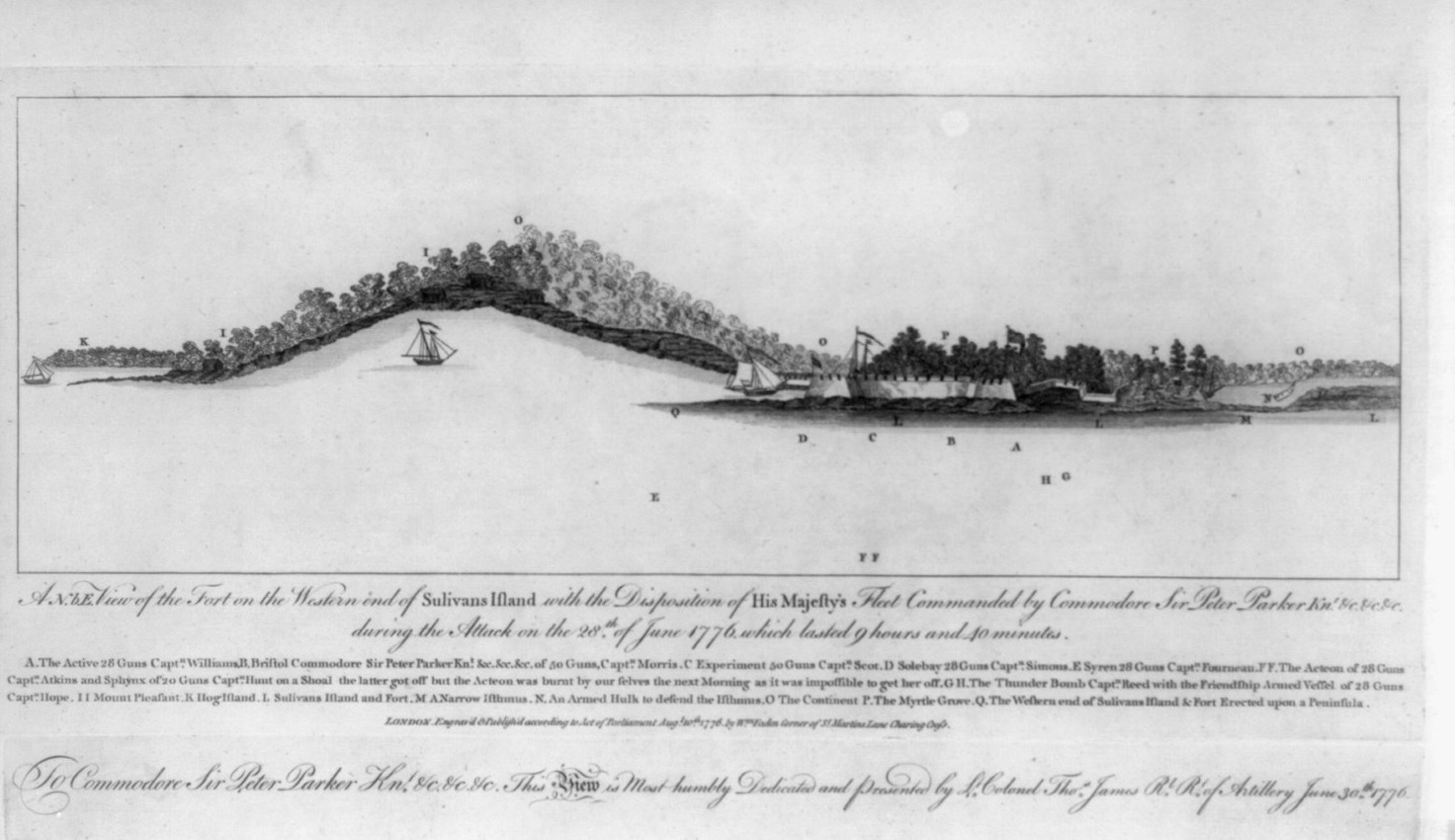
For a moment, set the scene against a memory the city was very proud of. Four years earlier, on June 28, 1776, this same harbor had been the site of one of the Revolution's great early victories. A half-finished fort of palmetto logs on Sullivan's Island, the island on the north side of the harbor mouth, held by about 400 men under William Moultrie (American), had stood up to nine British warships for a whole day. The spongy palmetto logs swallowed the cannonballs instead of splintering, the fort's blue-and-crescent flag (Moultrie's own design) became the icon of southern resistance, and the British were kept out of the South for three years. Charleston's myth was built on that harbor. In 1780 the British were about to take the city by ignoring the harbor entirely, and the fort that had wrecked a fleet would change hands without firing a shot.