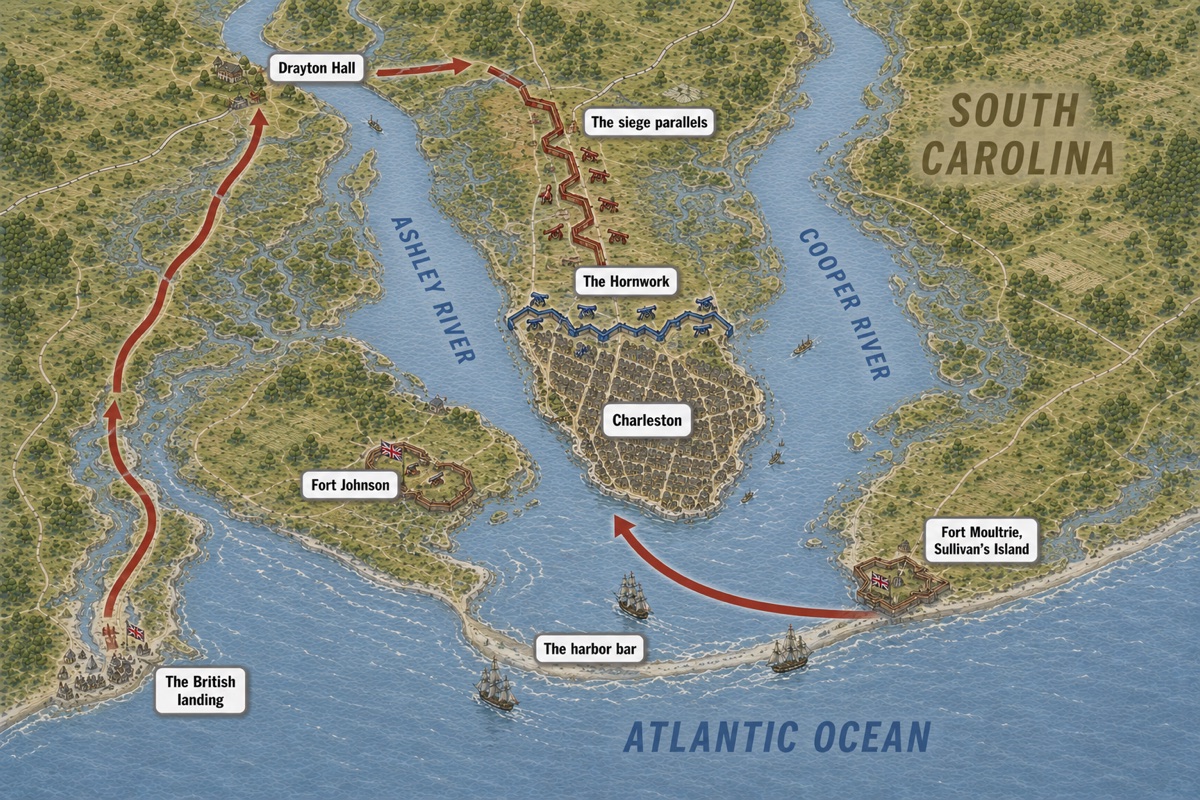
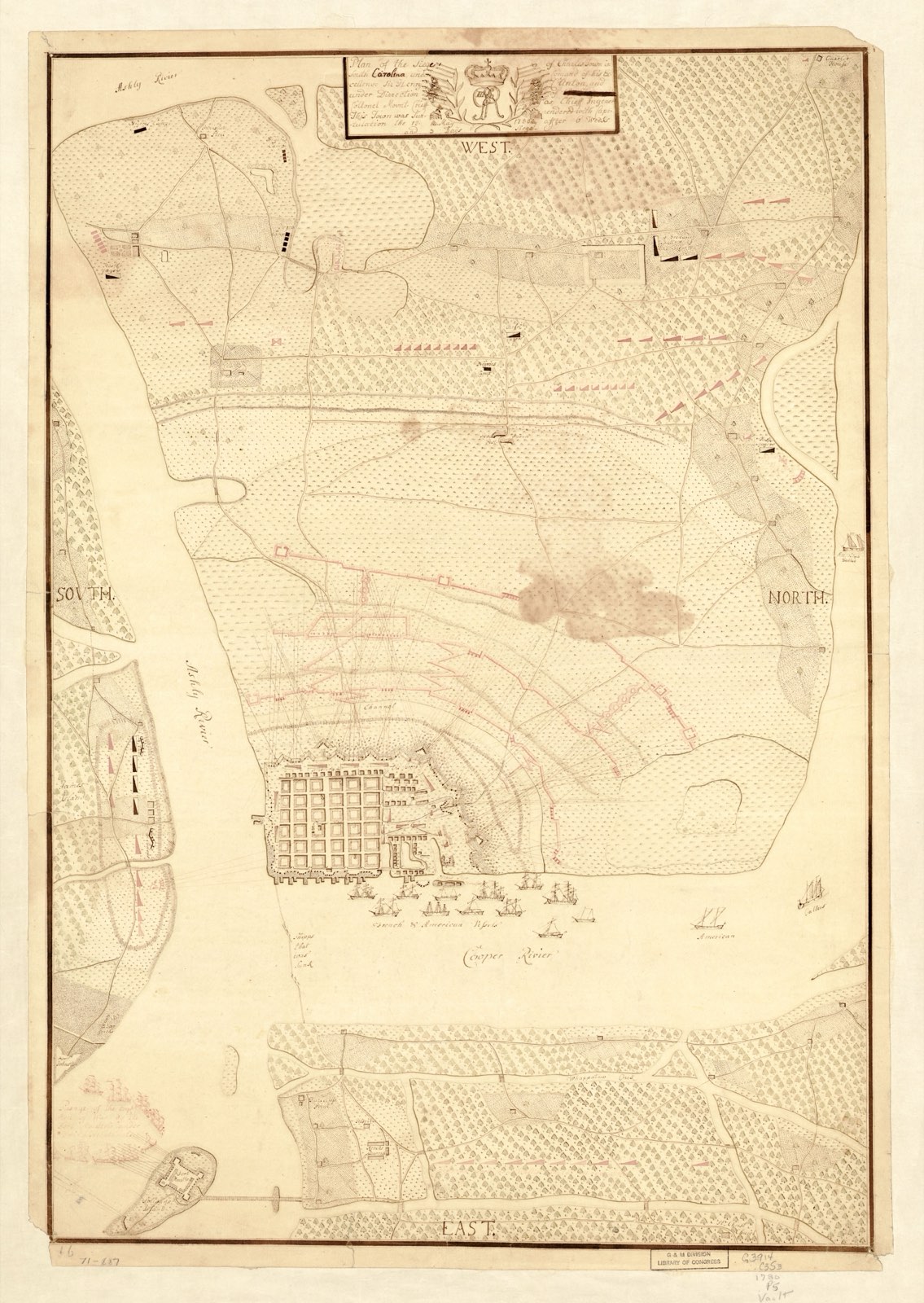
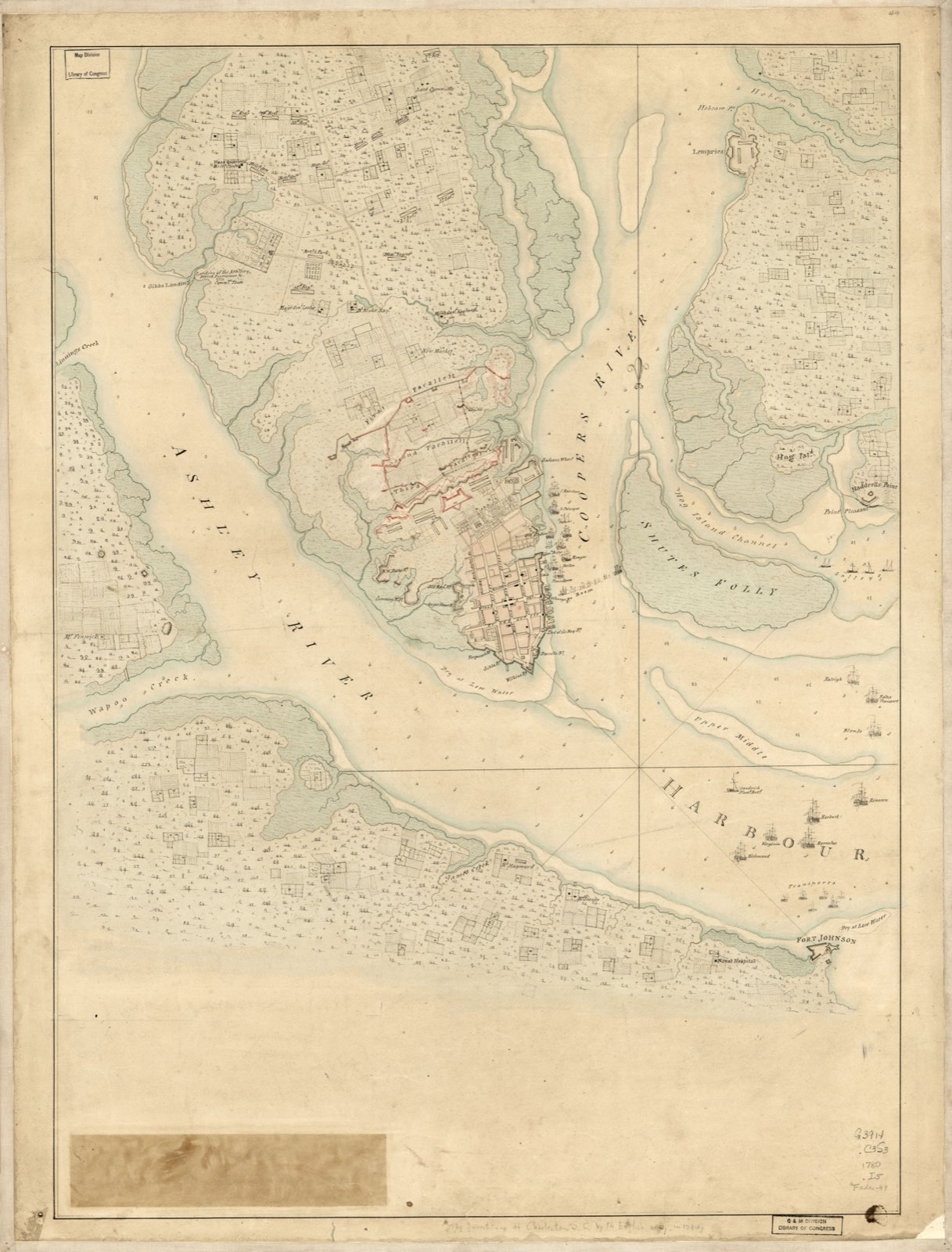
A siege in the eighteenth century was not a battle so much as a piece of engineering, and Clinton was a master of it. On the night of April 1, the British broke ground about 800 yards from the American lines and dug their first parallel: a trench running parallel to the enemy works, so the diggers were never exposed broadside to the defenders' guns. From a parallel, zigzag trenches called saps (dug at an angle to the enemy so no single cannon shot could sweep their whole length) creep forward toward the enemy, and then a second, closer parallel is dug, and the process repeats, the trenches walking steadily nearer until the attacker's guns can fire point-blank into the defense. This was the textbook reduction of a fortified place, slow and nearly bloodless and very hard to stop. Clinton, who had been beaten off this very ground in 1776, was now taking the city by arithmetic.
It went almost exactly to the book. On April 8, Arbuthnot ran eight warships past Fort Moultrie on a flood tide and into the harbor, losing only a handful of men and one supply vessel, the whole passage taking well under two hours. The fort that had wrecked a British fleet in 1776 was simply sailed past in 1780. And the man it was named for was inside the lines to watch it happen: William Moultrie, the hero of the palmetto logs, could only listen to his own guns bark at ships that did not stop to fight them and slide past into the harbor he had once owned. The harbor was now British water, and the city could no longer be supplied or escaped by sea. The same day, Woodford's exhausted Virginians marched in, the last reinforcement to make it through. Two days later, on April 10, Clinton and Arbuthnot together summoned Lincoln to surrender. He refused, replying that duty and inclination alike pointed to defending the place to the last extremity. The next day the British batteries opened, and the bombardment of the city began.
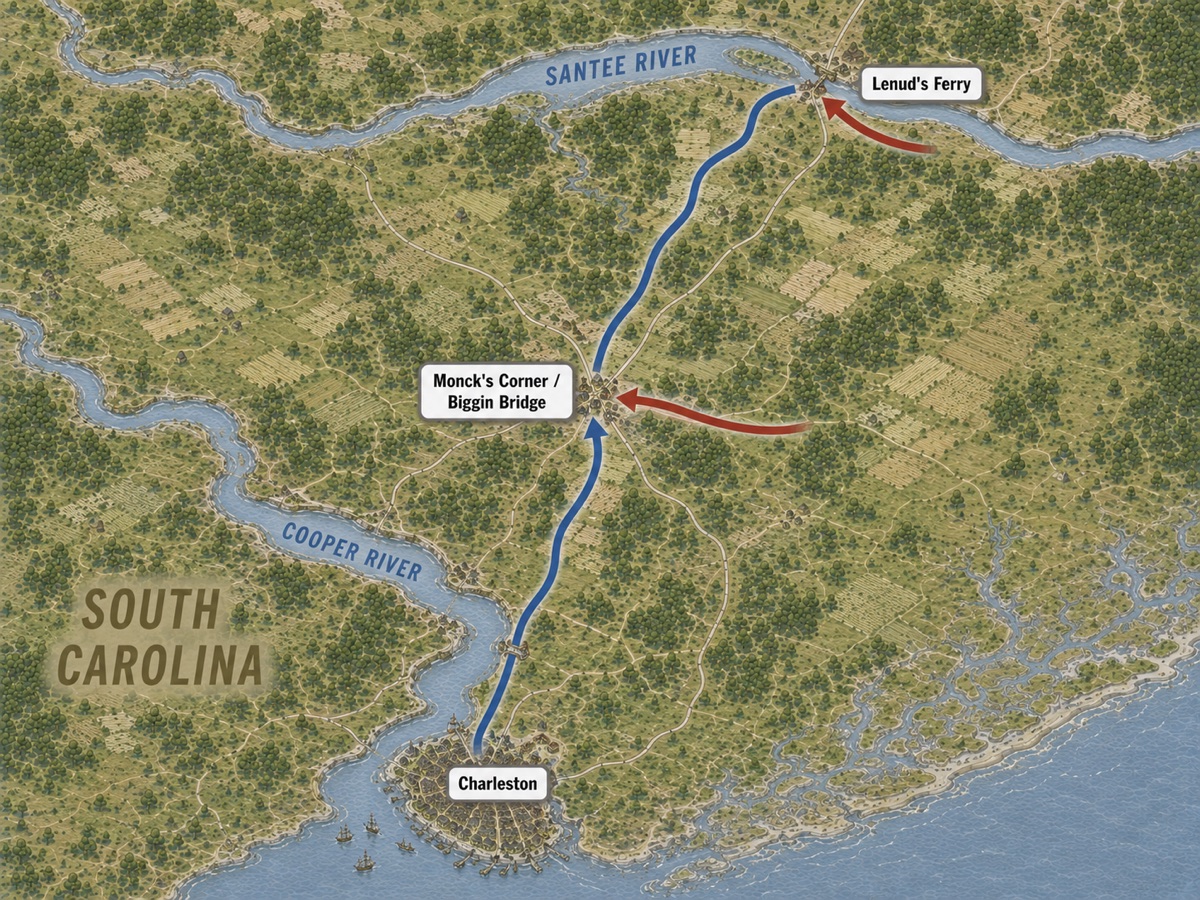
Now the trap had a single weak seam, and both sides knew where it was. The only escape route left to the American army ran north: out of the city, across the Cooper River on the eastern side of the peninsula, and up the roads beyond, toward the Santee River and away. That route was held open by Brigadier General Isaac Huger (American), with about 500 cavalry and militia posted thirty miles up the Cooper at Monck's Corner, where the road crossed at Biggin Bridge. Whoever held Monck's Corner held the back door. On the night of April 13, Banastre Tarleton (British) marched for it with his British Legion and Major Patrick Ferguson's light infantry (British), about 1,400 men. On the way they captured a letter that betrayed the American dispositions, and at three in the morning on April 14 they fell on Huger's camp without firing a warning shot. The surprise was total. A few dozen Americans were killed or wounded, sixty or seventy captured, and the rest, Huger among them, escaped on foot into the swamps. And Tarleton took the thing the expedition needed most. His own horses had gone overboard in the winter storms; now the Legion seized the American cavalry's mounts and rode out of Monck's Corner superbly horsed. The near door was shut.
A few days later, Cornwallis crossed to the east bank of the Cooper with more than 2,300 men, and the American outposts on that side folded back. Now the city was ringed on every side, by land and by water. The investment, the complete encirclement of a place under siege, was finished.
This is the moment the siege of Charleston stops being a story about engineering and becomes a story about politics, and it is the heart of what happened to Benjamin Lincoln. A soldier in his position had two honest options. He could fight the siege out, or he could save the army, the irreplaceable thing, by marching it across the Cooper while the route was still open and abandoning the city. By the rules of his trade the second was the right answer: a city can be retaken, an army cannot be remade. But the civil government of South Carolina made the second option politically impossible. Governor John Rutledge had left the city around April 13 at Lincoln's own urging, taking several councilmen with him to keep a government alive in the state. But Lieutenant Governor Christopher Gadsden (American), the fierce Charleston radical who had designed the "DON'T TREAD ON ME" rattlesnake flag, stayed, and he was utterly opposed to giving up the city. When Lincoln's council of war took up the question of evacuation around April 19 and 20, Gadsden was admitted to it along with members of the South Carolina Privy Council (the governor's executive advisers), and one of them, Thomas Ferguson, made the threat that defined the siege: that if the Continentals tried to withdraw, the townspeople would open the gates to the British themselves and help attack the retreating army in its boats. There was the whole geometry of Lincoln's bind in a single sentence: by his trade the army was the irreplaceable thing, and he was being told that the act of saving it would turn the city he was defending into an enemy at his back, his own boats fired on by the people he had stayed to protect. The generals McIntosh and Moultrie wanted the army out. So did Louis Duportail (American), a French officer serving as Washington's own chief engineer, who had slipped into the city in late April; he took one look at the works, pronounced them untenable, and urged evacuation. That was the professional case closed: Washington's own engineer, brought in to judge, said get the army out. It changed nothing. The same government that would not let the army leave had also refused Lincoln's plea, weeks earlier, to arm enslaved men for the defense, as John Laurens had proposed the year before; in a city where half the population was enslaved, the men on the council who would not free their army to save it were also the men who would not arm the people they owned. Pressed from both sides, with a government threatening to turn on him if he saved his army, Lincoln stayed.
On April 21, Lincoln made one professional offer: he proposed to surrender the city if the garrison could march out with the honors of war and go free. The honors of war were the courtesies a respected enemy was granted on surrender, marching out under their own colors, drums beating, the dignity of soldiers rather than the shame of captives. Clinton, holding every card, refused flatly. A spirited American sortie before dawn on April 24, Virginians and Carolinians striking at the British trenches, drew blood and changed nothing; it was the only offensive blow the garrison struck in the entire siege.
Then, in the first week of May, everything fell at once. On May 6, the American cavalry had regrouped under two American colonels, Anthony Walton White and William Washington, about forty miles north, on the bank of the Santee River at Lenud's Ferry. Tarleton found them resting and destroyed them a second time: thirty or forty killed and wounded, dozens captured, the commanders escaping by swimming the river. Now there was no organized American force outside Charleston at all. On May 7, a Royal Navy landing party of some 500 sailors and marines summoned Fort Moultrie. Its garrison of about 200 men was cut off, outnumbered, and beyond any rescue, and it surrendered without firing a shot. The shrine of 1776 fell to a politely worded demand, and the British renamed it for their admiral. On May 8, Clinton summoned Lincoln to surrender unconditionally. The talks over the next two days broke on the same two points as before, the status of the militia and the honors of war, with Lincoln still asking for the full honors and Clinton still refusing them.
When the truce lapsed around nine o'clock on the night of May 9, both sides opened up with everything they had. By Moultrie's count it was the heaviest cannonade of the whole siege, something like 180 to 200 guns firing through the night, shells crossing overhead and magazines and ammunition chests blowing up along the lines. Moultrie left the unforgettable record of it.
it was a glorious sight, to see them like meteors crossing each other, and bursting in the air; it appeared as if the stars were tumbling down... it was a dreadful night!
And in the siege's final days the bombardment stopped being beautiful and started burning the town. The British began firing hot shot, cannonballs heated red in furnaces to set wooden buildings alight, and fires caught among the houses. From the lines the men could watch the glow spread roof to roof down toward the wharves, the same families who had crowded the streets all spring now beating at their own burning homes in the dark with the British guns still working. By morning the closest parallel was at the very lip of the lines, the wet ditch was drained, and the city had nothing left to hold with and no one left who wanted it held. That was what finally broke the city's will. The leading citizens of Charleston, Christopher Gadsden among them, the same men who had refused to let the army leave, petitioned Lincoln to surrender on whatever terms he could get. The militia in the garrison sent word that the British terms were acceptable to them. On the evening of May 11, Lincoln reopened negotiations. There was nothing left to defend the city for, and no one left who wanted him to try.
Off the fieldLoyalist against Patriot: the war between Americans, told whole