A little after five in the morning on October 4, 1777, the head of the main American column came down the Germantown Road out of the dark and struck the British picket (a small forward guard posted to give the alarm) at Mount Airy, northwest of the village of Germantown. The picket's two cannon fired the alarm, and the battle was on. This was the column of John Sullivan (American): his own division and that of Anthony Wayne (American), the general whose men had been bayoneted at Paoli, with George Washington (American), the commander in chief, following close behind with the reserve. It was the spearpoint of an 11,000-man, four-column dawn attack on the camp of General Sir William Howe (British), whose army had taken the rebel capital of Philadelphia, 5 to 6 miles down this road, eight days before.
Posted forward were the 2nd Light Infantry battalion (light infantry: fast, aggressive troops used for skirmishing and shock work) and the 40th Regiment of Foot (an ordinary infantry regiment). The light infantry were the very corps that had bayoneted Wayne's division at Paoli two weeks earlier, and Wayne's men knew it. After a sharp fight the light infantry broke and ran back through their own camp, and Wayne's men went after them with the bayonet. British officers remembered cries of "At the bloodhounds" as the Americans came on.
Howe himself rode up toward the firing believing it was a raiding party, and found his elite light infantry streaming back at him.
For shame, light infantry! I never saw you retreat before.
Then American grapeshot (a cannon round that sprays a cloud of iron balls) came rattling through the trees around him, and Howe understood. It was Washington's whole army.
For about an hour, the unthinkable was happening. Sullivan's column rolled some two miles down the Germantown Road into the village, overrunning the light-infantry camp as it went. And then the fog closed in for good. The dense ground fog that had come with dawn thickened as black-powder smoke poured into it, until men could see only a few dozen yards. The plan depended on four columns striking together; now they could not see one another at all. Units drifted off their roads, officers could not tell friend from enemy, and the white paper in the men's hats was little use in a fog that hid the hats. Washington told Congress the next day: "The Morning was extremely foggy, which prevented our improving the advantages we gained so well, as we should otherwise have done."
And in the middle of the rolling advance, a stone house filled up with redcoats (British soldiers, for their uniform coats). As the 40th Foot fell back through the village, its commander, Lieutenant Colonel Thomas Musgrave (British), threw about 120 men, six depleted companies (the small subunits of a regiment, these were down to about twenty men each), into "Cliveden," Chief Justice Benjamin Chew's new stone country house: walls about two feet thick, doors barred, ground-floor shutters closed, muskets at the upper windows. The American advance flowed around and past it, leaving a fortified island of British infantry behind the moving American front. Musgrave's stand was a superb piece of soldiering, decided in minutes under a collapsing line, and it changed the battle.
Washington and his staff, coming up with the reserve, now had a decision to make, and they made the most argued-over one of the day. Some of the staff, Timothy Pickering among them (and by several accounts Alexander Hamilton, another of Washington's staff officers), argued the obvious: leave a regiment to mask the house (pen the garrison in and ignore it) and push everything else on into the village where the battle was being won. Henry Knox, the army's chief of artillery, argued the doctrine: it was, as Pickering remembered him insisting decades later, contrary to all military rule to leave a castle in one's rear (the fear being that a fortified enemy left behind your line can sally out against your back, or cut your only road home if the attack goes wrong). Washington sided with Knox. The army stopped to take the castle.
It could not be taken. Knox's 3- and 6-pounder field guns (light cannon, named for the weight of ball they threw) simply bounced off the stone. So the infantry went in. Imagine being one of them: you cross ground you can see only a few dozen yards of, toward a house you mostly hear, every ground-floor window shuttered, every door barred, muskets working steadily from the upper floor. The cannonballs that were supposed to open the wall for you have bounced off it. You reach a door that will not give, and the men who reached it before you are lying at the step. Maxwell's New Jersey brigade went in like this and was thrown back with slaughter; rushes at the doors and windows failed; attempts to set the house alight failed. Lieutenant Colonel William Smith of Virginia, sent forward under a flag of truce (a party the rules of war said you did not shoot at) to demand the garrison's surrender, was shot down and died of the wound. John Laurens of Washington's staff was wounded; one French volunteer, the Chevalier de Mauduit du Plessis, actually reached the house. Roughly an hour was consumed. The reserve was sucked in piece by piece. More than 50 Americans died at the Chew House, over a third of all the Americans killed in the entire battle, in front of a building defended by about 120 men.
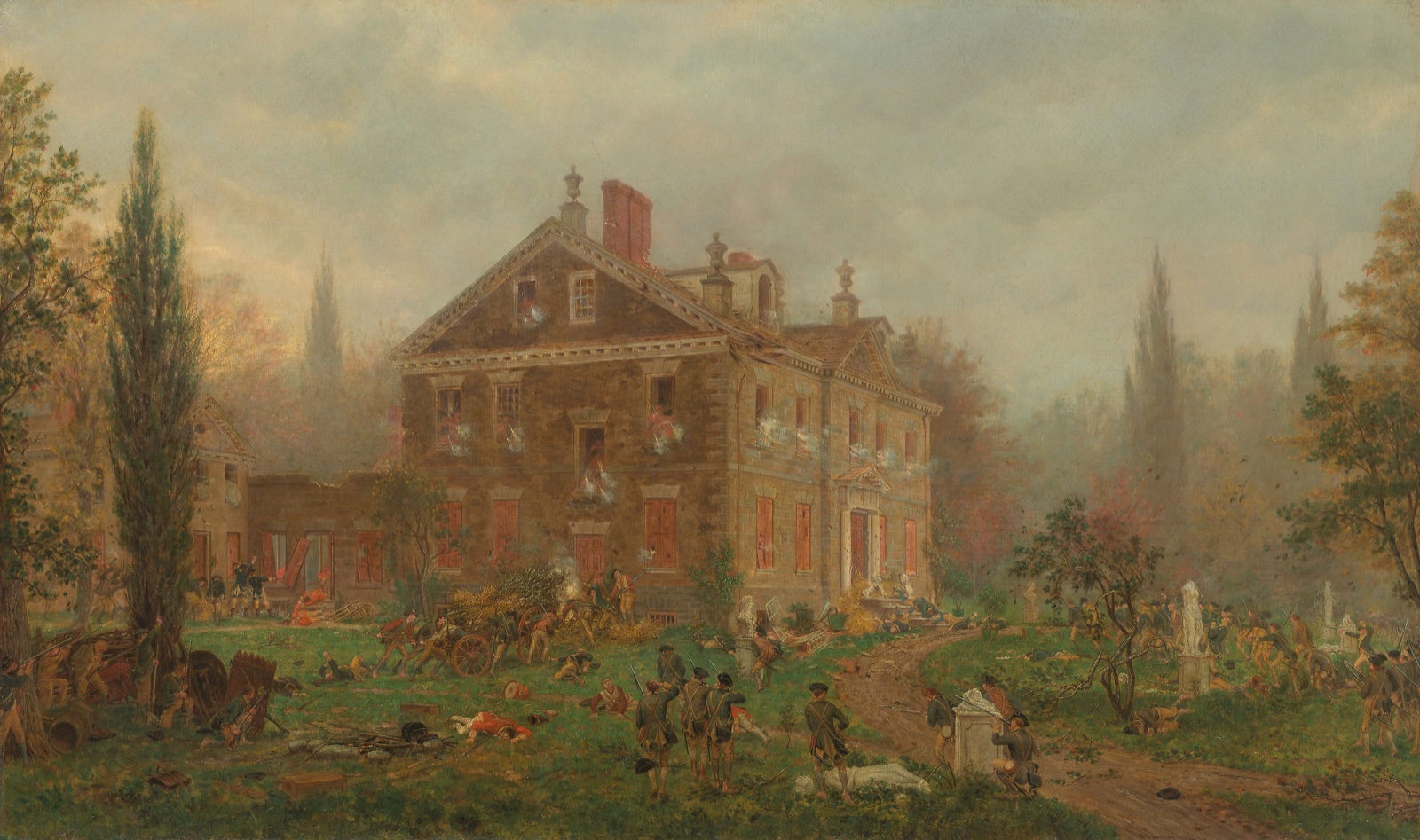
The cannonade at the house did something worse than kill the reserve: it confused everyone else. In fog, sound was the only map, and the heaviest firing on the field was now behind the American advance. It is widely credited with pulling wandering units toward it, and with convincing men at the front that they were being cut off.
One of the wandering units was a whole division. Adam Stephen (American), a Virginia major general marching with the left-hand column, drifted off the Limekiln Road in the fog, by most accounts toward the gunfire at the Chew House, and his division blundered into the rear-left of Wayne's. Each took the other for British. The two American formations opened fire on each other, and both broke. Wayne's men, at that moment deep in the village and winning, fell back through the fog, and the center of the attack began to come apart. Exactly what happened, and whose fault it was, would be argued at a court-martial within weeks.
On the far left, Nathanael Greene (American), commanding the army's largest column, had finally arrived, about three-quarters of an hour late behind a guide who lost the way in the dark, and his attack near Luken's Mill hit hard. Colonel Walter Stewart claimed a trophy in the first rush: "I engaged the 5th and 38th; both ran lustily, and I took a little flush redoubt, with three pieces of cannon from them." Colonel George Mathews's 9th Virginia drove deepest of any unit on the field, clean into the British camp, taking prisoners, until the British closed in around it (Lord Cornwallis's reinforcements, up from Philadelphia, among them) and captured the regiment entire, Mathews included.
It was not enough. Sullivan's men, who had been fighting longest, were running out of ammunition. The Wayne–Stephen wreck was spreading panic through the center. The militia columns on the far flanks had barely gotten into action. And the British, rallied by Howe, were counterattacking from both wings, the brigades on the left led by Charles Grey, the same "No Flint" Grey of the Paoli bayonets. Roughly three hours after the first shots at Mount Airy, around half past eight in the morning, Washington ordered a general retreat. Greene pulled his divisions out and covered the army with his guns. The battle that had been nearly won dissolved back up the roads it had come down.