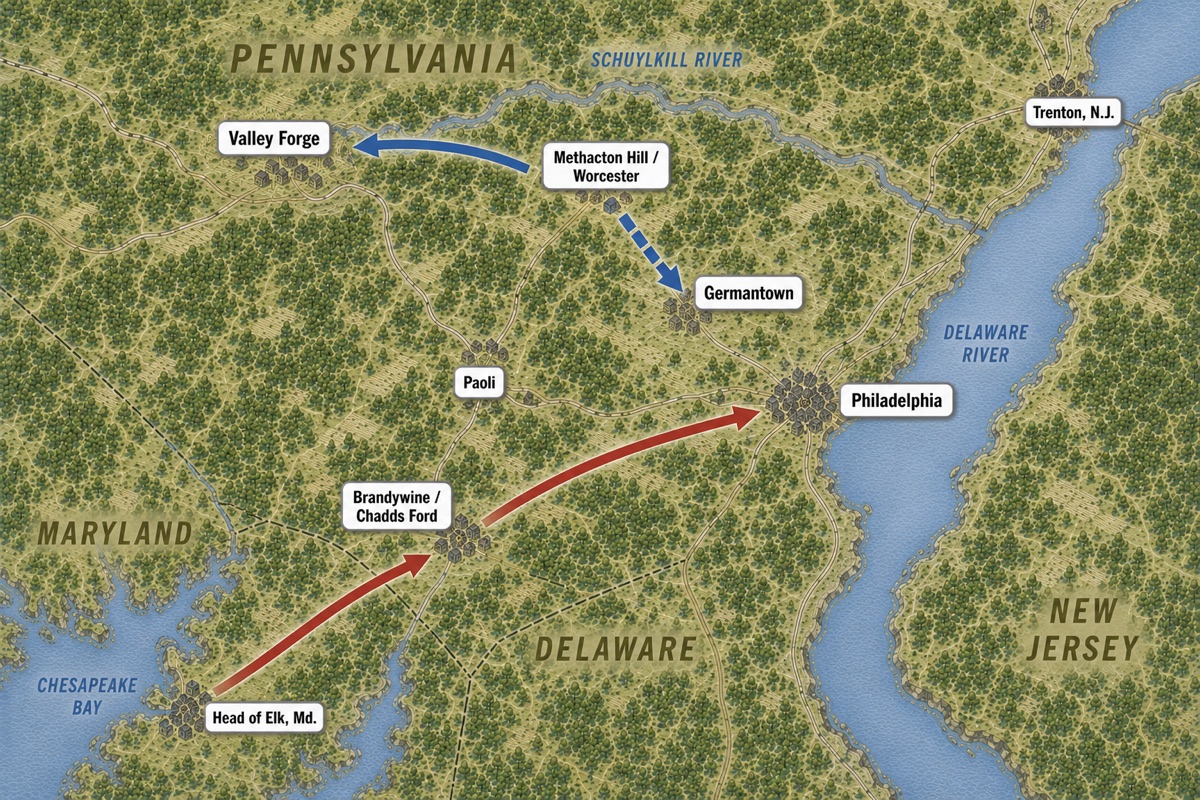
The retreat was long but it was not a rout. The army of George Washington (American), the Continental Army that had attacked the British camp at Germantown at dawn and seen the attack come apart in the fog, fell back up the same roads it had marched down in the night, with Anthony Wayne's guns and Nathanael Greene's rear guard turning to check the pursuit. Many of the men marched 20 miles and more that day, on top of the 14 to 16 they had marched the night before. The British followed for about 9 miles and gave up; General Sir William Howe (British), true to form, had won his battle and declined to chase the beaten army to destruction. During the withdrawal a cannonball struck Brigadier General Francis Nash of North Carolina, who died of the wound four days later. The British had lost a senior officer of their own: Brigadier General James Agnew was killed.
The count, when it finally ran, was about twice as ugly on the side that attacked. American losses: roughly 152 killed and 521 wounded, around 650 to 675 in all, plus somewhere between 400 and 440 captured or missing, including the entire 9th Virginia regiment, taken in a body at the deepest point of the advance. Call it about 1,100 men. British losses: about 70 killed, 448 wounded, and 14 missing, a total around 520 to 535, of whom only about two dozen were Hessians (the German troops in British service). The Americans had lost roughly twice what they inflicted, and more than 50 of their dead had fallen in front of one stone house.
The collision of the two American divisions, the moment they fired into each other in the fog, went to a court-martial within weeks, and the man on trial was Adam Stephen, the Virginia major general who had been Washington's own second-in-command back in the 1750s, and whose division had drifted off its road and into the back of Wayne's. The court (a formal army trial, with John Sullivan, a fellow division commander in the battle, presiding) found him guilty of "unofficerlike behavior, in the retreat from Germantown, owing to inattention, or want of judgement; and that he has been frequently intoxicated since in the service," and sentenced him to dismissal; the sentence was approved on November 20, 1777, and Stephen was cashiered, the only major general of the Continental Army dismissed by court-martial in the whole war. The popular version of the story says he was drunk during the battle and caused the friendly fire. The verdict itself is narrower than that: unofficerlike behavior in the retreat, and frequent intoxication "since in the service." Witnesses testified to his drinking and his erratic conduct, and the legend compressed it all into one bottle on one morning. What is certain is what followed: Stephen was gone, and his division went to a young French volunteer, the Marquis de Lafayette: a quiet hinge in one of the war's great careers. Twenty years with Washington, ending in a cashiering ordered under the same man.
Here is the strange part, the thing that makes Germantown more than a lost battle: the army did not feel beaten. They had marched all night, surprised the conquerors of their capital, and watched the famous British light infantry run through its own camp. Most of the men blamed the fog, the stone house, and accident, not the enemy, and certainly not themselves. Washington, reporting to Congress the day after, allowed that "it may be said the day was rather unfortunate than injurious." Wayne, whose division had been winning the battle when its own side shot into it, wrote home that "Fortune smiled on our arms. The enemy were broke, dispersed, and flying in all quarters." Then he summed up the whole morning in a sentence that has no business coming out of a defeat.
Upon the whole it was a Glorious day — Our men are in the Spirits — and I am confident we shall give them a total defeat the next Action.
And then there is the famous claim about France, which is wrong in a delicious way. The story goes that the Comte de Vergennes, the French foreign minister, was so impressed that Washington dared attack at all that Germantown helped persuade France to join the war, and a long, eloquent quotation usually travels with the story: that the battle's failure "was of small importance when weighed against the fact that it had been fought at all." Here is the catch: Vergennes never said it. The eloquent passage is the prose of Sir George Otto Trevelyan, a British historian writing more than a century later, and it has been pasted into articles under Vergennes's name ever since. The nineteenth-century historians themselves claimed something more modest. Trevelyan judged the battle "of great and enduring service to the American cause"; John Fiske wrote in 1891 that the French court "is said to have been influenced almost as much by the battle of Germantown as by the surrender of Burgoyne," hedge and all. What Germantown actually bought was an impression: a beaten, year-old army that assaulted Howe's veterans three weeks after losing its capital was an army that was not going to quit. Saratoga made the alliance. Thirteen days after Germantown, on October 17, the British army of General Burgoyne surrendered at Saratoga, and the French treaties followed that winter, signed February 6, 1778. Germantown helped make Saratoga believable.
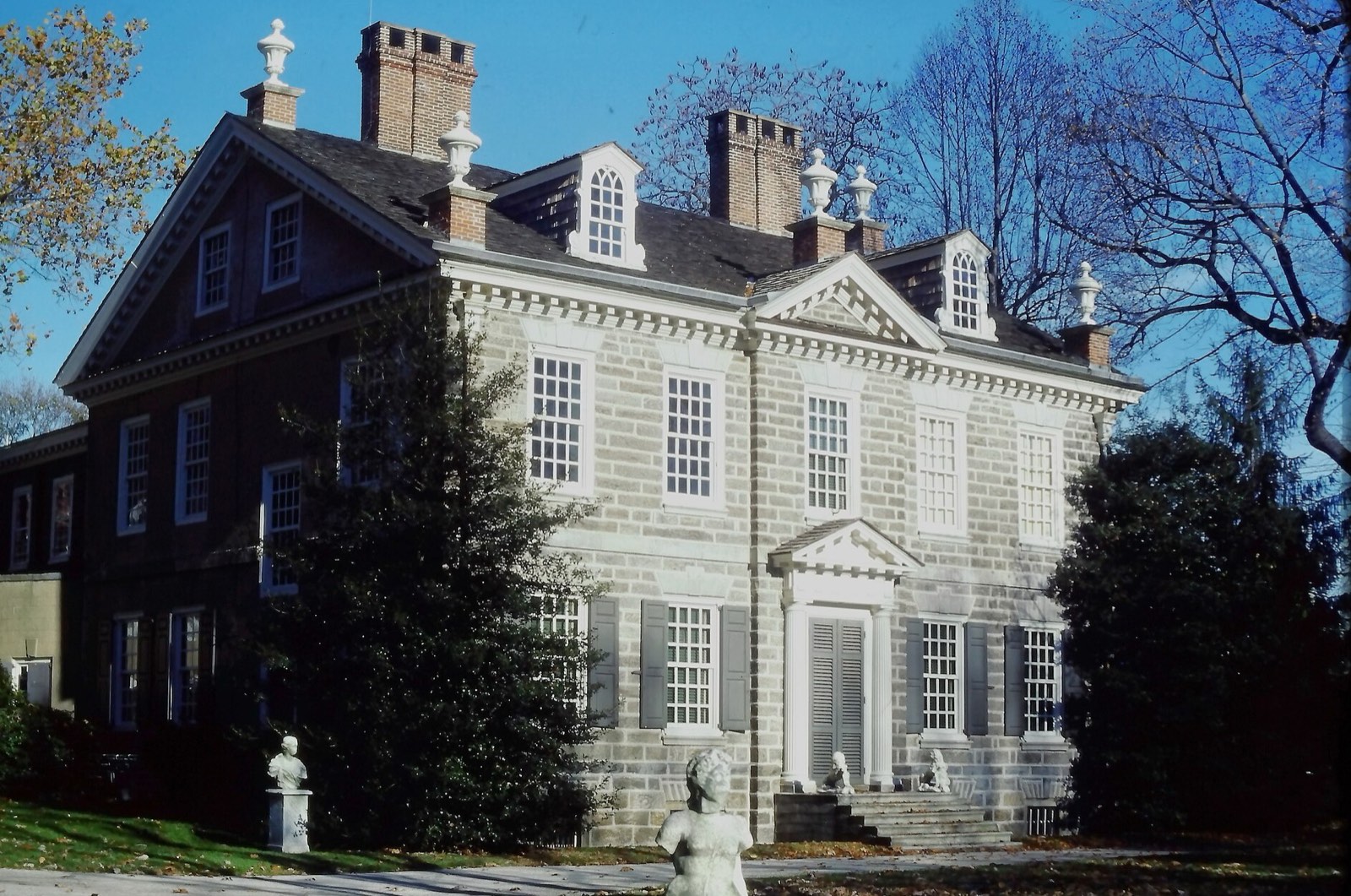
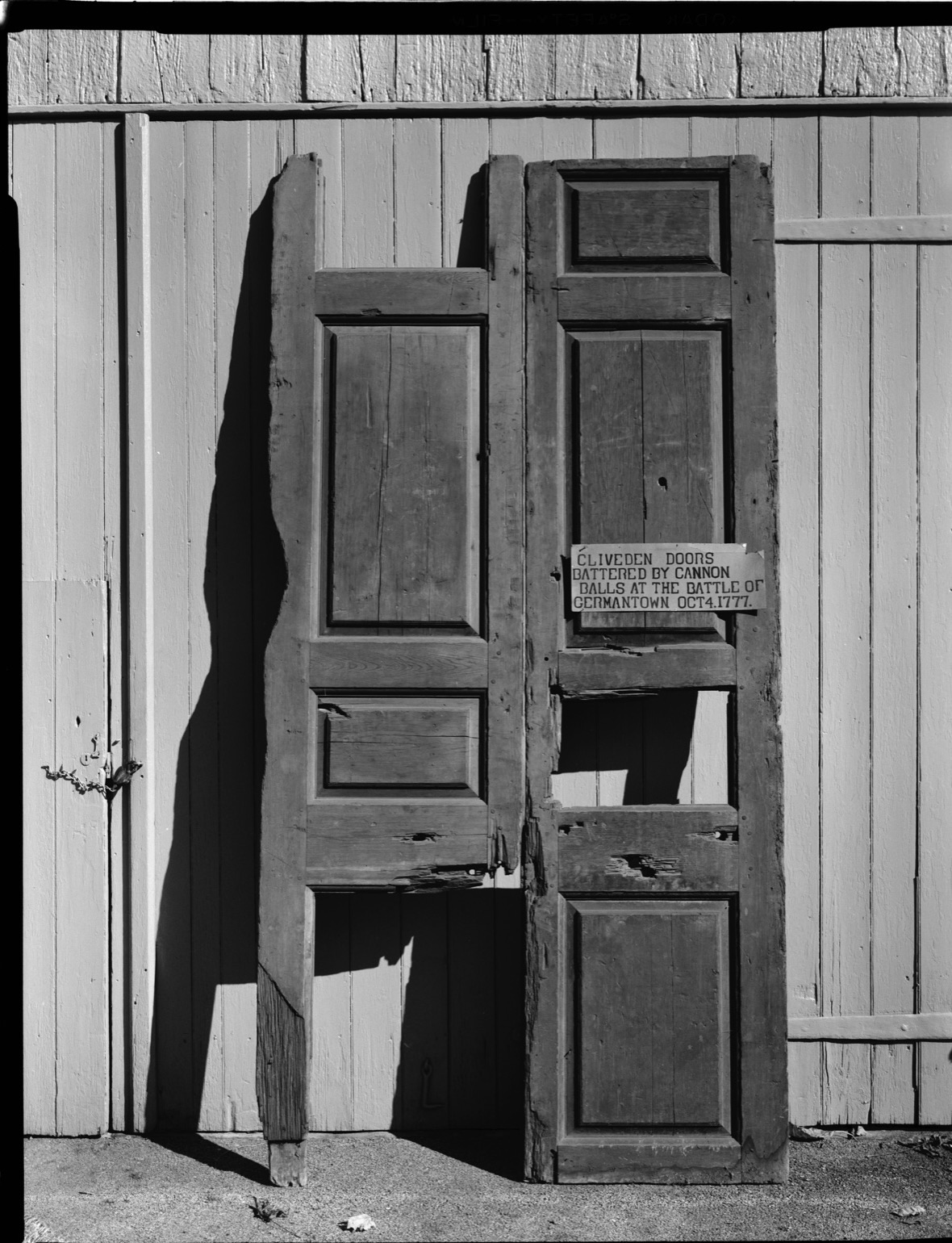
The war story1777: the year of two British armies, and the surrender that bought an allianceThe British took their own legend out of the morning. The defense of the Chew House made Thomas Musgrave, the British lieutenant colonel who had held the house with about 120 men, famous, and Sir George Osborn, later colonel of the 40th Regiment, struck a medal honoring the regiment's stand at Cliveden, among the earliest valor medals in the British Army's history. And the house itself outlasted everyone. Cliveden still stands at 6401 Germantown Avenue in Philadelphia, a National Historic Landmark since 1961, owned by the National Trust for Historic Preservation and run as a museum; the Chew family lived in it for seven generations, until 1972. The battle is still on the building. The doors carry the damage from that October morning, the marble statues in the yard are still chipped where the fire caught them, and every year, on the grounds, the battle is fought again in reenactment.