By the end of September 1777, the American war effort in Pennsylvania looked like a thing in collapse. General Sir William Howe (British), the commander in chief in America, had landed his army at the head of Chesapeake Bay in late August and marched on Philadelphia, the rebel capital and the largest city in America. On September 11 he beat George Washington (American), commander of the Continental Army (the rebels' regular army, as opposed to part-time militia), at Brandywine Creek. On the night of September 20 a British force surprised the division of Anthony Wayne (American) in its camp near Paoli and bayoneted it in the dark, an attack Americans immediately called a massacre. And on September 26 the British marched into Philadelphia itself, unopposed. The Continental Congress (the assembly governing the rebelling colonies) fled, first to Lancaster, Pennsylvania, then on to York. American morale sagged, and desertion was a real problem.
The BattlesBrandywine: the defeat that opened the road to Philadelphia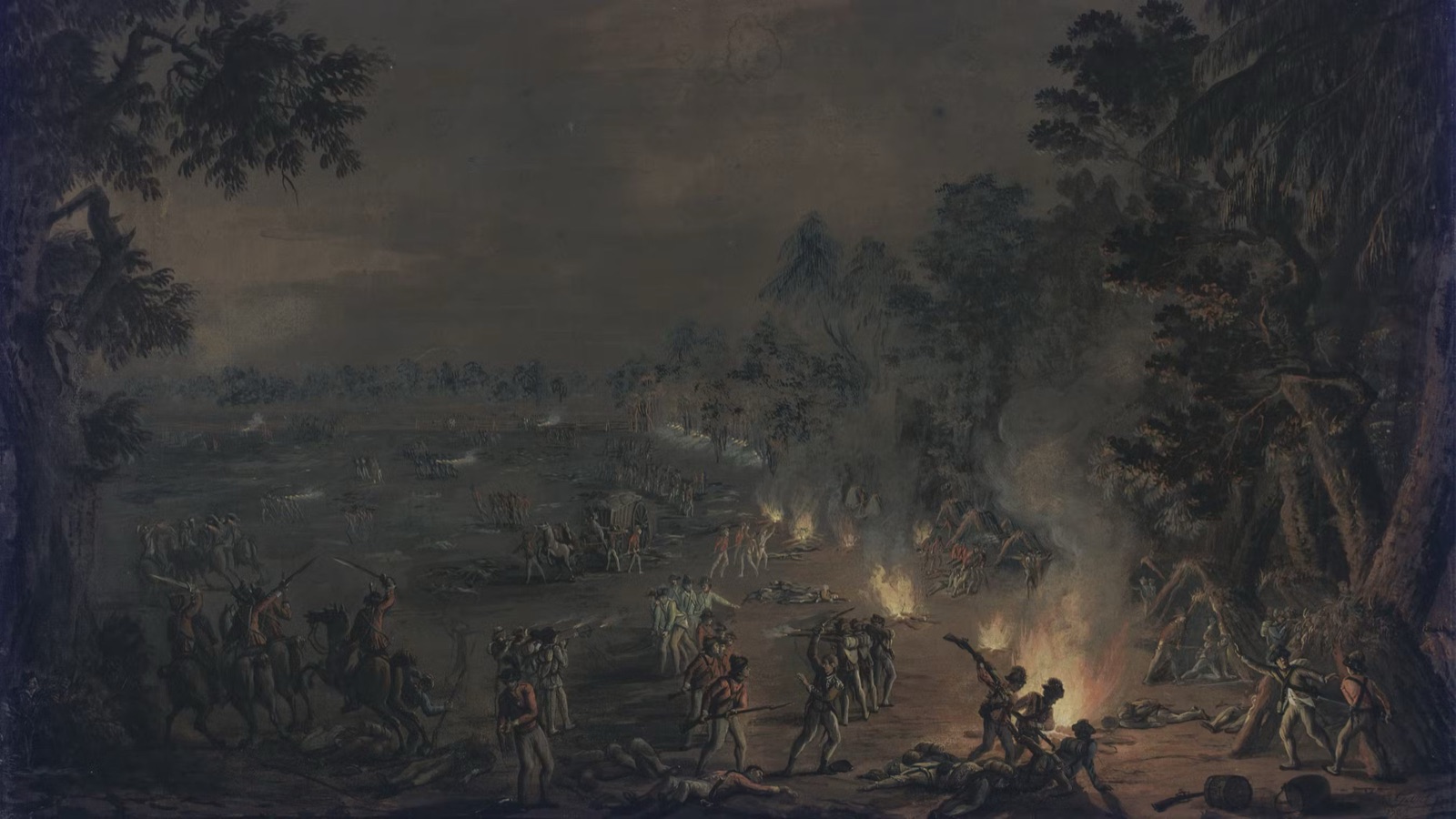
So what does a beaten army do? Here is what this one did. Eight days after losing its capital, it attacked.
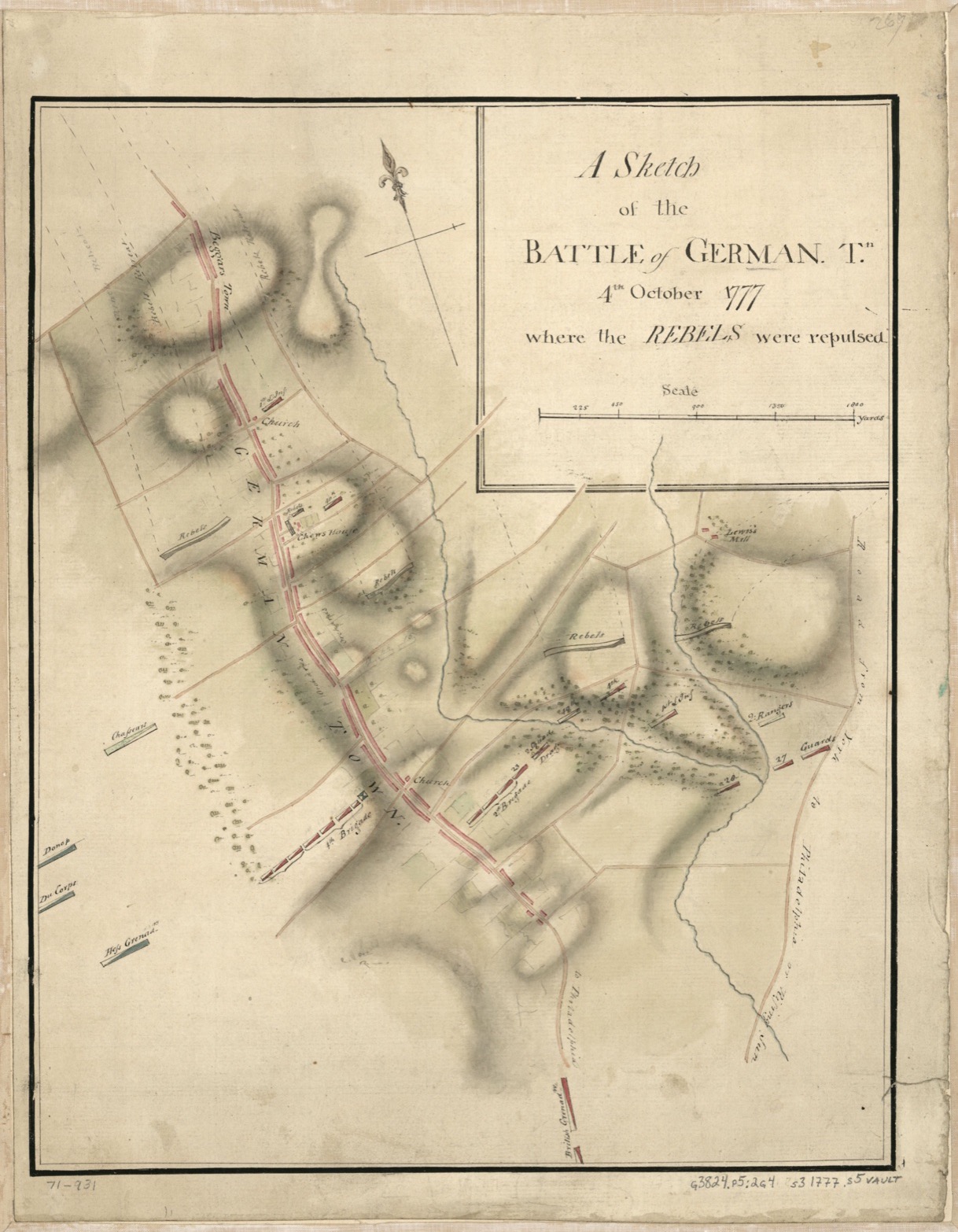
It could even attack with reason, because Howe had handed Washington an opening. The British army did not concentrate inside Philadelphia. Howe posted his main field force, roughly 8,000 to 9,000 men, in a camp strung across Germantown, a village about 5 to 6 miles northwest of the city on the Germantown Road (today it is a neighborhood of Philadelphia). Lord Cornwallis (one of Howe's generals) and several battalions garrisoned Philadelphia proper, other detachments were off escorting supplies up from Chester and operating against Billingsport (a rebel fort on the Delaware River below the city), and every detachment made the Germantown camp a little thinner. And Howe, the man who had won at Long Island, Brandywine, and now held the capital, was confident to the point of carelessness: he built no entrenchments or redoubts (small dirt forts) at Germantown at all. He did not believe the beaten Americans would attack.
Washington knew most of this. At the end of September, intercepted intelligence and deserters told him Howe had detached troops, cutting the camp at Germantown down to that 8,000 to 9,000. His own army, reinforced by Maryland and New Jersey militia and by troops sent down from the Hudson, was back up to about 11,000 men: roughly 8,000 Continentals and 3,000 militia. On September 28 a council of war (a formal meeting of the senior generals) voted to move closer and watch. Then came news of further British detachments, and Washington committed: a dawn surprise attack on the main camp of the army that had just taken his capital.
If the shape of the idea sounds familiar, it should. The winter before, after losing New York, Washington had marched at night and fallen on a sleeping garrison at Trenton, in New Jersey, at dawn. That was the pattern that made him: lose the set-piece battle, keep the army alive, then strike the moment the enemy relaxed. Germantown was Trenton again, scaled up. And the scaling is exactly where the trouble lived. Trenton used 2,400 men in two coordinated columns against an outpost. Germantown asked 11,000 men, including 3,000 part-time militia, to march 14 to 16 miles overnight on four separate roads and hit a 9,000-man veteran army simultaneously at five in the morning, with no way for the columns to signal one another in the dark. Every piece of it had to go right at once, in the dark, on a clock, with no way to know when a piece had gone wrong.
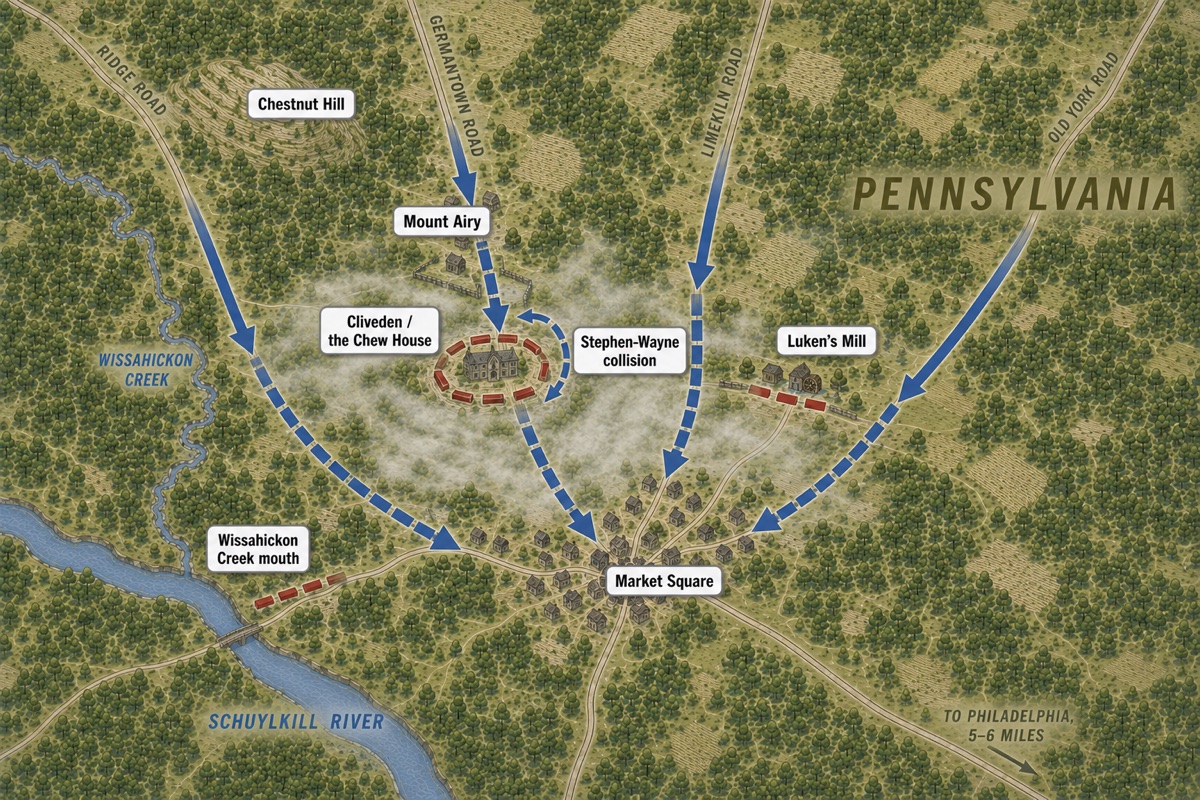
The four columns looked like this. A column here meant a separate marching body of troops, each taking its own road. Down the Germantown Road itself, the spine of the attack, came the main blow: the divisions (the army's big building blocks, a few thousand men each) of John Sullivan (American), the New Hampshire general whose flank had been turned (the British had marched around the end of his line and hit it from the side) at Brandywine three weeks before, and of Anthony Wayne, whose men had been bayoneted at Paoli two weeks before and had not forgotten it, with Washington himself and the reserve (troops held back from the first clash, to be thrown in wherever they were needed) following. On the left, by the Limekiln Road, came the largest column of all, about two-thirds of the Continental infantry, under Nathanael Greene (American), Washington's most trusted subordinate, with the division of Adam Stephen (American), a Virginia major general with an old, prickly rivalry with Washington. On the far right, Pennsylvania militia under John Armstrong would demonstrate (make a threatening show, without pressing a real attack) along the Schuylkill River against the Hessian troops (German soldiers in British service) anchoring the British left. On the far left, Maryland and New Jersey militia under Smallwood and Forman would swing by the Old York Road against the British right and rear. The point of splitting the army four ways was to hit the strung-out British camp everywhere at once, front, both flanks, and rear, so that no part of it could form a line or come to another part's rescue, with everything converging on the market square at the center of the village. Four roads, four columns, one village, one clock.
The orders, issued on October 3, called for all four columns to attack precisely at five o'clock with charged bayonets (the long blade fixed to the muzzle of the musket, a silent weapon for an attack meant to start before the enemy could shoot). And they contained one detail that tells you everything about what this plan was asking: each soldier was to put a piece of white paper in his hat, so that in the dark, at bayonet range, Americans could tell each other from the enemy. An army was marching all night to fight at first light, and it knew it might not recognize itself when it got there.
The army left its camps around Methacton Hill, in Worcester Township about 14 to 16 miles northwest of Germantown, after dusk on October 3 and marched all night. The columns ran late. Dawn found them short of their start lines. And with the dawn came something nobody had planned for: a dense ground fog, settling over the whole field, about to swallow four converging columns that already could not talk to each other. A week later, Washington described in a letter exactly what it did.
Unfortunately, the day was overcast by a dark & heavy fog, which prevented our Columns from discovering each Others movements, and from improving the advantage