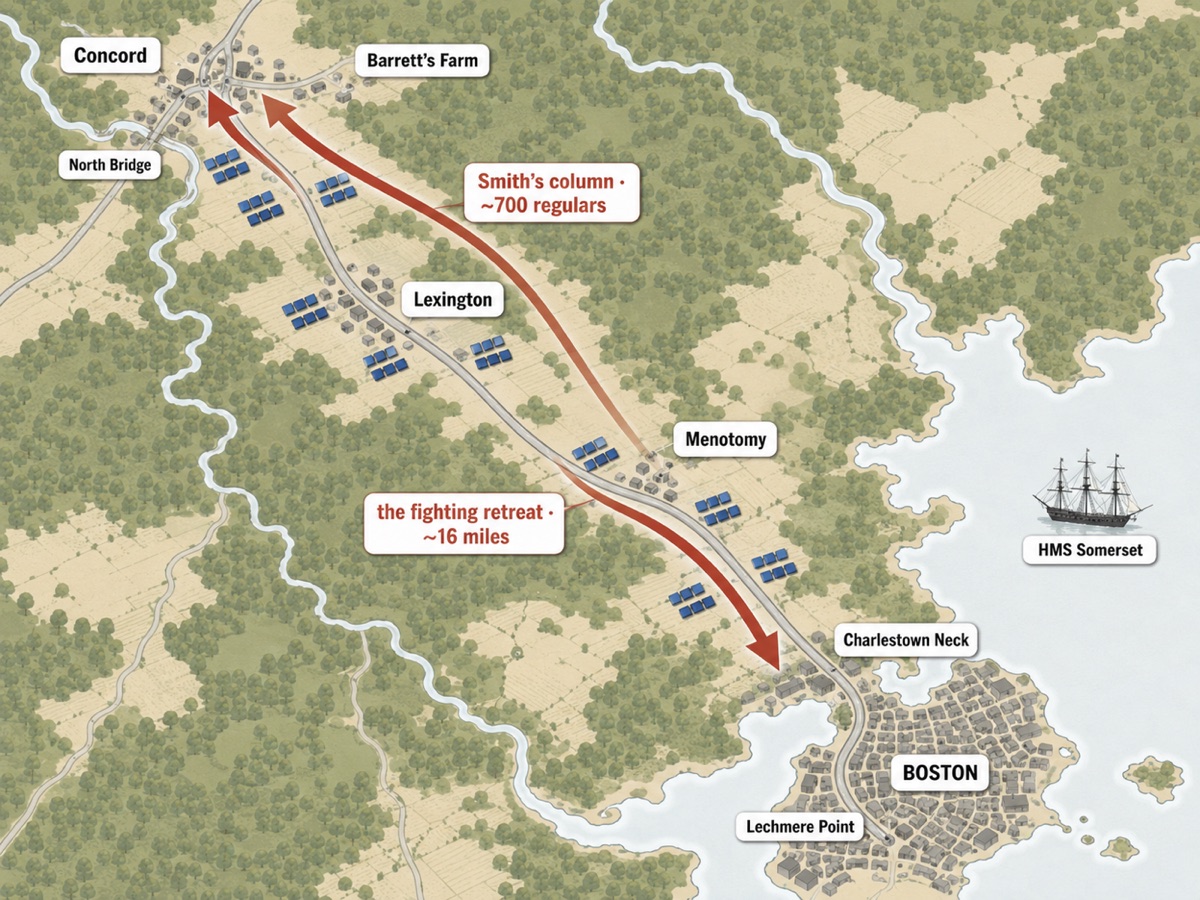
In the spring of 1775 Boston was an occupied city, and very nearly an island: a peninsula town joined to the mainland by a single narrow neck of land. After years of escalating quarrel between Britain and its American colonies, the town was garrisoned by regiments of regulars (the king's professional, full-time soldiers) and a force of Royal Marines (Britain's sea-service soldiers), all under General Thomas Gage (British), and the occupation was exactly the problem it was meant to solve. Outside Boston, the Massachusetts countryside had been organizing for months for the day the troops marched out of it. Every town kept a militia (the part-time citizen soldiery of farmers and tradesmen, mustered into companies under their own officers), and the towns had built a designated rapid-response tier on top of it: the minute companies, roughly a quarter to a third of the militia rolls, picked men expected to turn out at a minute's warning. None of this was spontaneous. It was a system, drilled and re-drilled, waiting for a trigger.
Off the fieldAn army in Boston: the Townshend Acts & the MassacreThe trigger was a warehouse town. The Provincial Congress (the assembly the Massachusetts rebels had set up in defiance of Gage's government) had been stockpiling arms and supplies at Concord, about 18 miles from Boston, and Gage's spies knew it in detail. On the night of April 18 he handed Lieutenant Colonel Francis Smith (British), a heavy, methodical, thirty-year professional of the 10th Regiment of Foot, written orders to take about 700 men drawn from the garrison's grenadier and light infantry companies (the two picked "flank companies" every regiment kept: the grenadiers its biggest men, for assaults; the light infantry its fastest, for skirmishing and flank work) and march on the stockpile.
with the utmost expedition and Secrecy to Concord, where you will seize and distroy all Artillery, Ammunition, Provisions, Tents, Small Arms, and all Military Stores whatever
The spelling is Gage's own. So is the restraint: the same orders told Smith, "But you will take care that the Soldiers do not plunder the Inhabitants, or hurt private property." Gage even specified the method, down to the detail: knock the trunnions (the stub axles a cannon barrel pivots on) off each gun, shake the powder and flour into the river, burn the tents. He attached a map of Concord with the supply caches marked on it, because his spies really were that good. On paper it was a police raid: stores, not people, and no first shot.
The secret leaked before the boats were in the water. Dr. Joseph Warren, the Boston physician at the center of the rebels' intelligence in the city, had a source close to the very top of the British command, and on April 18 he consulted that source before dispatching his riders. Gage later said he had told the full plan to only one person besides his second in command. Who Warren's informant was has never been established. The famous candidate is Gage's own American-born wife, Margaret Kemble Gage, and Gage did send her to England that summer; but the evidence is entirely circumstantial, several specialists call the spy story a myth, and it remains an unproven suspicion, nothing more. The leak is a fact. The leaker is a blank.
Warren sent two riders out ahead of the column by two routes toward Lexington and Concord: William Dawes overland through the town gate at Boston Neck, and Paul Revere across the water by the Charlestown crossing, riding for the Hancock-Clarke House in Lexington, where the rebel leaders John Hancock and Samuel Adams were staying. The two lanterns hung in the Old North Church steeple that night were a pre-arranged backup signal in case neither rider got out, not the message itself. And nobody shouted that the British were coming, because everyone in Massachusetts was still British; the warning that ran ahead of the column that night was that the regulars were coming out. From Lexington, 11 miles up the road from Boston, the word stopped depending on any one man. It propagated through the pre-built system, fresh riders, church bells, signal guns, drums, town to town through the dark. Revere himself was captured in Lincoln (the next town along the road toward Concord) and released on foot; it was Dr. Samuel Prescott who carried the alarm the last miles into Concord. The town's minister, the Reverend William Emerson, recorded it in his diary: "This morning, between 1 and 2 o'clock, we were alarmed by the ringing of the bell." That system, not one horseman, is what put thousands of armed men on the road by morning.
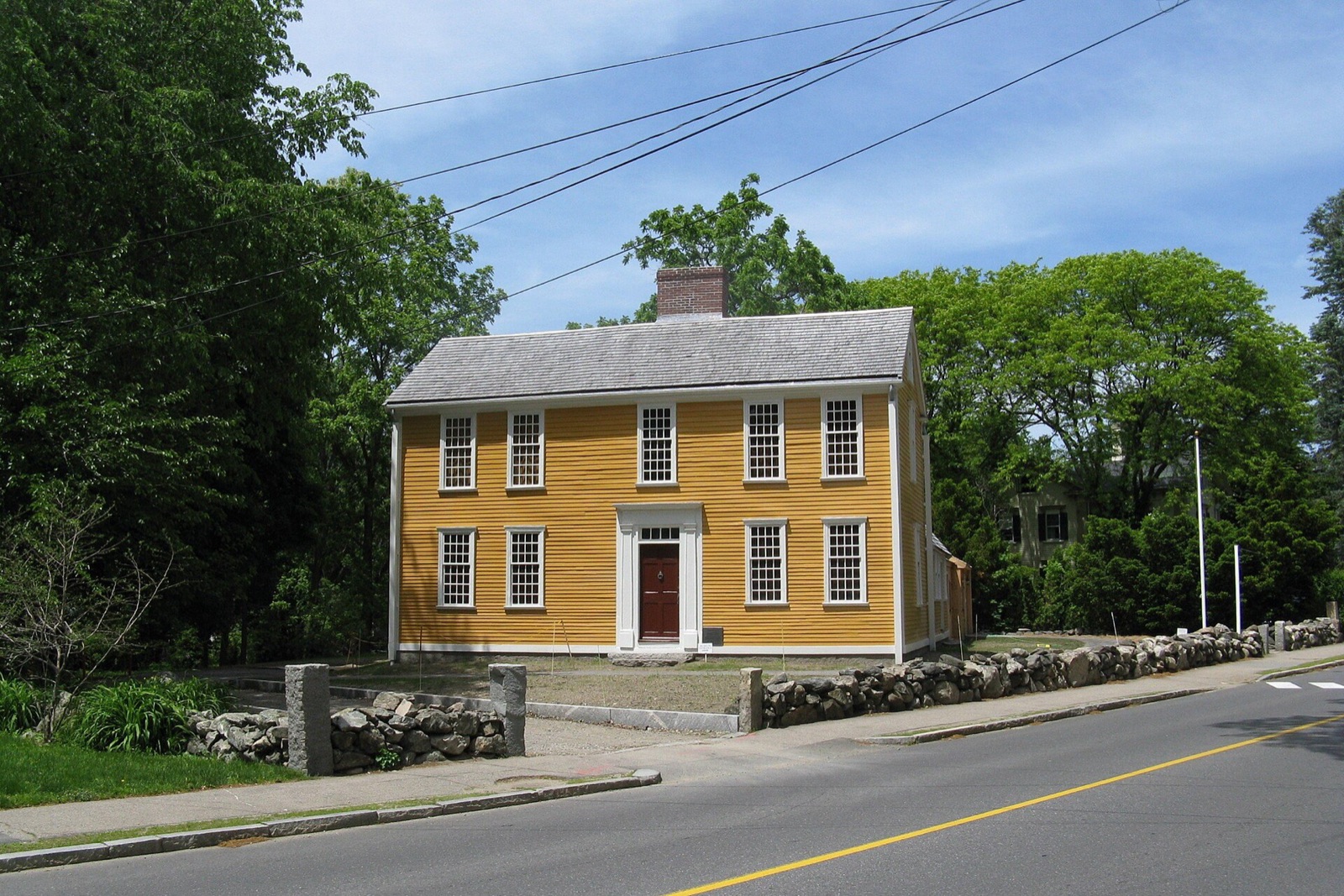
Concord, in truth, had not needed the midnight warning. Revere had ridden out with an earlier alert on April 8, and the Provincial Congress's stores had been dispersing for days, carted off, buried, hidden farm by farm. The regulars were marching all night to raid a warehouse that had been quietly emptying for the better part of two weeks.
The raid itself began badly. The companies mustered on the Back Bay beach of Boston Common around 10 p.m., rowed across the Charles to Lechmere Point in East Cambridge about an hour later (the short way out of the peninsula, skipping the long land march over Boston Neck), waded ashore through the marsh, and then stood soaked in the dark for hours waiting on provisions. The column did not actually march until around 2 a.m., its secrecy already dead. Somewhere on the road, hearing the alarm bells ringing ahead of him in the night, Smith did two smart things early. He sent Major John Pitcairn (British), a Royal Marines officer whom even Bostonians respected as one of the fairer men of the occupation, ahead at speed with six light infantry companies. And he sent a rider back to Gage requesting reinforcements, hours before a shot had been fired. That message would produce a relief brigade out of Boston under Brigadier General Hugh, Earl Percy, and it would save the column's life.