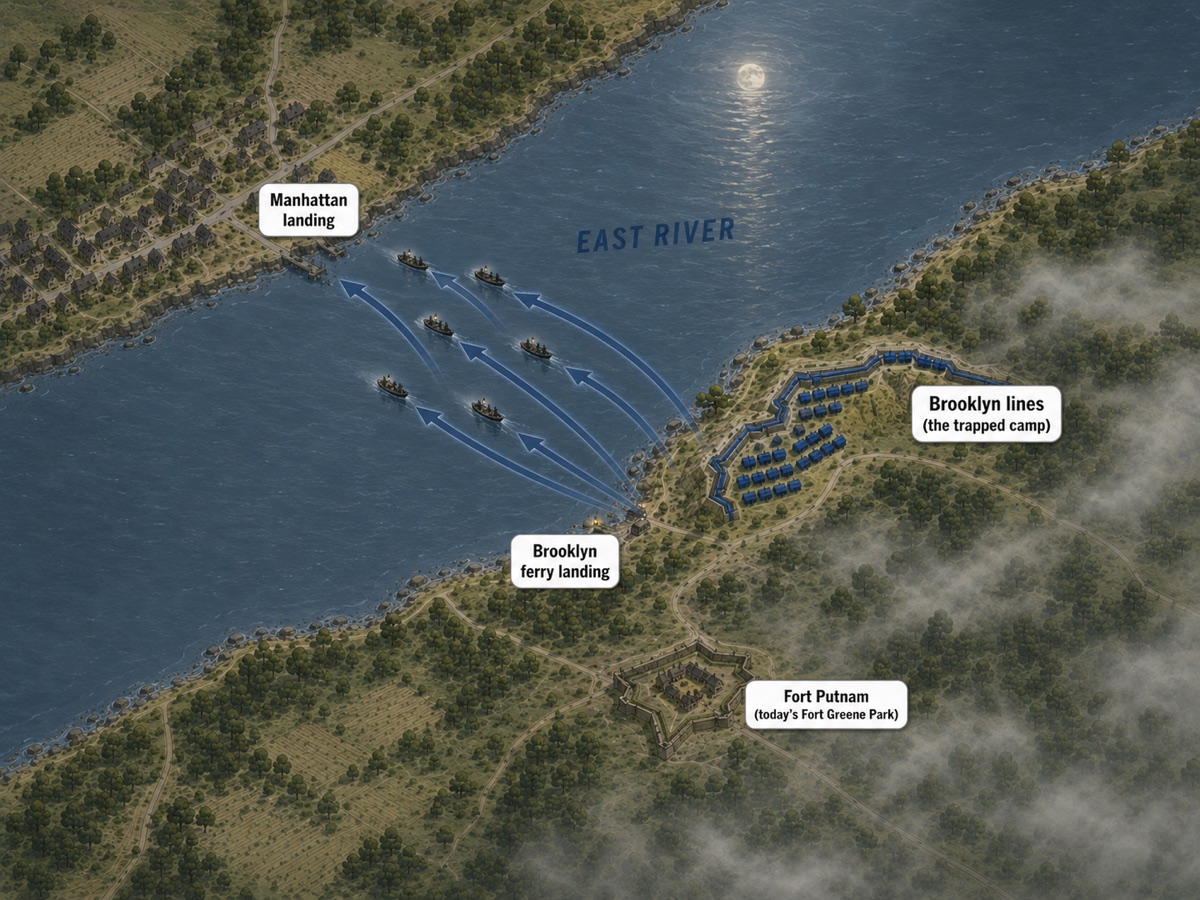
On the evening of August 27, 1776, what was left of the American army on Long Island sat inside its fortifications at Brooklyn, on the high ground across the East River (about a mile of tidal water) from New York City. The forward line on the ridge had been destroyed that morning; a thousand men or more were prisoners, two generals among them. General William Howe (British), rather than storm the works, had begun formal siege approaches, the slow, methodical digging of trenches toward an enemy position. Some 9,500 Americans were penned on a riverbank, and the Royal Navy, the largest fleet ever seen in American waters, lay just around the bend.
What saved them first was weather. On August 28 and 29 a cold nor'easter (a storm blowing from the northeast) sat on New York: driving rain, flooded trenches, men who had not slept in days standing in water without tents or dry gunpowder, while the British siege trenches crept to within about 600 yards. But the same northeast wind that made the camp miserable kept the British warships out of the East River: a sailing ship cannot sail straight into the wind, and the wind was blowing straight down the river against them. George Washington, commanding, actually fed another 1,200 men across from Manhattan on the 28th, still thinking of holding Brooklyn. Then he grasped the real shape of the trap: the moment the wind shifted, British frigates (fast medium-sized warships) would sail into the river behind him, and 9,500 men, the heart of the Continental Army (the new national army), would be sealed in Brooklyn. The war could end there.
On the afternoon of August 29, at about 4:00, a council of war (a formal vote of the senior generals) voted unanimously to withdraw to Manhattan. Orders went out to collect every usable boat on the East River and the Hudson. The troops themselves were told nothing true: the word was that they were being relieved by fresh units during the night. The lie was the point; an army that knows it is retreating in front of an enemy tends to bolt.
From about 9:00 p.m. the regiments began slipping away by detachments, down to the Brooklyn ferry landing, wagon wheels muffled, all talk forbidden. The boats were crewed by Colonel John Glover's 14th Continental Regiment, the mariners of Marblehead, Massachusetts, along with Hutchinson's 27th Massachusetts, fishermen from Salem: sailors and fishermen, in the dark, rowing an entire army with its gear, horses, and cannon across a mile of tidal river, trip after trip after trip. Early in the night an adverse wind nearly wrecked the timetable; around 11:00 p.m. it eased, and the ebb tide (the outgoing tide) and the rain covered the sound of the oars. There was one near-disaster on land: a garbled order pulled General Mifflin's rear guard (the men still manning the fortifications to screen the embarkation) out of the lines hours too early, leaving them briefly empty in front of the British army. The mistake was caught, the men were turned around, and the gap was closed before the British noticed.
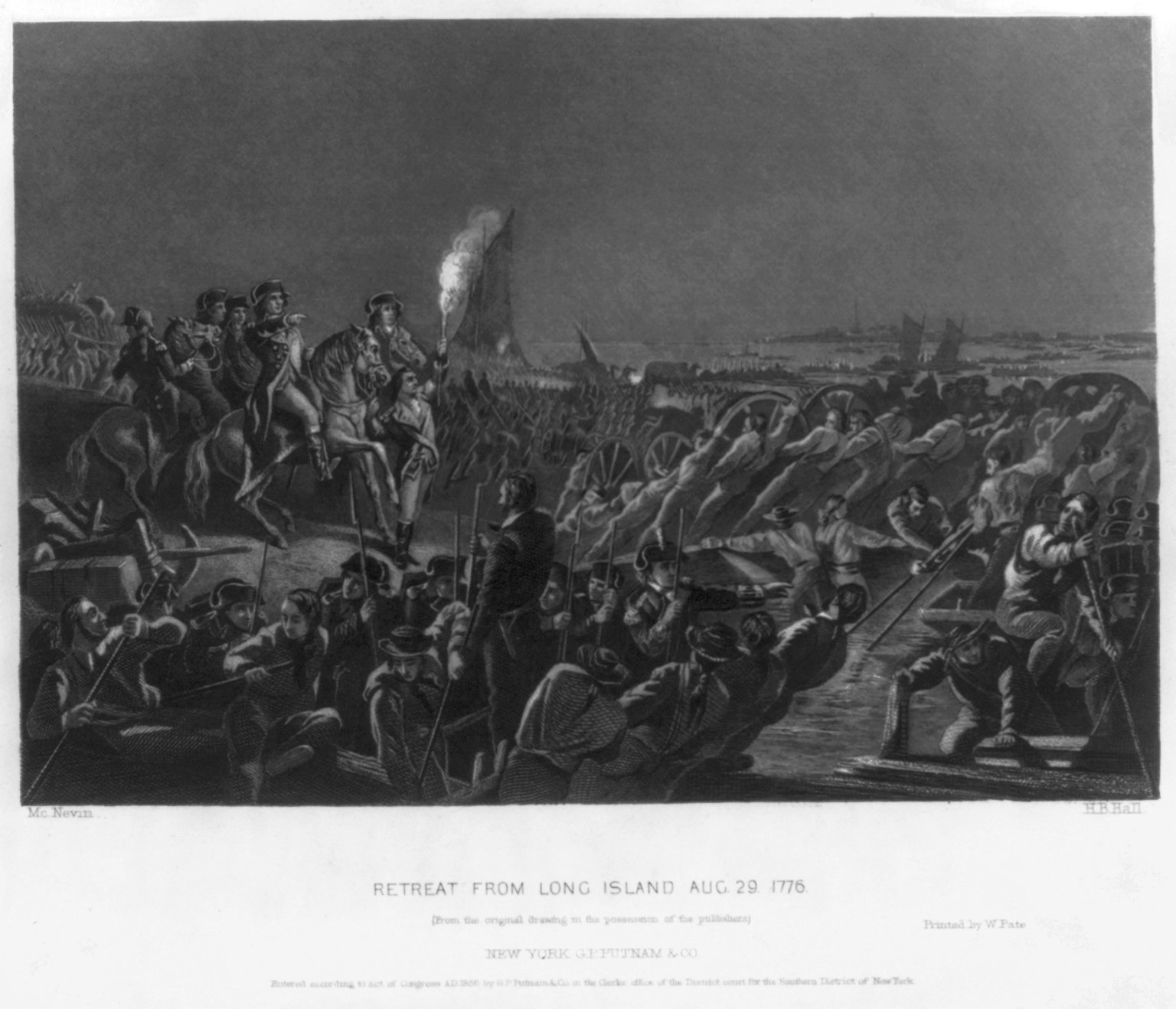
Toward dawn the timetable failed anyway (daylight meant discovery, and discovery meant the lines stormed and the boats shot out of the water). Much of the rear guard was still in the lines as the sky lightened, with the British close enough to hear. And then a dense fog settled over Brooklyn and stayed past sunrise, hiding the last boats on the water. Benjamin Tallmadge, then a young officer in the rear guard (and later Washington's spymaster), described it in his memoir, written in 1858, more than half a century on, so the polish is old age's, but he was there, and he called the fog a peculiar providential occurrence.
At this time a very dense fog began to rise, and it seemed to settle in a peculiar manner over both encampments.
By about 7:00 a.m. on August 30, some 9,000 to 9,500 men were in Manhattan with their field artillery, horses, and provisions. Washington, by tradition, crossed in one of the last boats; "among the last" is as much as the record will bear. The evacuation cost not a single life in the crossing; a few stragglers who stayed behind were captured, and a few heavy cannon, mired in the mud, were abandoned. The British woke on the 30th to empty trenches.
The army had survived, and that was the entire meaning of the Battle of Long Island. Everything else about it was disaster, and the weeks after felt like it. Militia deserted in droves. Washington reported to John Hancock, the president of Congress, on September 2 that "Our situation is truly distressing," and that the militia, far from rallying, were "dismayed, Intractable, and Impatient to return" home. For the captured it was worse: the Long Island prisoners became the first large cohort of New York's prison ships and sugar-house jails, where disease and starvation would kill a large share of them over the years of occupation.
The Howe brothers, who were peace commissioners as well as commanders, tried diplomacy while the wound was fresh. They paroled (released him on his word not to fight until formally swapped) the captured General John Sullivan (American) to Philadelphia carrying an invitation to talk; John Adams, the Massachusetts delegate in Congress, suspecting exactly what the gesture was, called Sullivan a "decoy duck." On September 11 a three-man delegation from Congress (Adams, Benjamin Franklin, and Edward Rutledge of South Carolina) met Admiral Lord Richard Howe, the general's brother, at the Billopp House on Staten Island for three hours and agreed on nothing: Howe could not negotiate with them as representatives of independent states, and they would not renounce independence. The war went on, and 1776 kept getting darker. The British landed at Kip's Bay (on Manhattan's east side) on September 15 and took New York City, which they would hold for seven years, until November 25, 1783. Then came Harlem Heights, the Great Fire of New York, White Plains, the catastrophic surrender of Fort Washington in November with some 2,800 more men captured, and the long retreat across New Jersey, all the way down to the day after Christmas and Trenton, the surprise counterattack that finally turned the war around. The army that won it was the army the boats had carried off Long Island.
For Long Island itself, the battle was not an ending but the start of an occupation, and a reminder that this was a civil war among Americans. It was Loyalist (loyal to the king) intelligence that handed Clinton the unguarded Jamaica Pass, and Loyalist farmers who guided the night column; the old Dutch farming towns of Kings County and the people of Queens County leaned toward the Crown. After the battle, New York and Long Island became the great Loyalist haven of the continent, and Oliver DeLancey, a New York Loyalist grandee, was commissioned a brigadier and raised three battalions heavily recruited from the island. The occupation cut both ways: seven years of requisitions and billeting (supplies seized, soldiers quartered in private homes) fell on the island's farms, Loyalist and Patriot (supporter of independence) alike, and many Patriots from Suffolk County, at the island's eastern end, fled across Long Island Sound (the water between the island and Connecticut) to Connecticut, turning the Sound into a raiding zone of whaleboat warfare.
One American general was still to fall. Nathaniel Woodhull of the New York militia, captured east of the lines on August 28 while rounding up cattle, was badly cut up by his captors and died of his wounds on September 20.
Off the fieldLoyalist against Patriot: a civil war among themselves