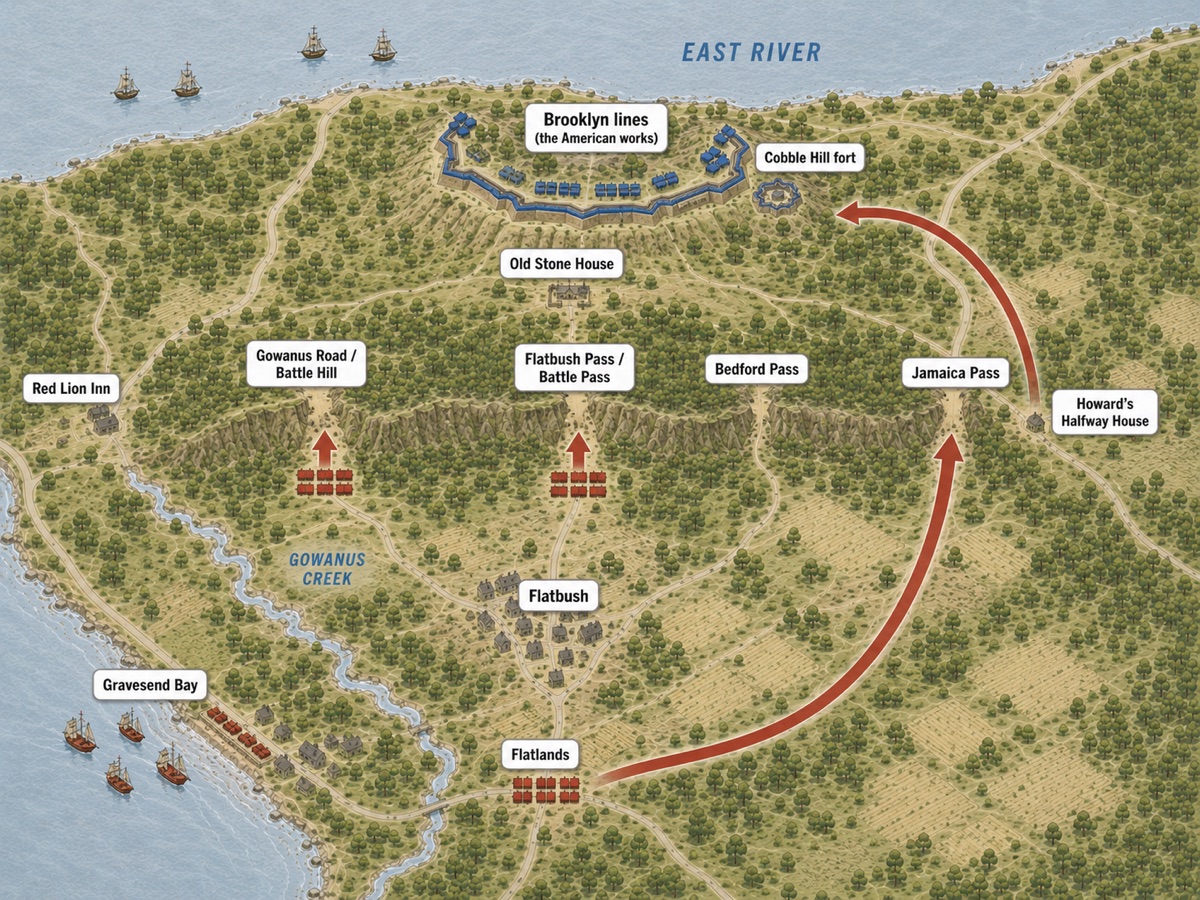
On the night of August 26, 1776, the American army on Long Island was watching the wrong doors. Some 20,000 British and Hessian (hired German professional) troops were ashore, facing the American fortifications at Brooklyn, across the East River from New York City, and between the two armies ran the Heights of Guan, a long wooded ridge an army could cross only at its passes: the Gowanus Road along the shore, Flatbush Pass and Bedford Pass in the center, and the Jamaica Pass far to the east, 3 miles from the main American line. The Americans had 3,000 to 4,000 men forward on the ridge under General John Sullivan (American), with pickets (small guard detachments posted out front to give warning) on the first three passes. At the Jamaica Pass they had five militia (part-time citizen soldier) officers on horseback.
Henry Clinton (British) knew what that meant. Clinton had grown up partly in New York, where his father had been royal governor, and local Loyalists (Americans loyal to the king) told him the Jamaica Pass was essentially unguarded. He proposed the kind of move armies attempt only in books: march the main body all night, around the far end of the American line, and appear behind it at breakfast. General William Howe (British), commanding, adopted the plan. Major General James Grant (British) with about 5,000 men would demonstrate (make a loud, threatening show of attack) against the American right on the shore road, and the Hessians under Lieutenant General von Heister would do the same at Flatbush Pass in the center, while roughly 10,000 men and 14 guns walked around the left.
The column set out from the village of Flatlands at about 9:00 p.m. on August 26: Clinton's vanguard (the lead element) in front, then Lord Cornwallis (British), Howe himself, and Lord Percy (British) bringing up the rear, moving northeast by back roads with Loyalist farmers as guides. Around 2:00 or 3:00 in the morning they reached a tavern near the Jamaica Pass called Howard's Halfway House, woke the tavern keeper, William Howard, and compelled him and his son to guide the army by a footpath around the pass. That scene comes down to us from the Howard family's own much-retold account, written down decades later, so the dialogue is tradition rather than record. The bones of it are solid: a tavern keeper and his son walking at the head of a British army.
The five mounted American officers watching the pass were captured without a shot fired; they mistook the British column for Americans. By dawn the army was through the ridge, and by about 8:30 or 9:00 a.m. on August 27 it stood at the village of Bedford, squarely behind Sullivan's line. Two signal guns boomed at about 9:00, telling Grant and the Hessians to turn their demonstrations into real attacks. Through the whole night, an army of 10,000 men had marched across the American front, and no one on the American side ever detected it.
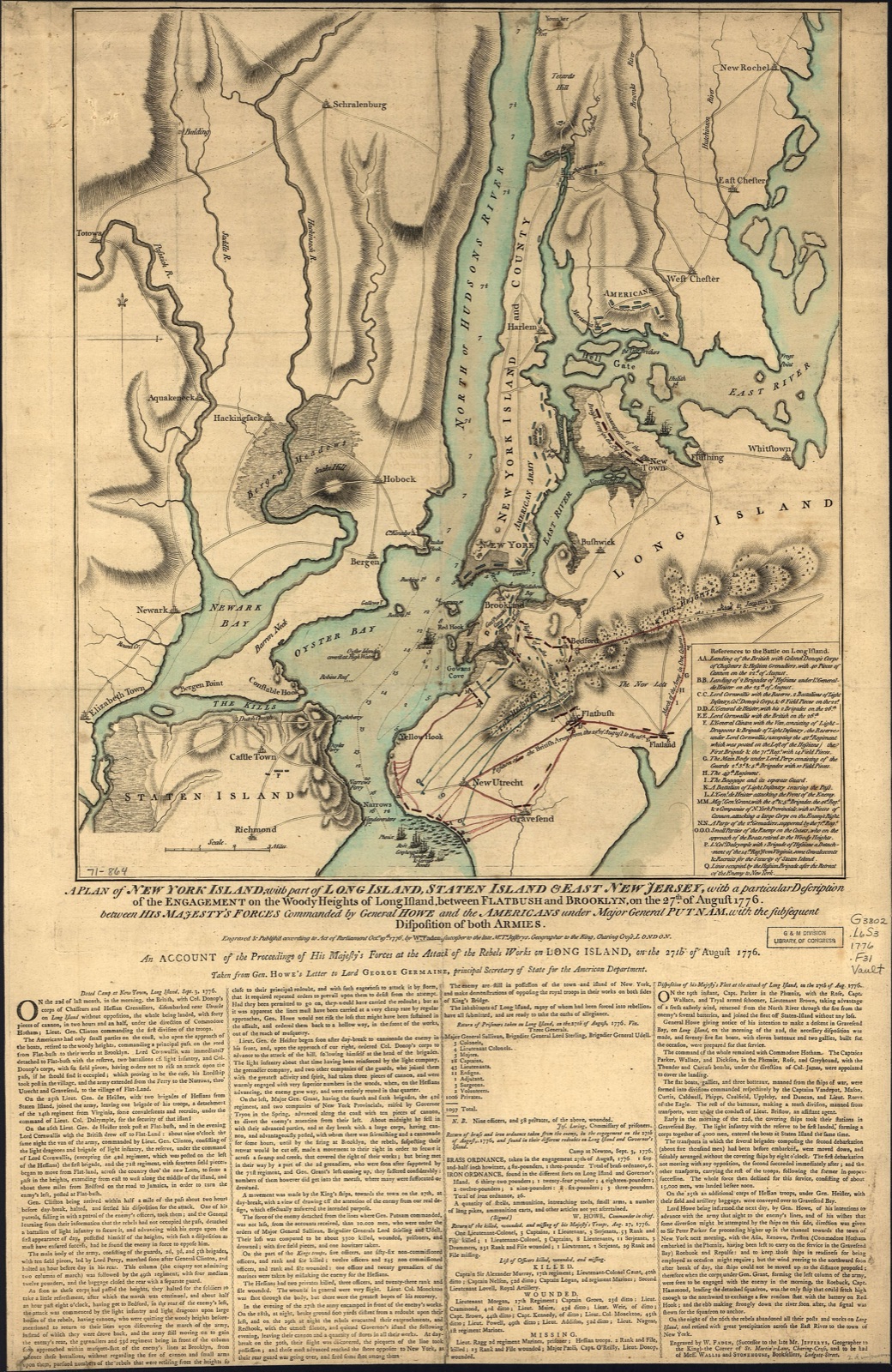
The diversion, meanwhile, had been burning since the small hours. Around midnight Grant's advance ran into American pickets near the Red Lion Inn on the shore road, and General Israel Putnam (American), commanding on Long Island, sent Lord Stirling (American), a New Jersey general who claimed a disputed Scottish earldom, down the Gowanus Road with about 1,600 men to block it. From dawn Stirling's line on the slopes, anchored by Smallwood's Maryland and Haslet's Delaware regiments (the best-trained troops in the American army, though both colonels happened to be in Manhattan that day at a court-martial, a military trial), stood up to Grant for hours in formal, open-field European style. Grant, under orders to pin rather than press, was happy to oblige. The Marylanders believed they were facing the very man who had boasted in the House of Commons the year before that with 5,000 regulars (full-time professional soldiers) he could march from one end of America to the other, a boast that is reported speech rather than transcript, but one the Americans knew and hated. Grant had, at that moment, almost exactly 5,000.
At the 9:00 a.m. signal the trap closed. Von Heister's Hessians came up Flatbush Pass from the front while British light infantry and grenadiers (the army's fast-moving skirmishers and its biggest assault troops, the elite of both kinds) rolled in from Bedford, directly behind Sullivan's position. For the men on the ridge, the first sign was musketry from the wrong direction: behind them, between them and home. The center broke. The fighting in the woods turned hand-to-hand, clubbed muskets and bayonets, and fleeing companies had to run a gauntlet of fire for miles back to the Brooklyn fortifications. Sullivan was captured, by tradition taken by three Hessian grenadiers in a cornfield. Some of the ugliest evidence of the morning comes from the winners' own mail: British and Hessian letters home boast of bayoneting rebels as they tried to give up, and the American camps filled with stories that the Hessians took no prisoners, stories that panic and propaganda swelled past anything that could be counted, though the letters needed no swelling. One British officer wrote home plainly.
The Hessians and our brave Highlanders gave no quarters, and it was a fine sight to see with what alacrity they dispatched rebels with their bayonets, after we had surrounded them so that they could not resist.
By late morning Stirling, still trading massed musket fire with Grant, was nearly surrounded: Grant in front, Hessians on his right, and Cornwallis's reserve now planted on the Gowanus Road behind him, at a stone farmhouse called the Vechte–Cortelyou house (the site of today's Old Stone House in Brooklyn). Stirling ordered the bulk of his command to escape the only way left, across the Gowanus marsh and its mill creek, about 80 yards of water. Imagine being one of them. You have been fighting since before dawn, the firing is now behind you as well as in front of you, and the only way out is water: you go in, mud pulling at your knees, the creek in the middle deep enough to drown in, men on either side of you wading and swimming the same 80 yards while the volleys keep coming. Most made it. Some men drowned trying.
Then Stirling personally led the rear guard (the detachment that stays behind, still fighting, so the rest can get away), roughly 260 to 270 men of Smallwood's Maryland battalion under Major Mordecai Gist, in repeated charges against Cornwallis at the house. An anonymous American account, written days later and secondhand, which is as close as the record gets, has George Washington, the army's commander-in-chief, watching from the Cobble Hill fort inside the lines, wringing his hands and crying out, "Good God! What brave fellows I must this day lose!" Stirling himself, refusing to hand his sword to the British, broke through the ring and surrendered to the Hessian commander von Heister instead. A Brooklyn historian, Thomas W. Field, wrote in 1869 that the Marylanders' stand bought an hour more precious to liberty than any other in history; a historian's verdict, not a participant's, but it has stuck.
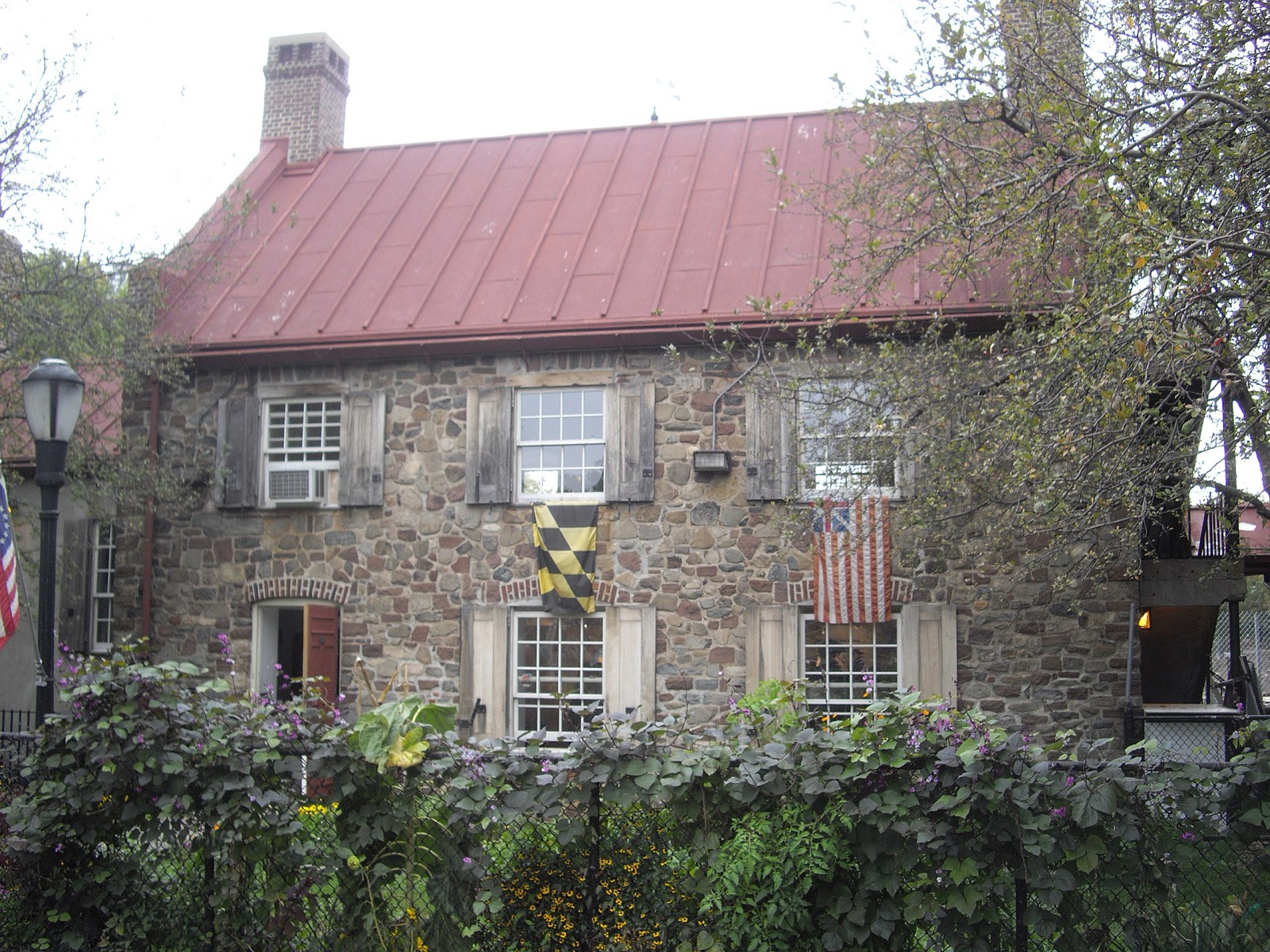
Posterity calls them the Maryland 400. The arithmetic is messier than the legend: the rear guard was about 270 men, not 400, and the famous figure of 256 killed comes from a report of killed and missing combined (the original casualty list is lost; later research showed many of the "killed" had actually been captured). What is true is brutal enough. The rear guard lost roughly two-thirds of its men killed, wounded, or captured, and only Gist and a handful of others, somewhere around a dozen, cut their way back to the American lines that day. Where the Maryland dead lie, nobody knows. A local tradition from the 1860s points to a mass grave on Third Avenue, but a 1957 survey and a 2017 archaeological dig found no human remains there, and period accounts suggest many of the dead were barely buried where they fell, still visible in the fields months later. The burial site is genuinely unknown.
By early afternoon the survivors of the forward line were inside the Brooklyn fortifications with their backs to the East River, and the Americans had lost a thousand men or more as prisoners, including two generals. Clinton and Cornwallis wanted to storm the works at once and end it. Howe said no, and ordered formal siege approaches (the slow, methodical digging of protected trenches toward an enemy position) instead.