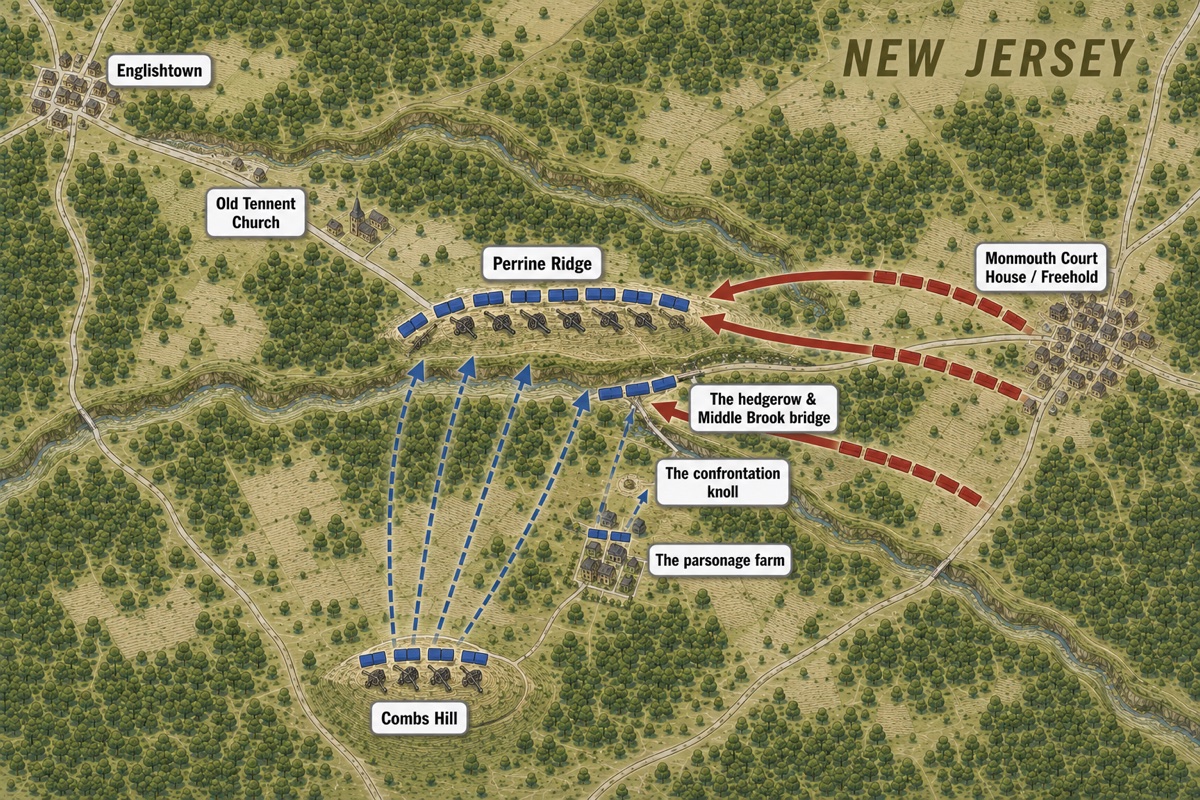
Clinton's column began pulling out of its camp at Monmouth Court House toward Middletown in the small hours of June 28, somewhere between two and four in the morning. That was the moment to strike the rear, and Charles Lee (American), commanding the vanguard (the forward attack force) of about 4,500 men, moved out from Englishtown, a village a few miles west where the vanguard had camped, to do it, with George Washington (American) and the main body of some 7,800 following four to six miles behind. The lead detachments skirmished near a brook around eight o'clock, and the battle opened in heat that was already climbing toward 100 degrees.
It came apart almost at once. Lee found what he took for a British rearguard of fifteen hundred to two thousand men near the courthouse and improvised a plan to swing around and cut it off, Wayne pinning it in front while the rest looped to the left. He did not explain the plan to his own subordinate generals, which mattered, because the rearguard was not a rearguard. Warned that his column was being attacked, Clinton turned Cornwallis's entire first division, ten thousand of his best troops, around and brought them back. As the British strength swelled in front of them, American generals who had been told nothing began to react on their own. Scott and Maxwell (two of Lee's brigade commanders, told nothing of his plan), uninformed and afraid of being cut off, pulled their men back without orders. Lafayette's part of the line shifted. Wayne's force was suddenly hanging in the air. And Lee, his plan in pieces and his command seemingly unraveling on its own initiative, ordered a general retreat westward, back past the courthouse.
The retreat was not a rout, and this is the part the legend always forgets. The vanguard fell back about three miles in generally good order, in heat now near 100 degrees, and lost only about a dozen men doing it. An army that had not spent the winter under Steuben would have dissolved; this one withdrew like soldiers. Steuben's drill was visible even in the failure. Lee's real sins were of a different kind. He communicated no plan, organized no stand at the strong defensive ground of the ravine lines he was falling back through, and, the worst of it, sent no word back to Washington, who was at that moment marching the main body forward into what he still believed was a developing attack. At one farmhouse, told the main body was still two miles off, Lee said, by the trial record, "that he really did not know what to say."
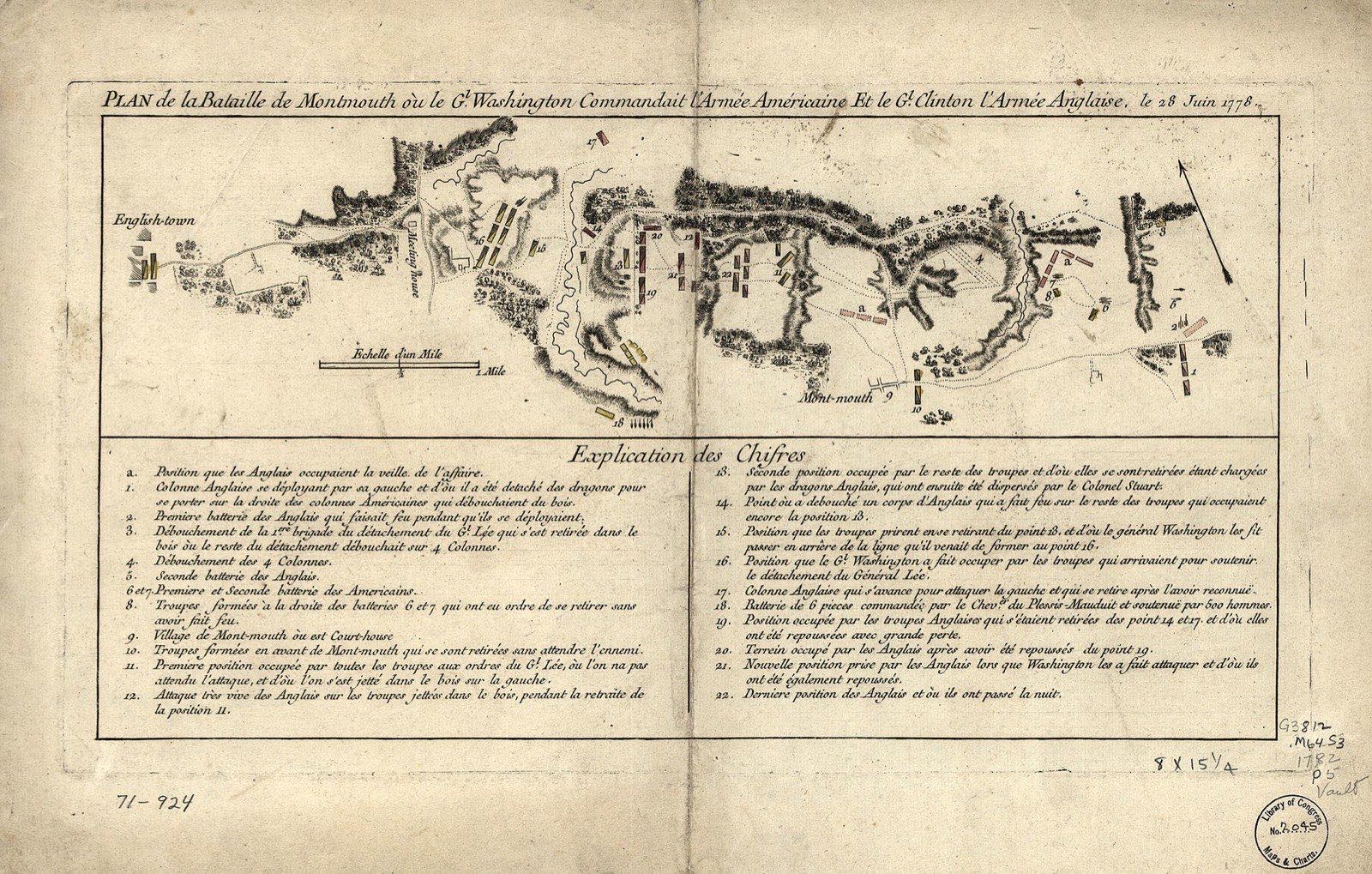
What Washington knew, riding ahead of his column, was nothing. The first he learned of any retreat was when he began meeting his own soldiers walking the wrong way. For Lee, the next minutes were the worst a soldier can face: he had read the British strength correctly and built a retreat that did not dissolve, and now, with his plan in pieces and Cornwallis's ten thousand somewhere behind him, he had to meet his commander in chief with no plan communicated and no explanation that would serve. Washington rode on and found him with the tail of the column at a low knoll just west of the Middle Brook crossing. What happened there is the most famous moment of the war and the most worked-over, and it is worth being careful about exactly what the evidence is, because two very different versions have come down.
Here is the version the evidence supports, the one set down within weeks by the men who were close enough to hear. Before seven staff officers, Washington demanded an explanation. By the sworn court-martial testimony of his aide Tench Tilghman, the words were these.
I desire to know, sir, what is the reason — whence arises this disorder and confusion?
Lee, caught flat, could manage only "Sir? Sir?" before he found his footing and began to explain: contradictory intelligence, Scott's withdrawal made without orders, his own openly stated belief that fighting a general action here was a mistake. Washington's reply, as the witnesses pieced it together, was that whatever Lee's private opinion, he had expected his orders to be obeyed, and that he was sorry Lee had taken the command at all unless he meant to fight. The witnesses described considerable heat, real anger. Not one of them recorded a single oath.
That last point matters, because the other version, the one most people know, is that Washington swore at Lee with such force, in Charles Scott's much-quoted line, that "he swore on that day till the leaves shook on the trees," and called him a "damned poltroon." Those stories are almost certainly invented. They first surface forty-six to eighty years later, from men who were not there: Scott was half a mile away with his brigade, and his line was first printed in 1860; Lafayette's "poltroon" version comes from table talk on his old-age tour of America, decades after the fact, and his own 1779 memoir has no swearing in it at all. Against them stands the sworn testimony of seven officers within weeks, recording anger and no profanity, and one witness more decisive than any of them: Charles Lee himself, who spent the rest of his life itemizing every grievance against Washington and never once claimed he had been sworn at. What Lee did say, in his own defense, was that "the manner in which he expressed them was much stronger and more severe than the expressions themselves." Careful modern scholarship has come down hard on the side of the record: Washington was furious, and Washington was not profane.
And then, contrary to the way the scene is usually staged, Washington did not order Lee off the field. He gave him a choice: command the delaying action right here, or go back and organize the rear. Lee chose to stay and fight, and he fought a creditable rearguard action of about half an hour at the hedgerow (a brushy fence line) with the troops at hand, buying time while Washington galloped back to throw the main body into a line. Then Lee withdrew across the bridge as ordered, was sent to organize the reserve at Englishtown, and was relieved there a couple of hours later by Steuben. The cashiering everyone imagines, the general publicly stripped of his command in the middle of the battlefield, did not happen. What happened was worse for Lee, and slower: he would do it to himself, in writing, over the next two weeks.