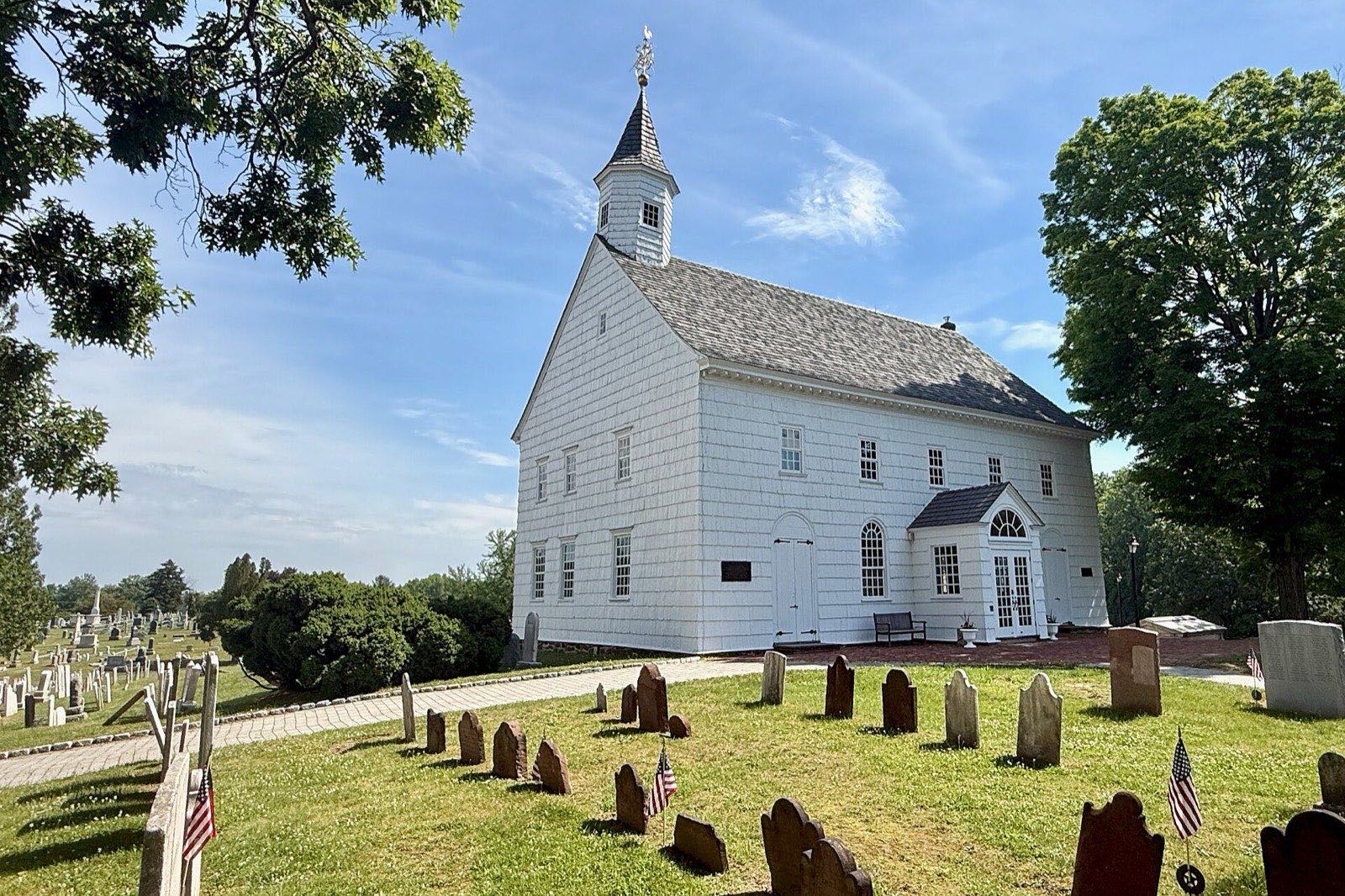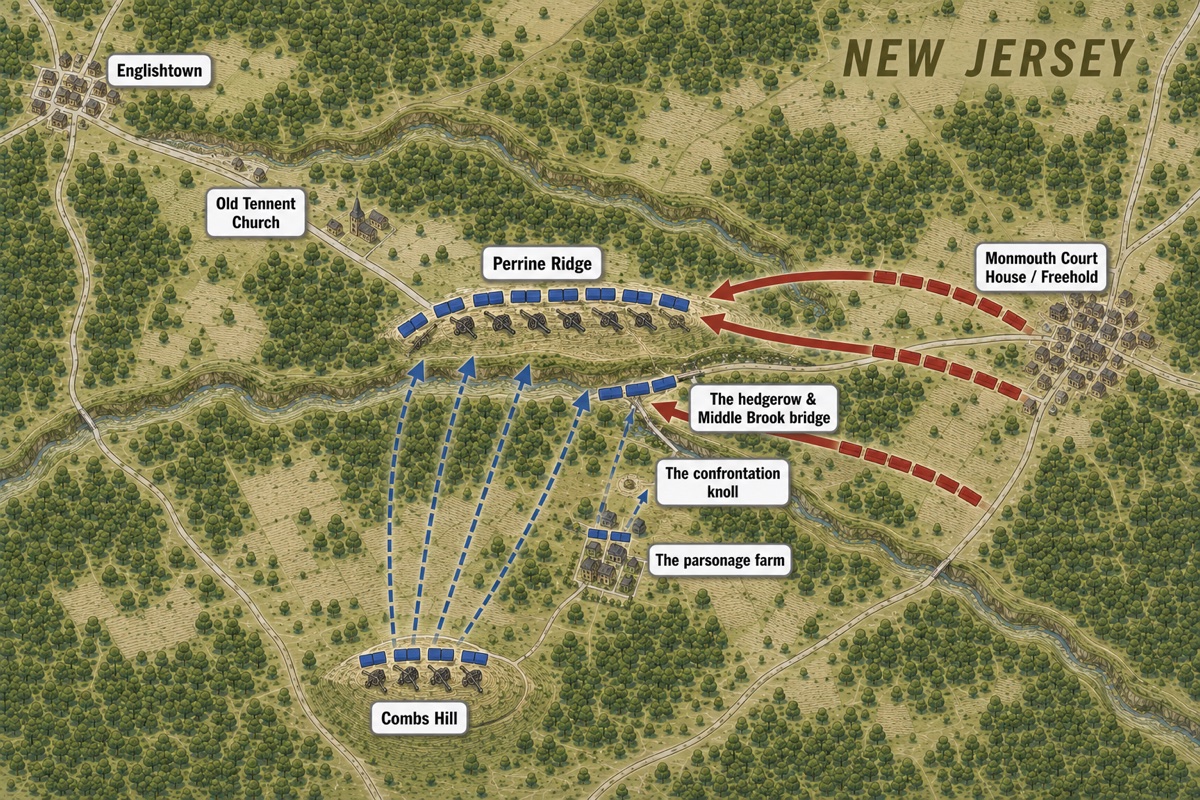
The ground west of Monmouth Court House is cut by three wooded ravines, swamp-bottomed and choked with brush, the beds of Spotswood's brooks. They run across the line of march, which makes them miserable to attack over and excellent to fight behind, and George Washington (American) put his line behind them. On the left, on a rise called Perrine Ridge, William Alexander, Lord Stirling (American) massed the artillery and the infantry of the left wing. On the right stood the wing of Nathanael Greene (American). Forward of the line, covering the bridge over the Middle Brook, Anthony Wayne (American) held a brushy fence line called the hedgerow, with the Point of Woods beyond it. The Marquis de Lafayette (American) formed the second line. And across the southern ravine, on a height called Combs Hill, Greene planted Henry Knox's guns where they could fire down the whole length of any British line that tried to form, the single decision that would settle the afternoon.
Against this came the best infantry in the British Army, and they came hard. Lord Cornwallis (British), who commanded the British first division, pushed his elites straight at the new line: the light infantry (fast-moving skirmishers who fought in loose order ahead of the main line) and the 42nd Foot, the Black Watch (a famous Highland regiment), against the American left; the Guards (the army's household regiment, its most socially prestigious troops) and the grenadiers (historically the men who threw grenades, kept on as the biggest, most experienced heavy infantry in each regiment) against the hedgerow and the center. Wayne's forward men were driven out of the Point of Woods. The fight at the hedgerow was close and bloody. The push against Stirling's wing on the left ran into massed guns and steady infantry volleys and stalled. By about two in the afternoon the British assault had spent itself against the ridge, and the battle settled into the thing Monmouth is most remembered for after the legends: a long, pounding artillery duel.
For roughly two hours, better than a dozen guns on each side hammered across the open plain, about 1,200 yards of it (nearly three-quarters of a mile), between Perrine Ridge and the British positions near the hedgerow. By tradition it was the largest field-artillery exchange of the war, though that is the kind of superlative that gets attached to a lot of battles, so call it one of the largest. What is certain is that for all its noise it killed fewer men than the weather did. The guns and the sun were working in parallel: men loaded and fired in heat that was killing other men thirty yards off who had simply stopped moving, on both sides at once. Because the real killer that day was not the cannon. It was the heat.
It was somewhere in the mid-90s, with claims that it touched 100 degrees, and no shade and no rest. Men dropped in the ranks and on the march and died where they fell, the wool-coated British grenadiers worst of all. Clinton's own casualty return listed 59 men dead "of fatigue," meaning heatstroke, not a wound among them. About a third of the German troops were overcome. American heat deaths ran to dozens. "More men died of the heat than of the fighting" is the kind of line that sounds like exaggeration and, by many accounts of this particular day, simply was not.
It is into this cannonade, exactly here, that the most famous legend of the battle belongs, and it deserves to be told straight, because the truth of it is better than the myth. The story everyone knows is Molly Pitcher: a woman named Mary Hays carrying water to the gun crews in the heat, who took her fallen husband's place at his cannon when he went down and served it for the rest of the day, and was thanked by Washington himself afterward. Almost none of that can be supported. No source from the time names any "Molly Pitcher," and no source from the time names Mary Hays. The name appears in print only decades later, and it was attached to a real Pennsylvania woman, Mary Hays McCauley, around 1876, more than forty years after she died; her own 1832 obituary says nothing about a cannon, or water, or any such name. Scholars treat "Molly Pitcher" as a composite, a kind of folk shorthand for the many women who followed the army and worked at the edge of its battles.
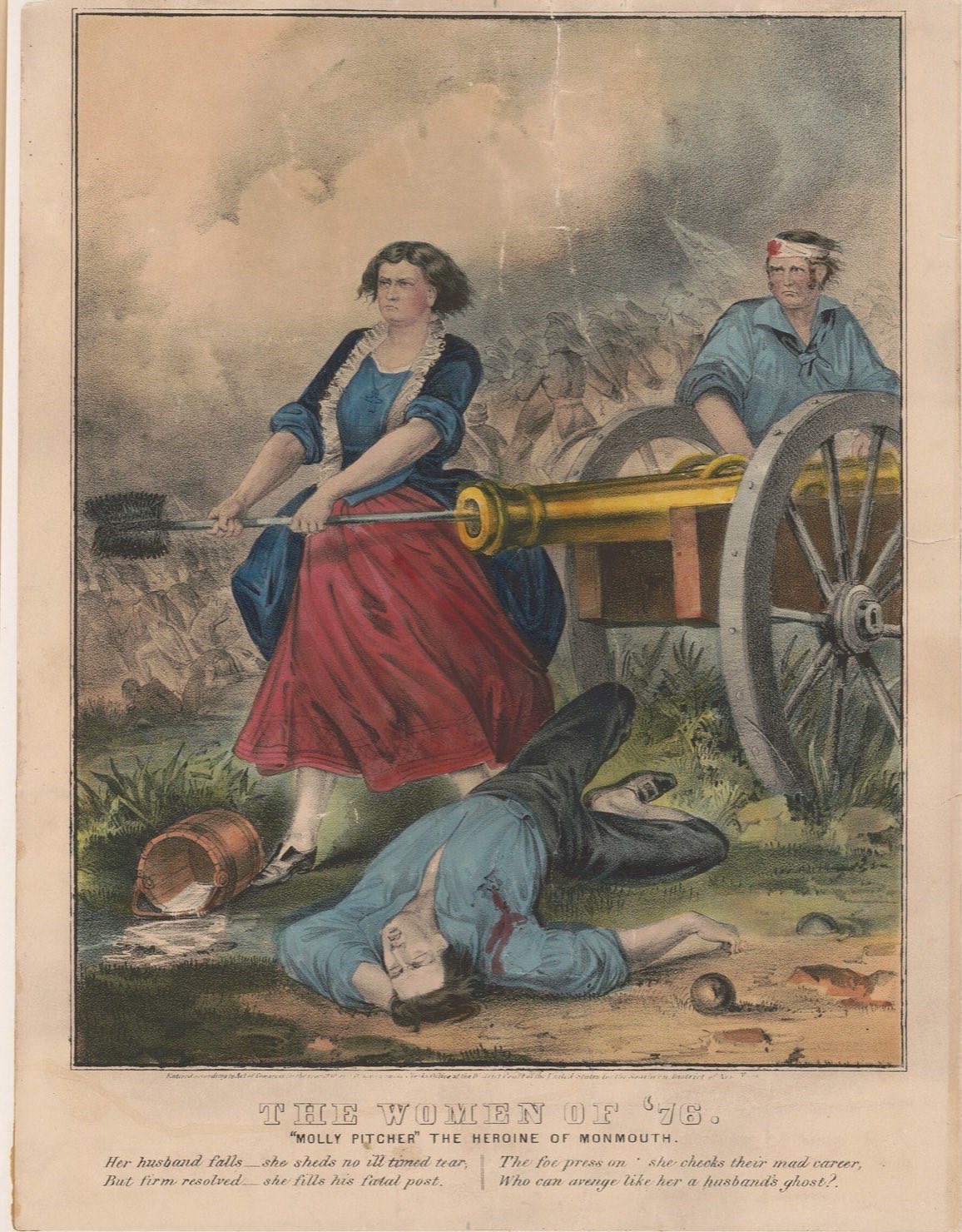
But women were at the guns' edge at Monmouth, and the near-contemporary evidence for it is real and vivid, and that is the part worth keeping. A surgeon named Albigence Waldo wrote in his diary, days after the battle, of "one of the camp women" whose man was shot down beside her: "she immediately took up his gun and cartridges and like a Spartan heroine fought with astonishing bravery, discharging the piece with as much regularity as any soldier present." And the soldier Joseph Plumb Martin, in a memoir published long after, described an unnamed woman who attended with her husband at the piece the whole time, serving at a cannon when an enemy round shot passed clean between her legs, carrying away the lower part of her petticoat, which she looked at, by his account, with apparent unconcern. Neither man names her. One describes a musket, the other a cannon. What they document is not a single heroine with a nickname but something truer and stranger: that on this murderous afternoon, women were in the fire alongside the men, and at least one of them, when her man fell, picked up his weapon and kept fighting. The Pennsylvania legislature, decades later in 1822, did pension Mary Hays McCauley by a special act that pointedly changed the bill's reasoning from a soldier's-widow's relief to her own service during the war. That much is on the record. A specific woman at a specific gun, commended by Washington, is not.
The war story1777: the two British armies and the surrender that bought the alliance now playing out across New JerseyThe thing that finally broke the British attack came from Combs Hill. Around a quarter to four, Greene's guns up on that height opened on the flank of the British line, firing down its length, and there was no answer to it. Clinton had to pull his own artillery back and his infantry into whatever cover they could find. The American edge in the duel was now decisive, and with it the initiative changed hands. Clinton began to disengage, and Washington did something this army had never done at the end of a battle: he attacked. Colonel Joseph Cilley (one of the American commanders on the field) took about 350 picked men up a ravine and drove the 42nd Highlanders out of an orchard in a sharp stand-up fight. Wayne crossed the bridge with roughly 400 Pennsylvanians and tore into the rearmost grenadier battalion at the parsonage farm, where the British Lieutenant Colonel Henry Monckton (British), leading the grenadiers, was shot dead, the highest-ranking British officer to fall at Monmouth. When a fresh British regiment counterattacked, the Combs Hill guns covered Wayne's men as they pulled back. As the light went, the armies stood about a mile apart, and Washington's evening probes were halted by darkness before they made contact.
His troops slept on their arms on the ground they had held, and Washington meant to renew the battle at dawn. He did not get the chance. Around midnight Clinton's division marched, screened and silent, and by morning had rejoined Knyphausen's train near Middletown. The British reached the Sandy Hook area in the first days of July and were ferried across to New York, safe in the city before the French fleet ever arrived off the coast. Washington, with an exhausted army and bad ground ahead, declined to chase, and turned north toward the Hudson. The Philadelphia campaign was over, and so, though no one announced it, was the era of big set-piece battles between the two main armies in the north.
The American side chose to read the draw as a triumph, and not without cause: Clinton's own secretary admitted that "the Rebels stood much better than ever they did." What was not over, though, was the matter of Charles Lee. Two days after the battle, Lee wrote Washington an extraordinary letter, demanding to know what exactly he was accused of, blaming the "dirty earwigs" he imagined whispering around the commander, insisting his own maneuvers had actually saved the army, and accusing Washington of "an act of cruel injustice." Washington replied coldly that the letter's tone was highly improper and that Lee would have the inquiry he was asking for. Lee fired back demanding a court-martial, and Washington granted it by placing him under arrest, the formal procedure for suspending an officer from command while charges were heard, not a cell. The trial ran from July through August on three charges: disobeying orders by not attacking, misbehavior before the enemy in making "an unnecessary, disorderly, and shameful retreat," and disrespect to the commander in chief in those letters. The court convicted him on all three, but it half-flinched on the one that stung most: it struck the word "shameful," which carried the charge of cowardice, and allowed that the retreat had been disorderly only "in some few instances." The sentence was suspension from command for one year. Congress confirmed it that December by a narrow vote.
Historians have argued about that verdict ever since, and it was probably the army choosing Washington more than clean justice. The historian John Shy put the politics of it plainly: "Under the circumstances, an acquittal on the first two charges would have been a vote of no-confidence in Washington." The trial record itself shows a retreat that was mostly orderly and may well have saved the vanguard; Lee's genuine failures were his silence toward Washington and his prickly, plan-it-myself conduct before the battle, not cowardice and not treason. Some modern scholars think the disobedience charge had real substance; others think the whole thing was a political conviction. What is not in doubt is what it did to Lee. He kept attacking Washington in print, called the official account of the battle "a most abominable damn'd lie," was wounded in a duel by one of Washington's aides over it, and in 1780 got himself thrown out of the army for good with a final insulting letter to Congress. He died in a Philadelphia inn in 1782, broke and bitter. His will asked that he not be buried in any church or churchyard; his friends buried him in Christ Church's yard in Philadelphia anyway, in an unmarked grave.
After Monmouth, no one inside the army seriously questioned Washington's command again. The draw on the field read, on the American side, like a victory, and worked like one: Congress voted its thanks "for the important victory of Monmouth over the British grand army," the press celebrated, and the year ended with "Father of his Country" current in print. The strategic truth was a wash. Clinton had saved his army and his wagons and gotten them to New York, exactly as he set out to do. But the army Steuben had drilled all winter had stood for a full day in open field against the best regiments Britain had, finished the day advancing, and slept on the ground it held. Half of those men were recruits who had enlisted only since January, carrying nothing onto the field but the training; what the drill produced was an army that did not just hold but ended the day moving forward. That was the thing the winter had been for, and at Monmouth, in front of the whole country, it was made good. Whether it settled anything about who would finally win the war, no one on either side that July yet knew.