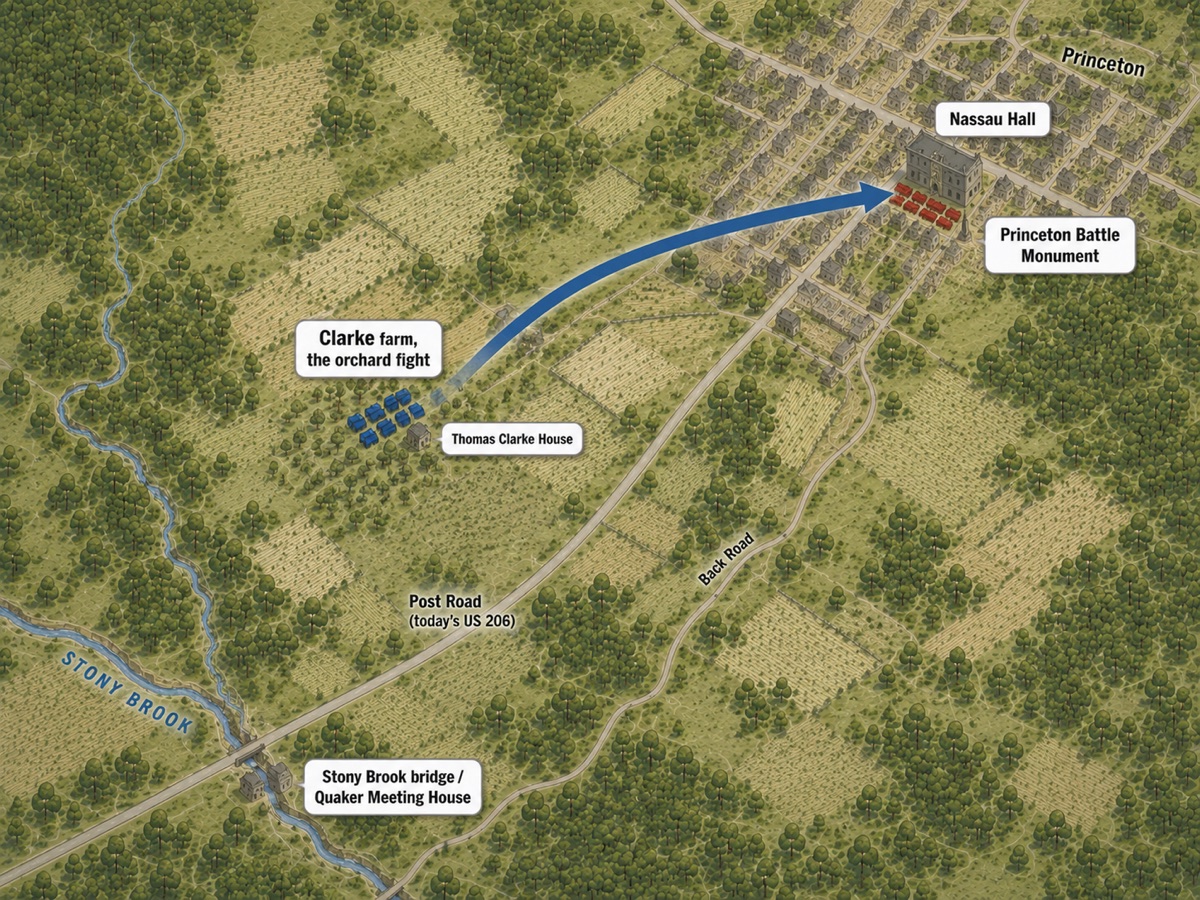
Through the night of January 2–3, 1777, the American army was somewhere it had no business being. Trapped the evening before against Assunpink Creek at Trenton by a British army under Lieutenant General Charles, Earl Cornwallis, George Washington's Continentals (the rebels' full-time regular soldiers) and militia (the part-time citizen soldiers) had left their campfires burning behind them and marched a dozen frozen miles by back roads around the British flank, aiming for the lightly held British post at Princeton. The icy march ran late. Sunrise on January 3, a clear, hard-frozen morning, caught the army still short of the town and split into two wings. Major General John Sullivan took the main body right, angling toward Princeton's back side. A smaller wing under Major General Nathanael Greene peeled left toward the Post Road (the main Trenton highway) with an errand: break the bridge over Stony Brook and block the road Cornwallis would come back on.
At that same hour, the British garrison commander, Lieutenant Colonel Charles Mawhood, was marching the 17th Regiment of Foot (an infantry regiment) and part of the 55th OUT of Princeton, down that same Post Road toward Trenton, under orders to join Cornwallis. In the low winter sun, each column spotted the other across the fields near William Clarke's farm, about a mile and a half (2.4 km) southwest of town. Neither commander had expected the other to exist. Mawhood could have run for it. Instead he turned his column around and went straight at the strangers on his flank.
Washington detached Brigadier General Hugh Mercer's brigade, about 350 men, to deal with the British, and Mercer ran head-on into the 17th Foot at the edge of Clarke's orchard. The two lines traded volleys (massed simultaneous musket fire) at close range across a fence line. The Americans got off heavy fire, but many of them carried rifles (hunting weapons, accurate but slow to load and fitted with no bayonet, the long blade on the muzzle of a military musket), and Mawhood ordered a bayonet charge. The 17th came through the orchard with the blades, and Mercer's line broke. Mercer's horse was shot from under him, and on foot among the enemy he refused to surrender, laying about with his sword. Accounts say the British called on the cornered officer to yield; some traditions hold that they took him for Washington himself. He was clubbed down and bayoneted repeatedly, and left for dead in the orchard. Colonel John Haslet of Delaware, trying to rally the brigade, was shot through the head and killed. Captain Daniel Neil of the New Jersey artillery was bayoneted at his guns.
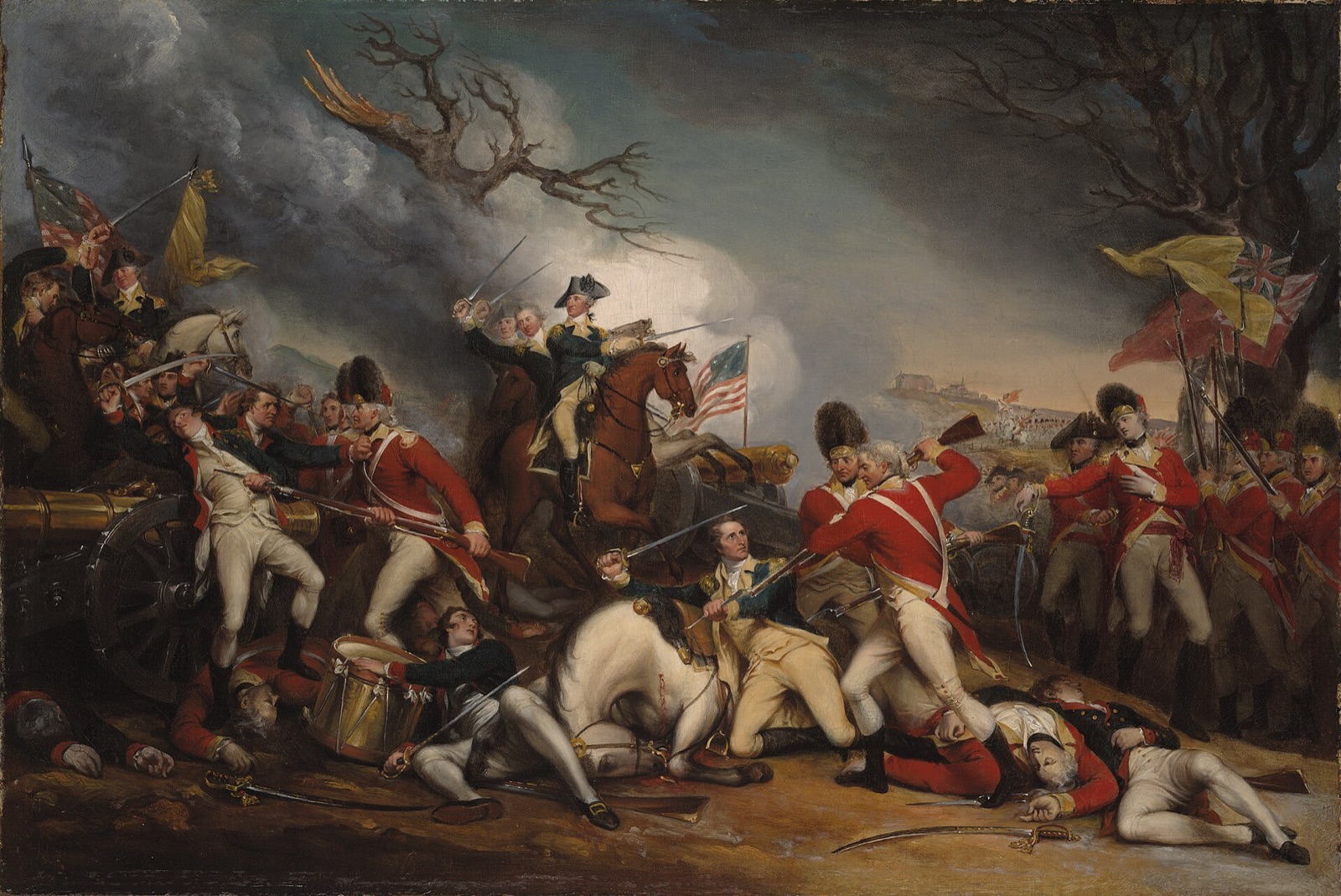
The break spread. Mercer's men streamed back into the militia coming up behind them, Brigadier General John Cadwalader's Philadelphia Associators (the city's volunteer militia), who came apart in turn under fire, and for a few minutes the whole American left was on the edge of rout, with Captain Joseph Moulder's two four-pounder cannon (light guns firing four-pound balls) blasting grapeshot (clusters of small iron balls, a giant shotgun blast) to hold the British line off. This is the moment the winter turned. Washington galloped up with reinforcements, Hitchcock's New England Continentals and Colonel Edward Hand's Pennsylvania riflemen. He rode out in front of the wavering militia and reined up, by the accounts of men in the line, within about thirty yards of the British line. He is said to have called, "Parade with us my brave fellows! There is but a handful of the enemy, and we shall have them directly!" The Americans came forward, and a volley crashed out from both sides with Washington between them. One nineteenth-century anecdote has his aide John Fitzgerald pulling his hat over his eyes, certain the general was down, until the smoke thinned and the general was untouched, waving the line on. The words of the rally are a later memory; the ride between the lines is not. Men who stood in that line reported it, and one of them painted it: Charles Willson Peale, a militia lieutenant in Cadwalader's ranks, wrote in his diary that his company
stood the Fire without regarding [the] Balls which whistled their thousand different notes around our heads
Outnumbered now and flanked (attacked from the side), the 17th Foot finally broke, and even then Mawhood did not surrender it. He cut his way out down the Post Road toward Trenton with another bayonet charge and saved a good part of his regiment, a performance admired on both sides of the field. The official dispatch of General William Howe (the British commander in chief in America, Cornwallis's superior) praised the brigade's "Gallantry and good Conduct," and Washington, writing to Congress two days later, said the British regiments, "especially the Two first, made a gallant resistance." The Americans pressed the pursuit briefly. James Wilkinson, who was there, remembered Washington calling out, "It is a fine fox chase, my boys!" as the chase went down the road; Wilkinson wrote that memory down thirty-nine years later in a memoir not famous for reliability, so hold the line loosely. Washington soon called the pursuit off. Cornwallis was somewhere behind them with his whole army, and the morning was not finished.
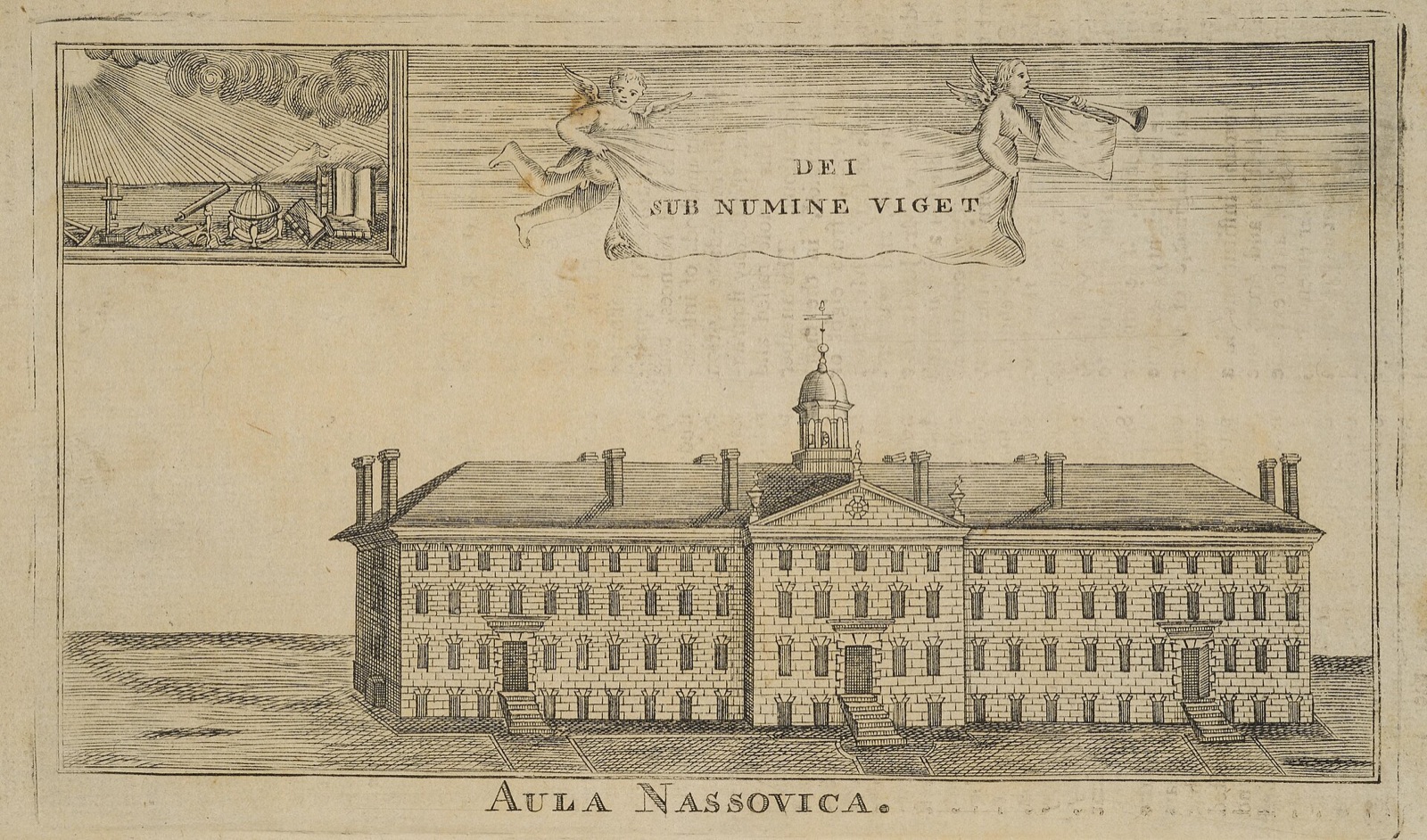
The rest was a sweep. Sullivan's wing drove the 55th's detachments from the high ground in a ravine fight remembered as Frog Hollow, and pushed on through town; the 55th and the 40th Foot fell back toward New Brunswick (the British supply base farther up the road toward New York). A remnant, mostly of the 40th, barricaded itself inside Nassau Hall, the great stone main building of the College of New Jersey (the colonial college in the town, today's Princeton University) and then the largest academic building in America. American cannon were brought up, among them a New York company commanded by a young captain named Alexander Hamilton, and fired on the building. After a few rounds and a rush at the door, some 194 British soldiers inside surrendered. A tradition grew up later that it was Hamilton's gun that sent a cannonball through the prayer hall and beheaded the portrait of King George II hanging there; the college's own archivists note that no contemporary account ties Hamilton to the shot, which first appears in print in 1905. The portrait really was damaged in the battle, though, and the college got its revenge with style: in 1783 the trustees commissioned Charles Willson Peale, the lieutenant from Cadwalader's line, to paint "George Washington at the Battle of Princeton," and hung it, so the story goes, in the very frame George II had occupied. From the first shots in the orchard to the surrender at the Hall, the whole thing had taken roughly an hour to ninety minutes.