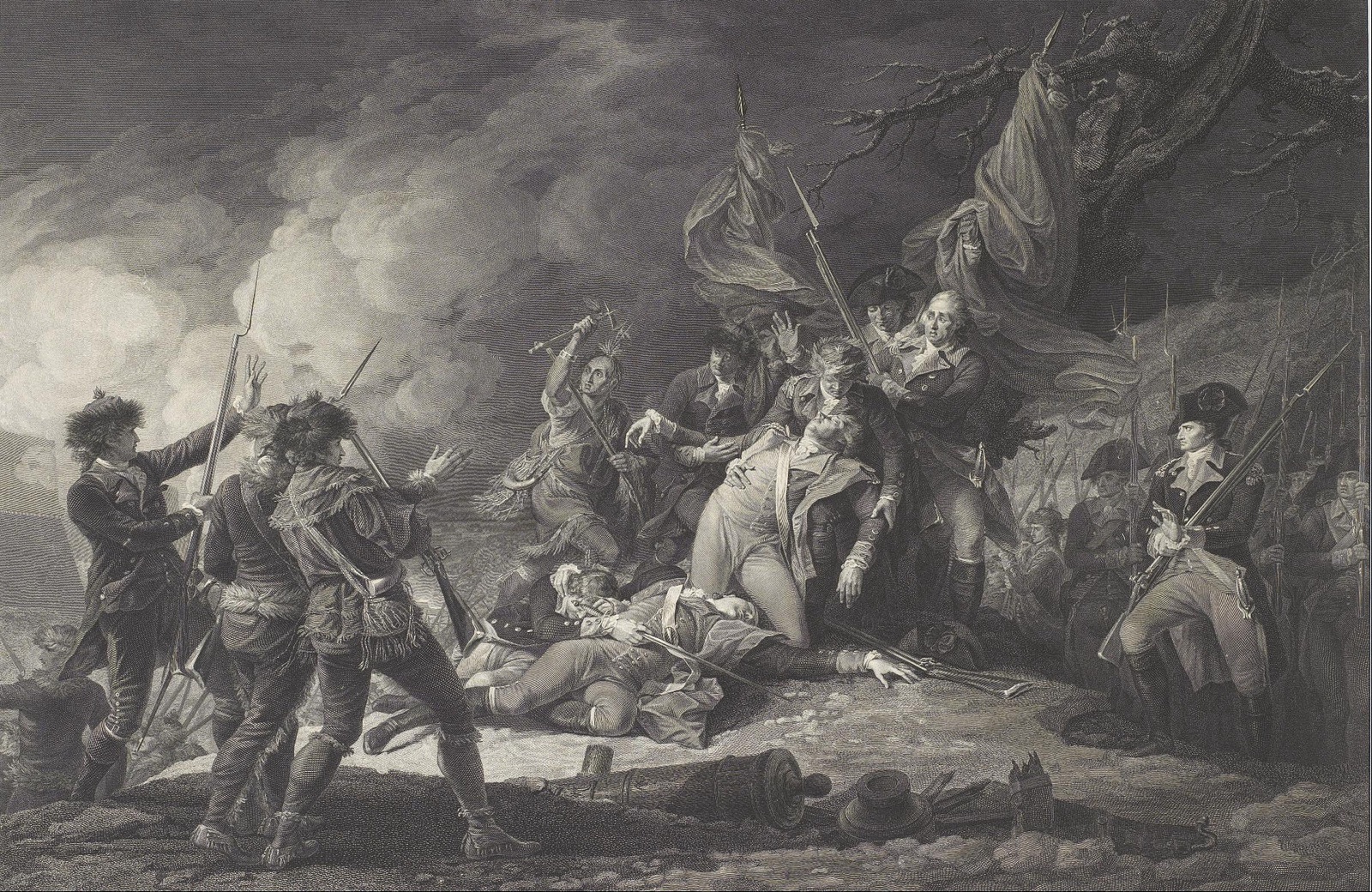
On New Year's Day the defenders found the body of Richard Montgomery, the American general killed leading the southern attack column, in the snow at Près-de-Ville (the riverside strongpoint where his assault had died). He was identified by people in Quebec who had known him. The government of Guy Carleton, the British governor who had held the city, gave the rebel general a decent, honorable burial: the lieutenant governor, Cramahé, paid for the coffin himself, and Montgomery was buried inside the city on January 4, 1776, with a simple military funeral. It was a genuinely respectful gesture toward a fallen enemy.
The news reached Philadelphia in mid-January, and the Continental Congress, not yet ready for independence, found itself with a martyr. On January 25, 1776, it voted Montgomery a monument, the first national memorial the United States ever commissioned; it was carved in Paris by the sculptor Jean-Jacques Caffiéri and installed at St. Paul's Chapel in New York in 1788. Orations poured out for months. He was mourned in Britain too, where opposition politicians eulogized him in Parliament as a fallen countryman of principle. George Washington, the Continental Army's commander-in-chief, who got the news from General Schuyler (the senior American general in the north), put the loss plainly.
In the death of this gentleman, America has sustained a heavy loss, as he had approved himself a steady friend to her rights and of ability to render her the most essential services.
Outside the walls, the strangest phase of the campaign began. Benedict Arnold, the American colonel shot in the leg during the assault, was promoted brigadier general on January 10 and ran the army from a hospital bed, keeping perhaps 600 men in the lines through a subarctic winter, maintaining the fiction of a siege against a city whose garrison now outnumbered the besiegers. Carleton, knowing relief would sail the moment the ice broke, declined to come out even now. Reinforcements trickled north, and smallpox killed them. The disease, fed by crowding and by soldiers secretly inoculating themselves against orders (deliberately infecting yourself with a mild case in hopes of immunity, which made you contagious while it ran its course), broke the American army faster than the British ever did. Money finished the job. The army's hard coin ran out, paper Continental dollars (Congress's paper money) bought nothing from the habitants (the French-Canadian farmers of the countryside), and requisitioning supplies at bayonet point turned a wary welcome into hostility. Arnold left for Montreal in April; command of the lines passed to other American generals, first Wooster, then John Thomas.
Off the fieldAn Army from Nothing: the army that survived its own diseases and its own payThe memory of what smallpox did to this army outlived the campaign: it is a large part of why Washington later took the radical step of secretly inoculating the entire Continental Army, a story the army chapter tells. For the men outside Quebec in the spring of 1776, there was no such rescue. On May 6 the ship HMS Surprise and two consorts came up the river to the city, carrying the vanguard of a relief force of more than 9,000 men under General Burgoyne, and Carleton, with the odds finally reversed, marched out at once. The American lines did not retreat so much as dissolve: guns, papers, even the sick were left behind in something close to a rout. General Thomas died of smallpox on the road on June 2. After a rear-guard defeat on June 8 at Trois-Rivières (a town on the St. Lawrence roughly halfway back toward Montreal), the army fell back up the lake to Ticonderoga, where the invasion had begun. The Canadian adventure was over.
So what had it all decided? Canada stayed British. The fourteenth colony never materialized, and the reasons were sitting in plain sight on the walls of Quebec on the night of the assault, where French-Canadian militiamen made up a large share of the garrison. The city was substantially defended by Canadians, and that fact is itself the answer to the question the invasion had been sent to ask. London's Quebec Act of 1774 had already guaranteed the Catholic Church and French civil law, so the clergy and the seigneurs (the landholding gentry) mostly held to Britain. The mass of habitants stayed pragmatically neutral: willing to sell provisions to whoever paid in silver, unwilling to die for either empire, though some hundreds did serve on each side, with Livingston's Canadian volunteers attacking the city and Voyer's militia defending it. When American silver ran out and the bayonet-point requisitions began, neutrality cooled into hostility. It was interest, fairly reckoned on all sides, and it held.
The door the Americans had tried to close stayed open, and the rest of the northern war came through it. The war's northern frontier settled back onto Lake Champlain, the same corridor where Richard Montgomery had soldiered as a young British officer in 1759.
Montgomery himself came home long after the war was won. In 1818 New York State brought his remains back from Quebec, down the Hudson by steamboat, and by arrangement with Governor Clinton the boat passed the riverside house of his widow Janet, who watched from her veranda as the band on deck played the dead march. He was reburied under his monument at St. Paul's Chapel in Manhattan on July 8, 1818. Janet had been his wife for two years; she was his widow for fifty-three, and she never remarried.